Mr. Cook’s Farm

13 of the farmsteads in Pittstown, NY, have been approved for the National Register of Historic Places, including a farm which served as an early meeting place for the first Troy Methodists.

“Henry Cook was one of the wealthy farmers whose kind hearts were ready to sustain the meetings, and whose large barns in the early days of Methodism served on Sabbaths as churches. “In 1800 or 1801,” Miss Curtis says, “when I was a young girl, I remember hearing Benjamin Stephens preach in Mr. Cook’s barn.” (…) The inconveniences of holding meetings at the dwellings of the members and in the court-house were evidently detrimental to the strong growth of the society. “In the court-room,” as Phebe Curtis relates, ” some- times on summer evenings, it would be nearly nine o’clock before the congregation could be seated. This was not owing to the slackness of the brethren in making timely application for its use, but because the person who had the key, or the one who rang the bell, had no interest in our prosperity.” From “Methodism in Troy” by Joseph Hillman, self-published 1888.  pp 22-3.

That two-sentence record of early Troy Methodists gathering in a barn, has led to some tantalizing clues about the importance of the Cook-Hayner-Halford Farmstead at Cooksboro Corners in Pittstown, for the growth of Methodism in the region.

Phebe Curtis, the young daughter of Caleb Curtis, and so from one of the earliest Methodist families in Troy, wrote a history of the congregation in the early 1800’s. The work is lost, but was frequently quoted by a number of local historians later in the century, including Hillman’s Methodism in Troy, which was the impetus for the research being undertaken by Alice Rose and I. Phebe wrote of the earliest Methodists and where they met, locations identified only by the owner’s name – which was adequate in a still tightly-knit village of a hundred or two residences, but frustrating to our research today, as we try to find out which of those early Trojans offered them a place to gather.

Journals of the time and histories from the following century described some of the difficulties of  starting a Methodist society in the early days of both Methodism and the history of the United States, something we can read in the diaries of the early preachers, many of whom endured beatings. Historians of Troy also recount some of the resistance to the society buying land for a church building – resistance which other denominations did not encounter.

As part of my research into early meeting sites for the congregation, I began looking for a farmer called Henry Cook…searching West Troy, Albia, then moving out to Brunswick, Poestenkill and the Greenbushes: nothing. The search illustrates the difficulty we are having locating places and the people who became the first State Street Methodist society. Women, of course, often go by the names of their spouse; servants, particularly if African American, slave or free, by their first name; houses identified by the owner with no location. Finding any Henry Cook with a farm took months of peering at maps, reading census documents and the journals of early preachers. 

Until the day – and I cannot think what prompted me to think it, but probably some Vanderheyden genealogical digging – I thought: ‘what if his name was not Cook – what if Cook is an anglicization of a Dutch name?’ In hours, I was on the trail: some of the Vandercook family seemed to have contracted their anglicized Dutch name, to Cook! Searching for the Vandercooks in censuses brought me to Pittstown, and also revealed that while the Vandercooks did not list many people of color on census forms, only one of the farmholders listed none at all…and that this farmer, Henry Vandercook, was often simply listed as Henry Cook. (Though also with the first name in its Dutch version: Hendrik, and the last name spelled differently: Henry/ Hendrik Van Der Cook or Henry Vander Cook or H.V. D.Cook or even with the last name Vanderkeock…but despite the variations, they all pointed to the same man.) 

Had I found “our “ Henry Cook?

It was not a given that I would locate a Cook with a farm, where there were no slaves. The farm owner could have made an arrangement with the Methodist group, who paid to use his barn –  but I had found a Cook with a farm, and therefore a barn, in a county which had considerable slave labor at the time, and this Cook had none. There was a chance I had found a follower of Wesley. 

Further research showed that  by 1795, Henry Cook was the leader (steward) of a Methodist class. Finding him in a leadership role that early confirmed he had known about Wesleyan teachings for a few years at least, predating the visit of Lorenzo Dow, a very famous preacher who came to Pittstown. And why Pittstown? Probably because at about the same distance as Troy was from Pittstown, but in the opposite direction, lay the farm formerly of Philip Embury, founder and builder of both the first and second Methodist structures in America , John St Chapel in New York City… and Ashgrove Chapel in Cambridge, NY. 

I doubt that Henry Cook was a Methodist during the lifetime of Embury who died far too young, in 1775, or that he visited the farm of Embury’s fellow Irish Methodist cousin, Barbara Heck, the so-called Mother of Methodism. She had helped found and run the John Street society in New York as well as the one in Cambridge. Those founding Methodists moved to the north shore of the St Lawrence at the end of the Revolutionary War: this group of Palatine German Protestants found themselves unable to support the Revolution out of loyalty to the British crown, which had rescued them from persecution on the European continent. But many – like Cook himself- who fought for the liberty of America did nonetheless join the Methodist cause, despite its  British origins, and they would have worshiped alongside other patriots as well as those who fought against them. For them the theology really mattered more. 

It is hard to imagine today, just how much furor and opposition there was to Wesleyan teachings. Methodism today is just one of many Protestant groups, which seem much the same. But in the 18th and 19th century, it stood alone in opposition to the Calvinist ideas of Presbyterian, Baptist and Reformed theology. Where they talked of the “elect few” who could be right with God, Wesley’s followers declared all could be saved. And not only all could be saved, but they could feel it, know it. The 18th century Irish Methodists who did not flee to Canada, and the group they had attracted,  stayed in Cambridge and continued to talk about the teachings of John Wesley. Meanwhile, 11 miles to the West of Pittstown, in Schaghticoke, Captain Groesbeck was inviting Methodist preachers to speak in his barn. The great Frederick Garrettson writes that he had a great reception there on September 24th, 1791, 4 years before we find Henry listed as the class leader. These farmers were spreading more than the seeds of wheat in their fields…they were seeding the church!

Janet Douglass, February 2025

At a distance of 16 miles from Troy, ‘Mr. Cook’s barn’ became a gathering for Methodists in the late eighteenth century. It is a piece of land which would eventually be the home of the Cooksboro Methodist Society, sharing this piece of Vandercook land with a cemetery and a schoolhouse. A barn with some distinctive early Dutch features remains visible on the land which is still a working farm. The address is #346 Cooksboro Road (CR 126), in Pittstown, NY,and the barn is near the junction with Plank Road. The church is no longer there, but its location is discernible. Henry is buried a little way down the road in the Old Cooksborough Cemetery, not the adjoining graveyard,  but both are generally off limits for safety/accessibility reasons. You can see an image of his tombstone at this link: https://www.findagrave.com/memorial/10289425/henry-vandercook

John Wesley grew his theology to stand in opposition to the prevailing Calvinist thought of his day. Many of his letters and treatises deal with this issue. Almost as many show his interactions with the British Government on the need to prohibit the use of British ships in transporting Africans westwards, and stop Britons profiting from slavery. These sentiments, along with its British origins, meant early Methodism had cause to be unpopular with many. That it grew as large and as fast as it did, attests to the work of the early leaders, their character and their determination.

A different version of this essay, with another emphasis, appears in the February newsletter of the Pittstown Historical Society. whose wonderful archive about the Vandercooks confirmed I had found “our Henry” and helped me understand more about the farm and the neighborhood in his day.
The Methodist Episcopal Churches of Troy: State Street/ Fifth Avenue-State Street/Christ Church United Methodist

Part of the series of extended essays on the early Methodist societies of Troy, New York.

The current sanctuary is the third building to house the Methodist congregation on State Street in Troy, NY, but it was a private home on State Street, which was regarded as the site of Troy’s first Methodist gatherings in the earliest days of the community, which would become the City of Troy. Records suggest Methodists first met on State Street in 1793. It is not yet possible to determine whose home that was and the location, but at that time there were few domestic buildings, and they centered on River, First and Second Streets. So, presumably where one of those crossed State there was a home where early Methodists found themselves welcome – which could never be assumed. Early Methodists were met with much opposition.

After its rocky start – Methodism did not have as many adherents as other protestant denominations at this point, and avowed Methodists were subjected, to ridicule, name-calling and outright violence for their beliefs – the congregation became sufficiently large and established, to need its own building. Lingering prejudice about the denomination is witnessed in the difficulty in obtaining the land to build. Jacob D. Vanderheyden, the landowner, had donated land for other denominations, or made the land extremely inexpensive for them to purchase, but he refused to sell land to the Methodists for a long time. It was the intervention of his brother-in-law, Dr. John Loudon, who shared his dream of pigeons “flocking” to the desired site, that is credited for Vanderheyden’s change of heart. Nonetheless, the Methodists paid top dollar for their piece of land.

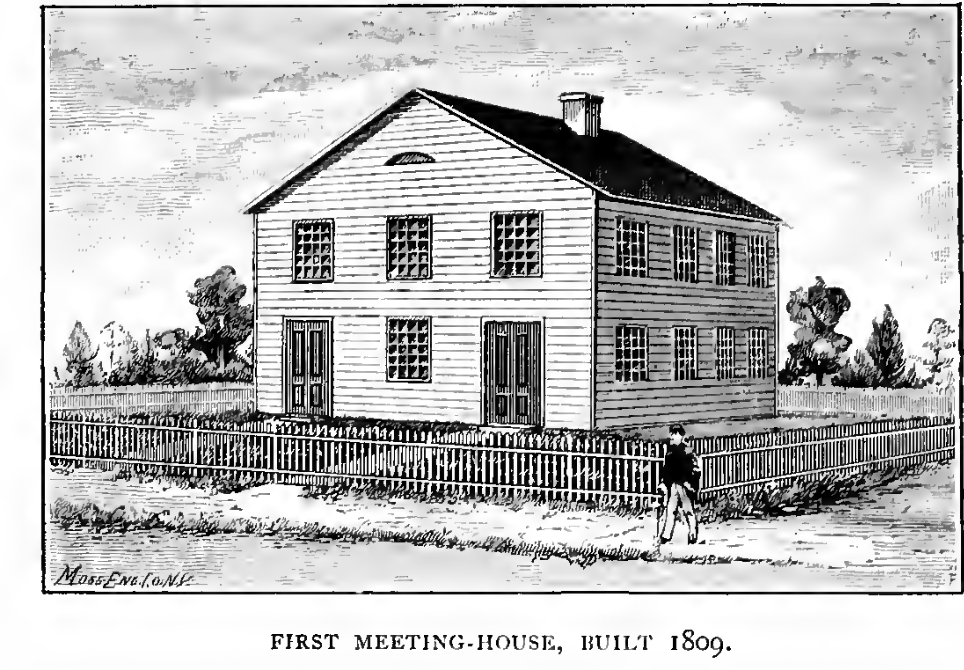
The congregation was incorporated as “The Methodist Episcopal Church of the Village of Troy” on November 29th, 1808, and a few weeks later, on Christmas Day, Vanderheyden conveyed the land to the trustees, having agreed to sell the land for $500, though with a $35 annual interest fee until paid off in full. The piece of land they acquired was the western half of the current site: two narrow lots, which has been designated the previous year as city lots 743 and 744, on the north east corner of State Street and Williams Street (the alley.) The building stood in what is now the small garden area in front of the parish house. It was two stories tall, plain, weatherboarded and painted white. The subscription started to pay for the construction of this modest building, despite having masons and carpenters in the congregation who gave their skills at no cost, still meant that the church was not ready to use for worship until 1811. Hillman reports that one of the largest sums donated came from Phebe, the daughter of Caleb Curtis: $5. He hints that there were very many, but very small donations, from those with less to give. The list of donations in the subscription book closed at $557.82.

The earliest drawing of that first clapperboard building is in A.J. Weise’s ‘Troy’s One Hundred Years” in which the building stands open on all sides. Weise describes the location as being built next to the common land. This was the land, donated by the Vanderheydens, for the annual Pingster or Pinkster Fest. Each Pentecost, both enslaved and free African Americans would gather for their annual celebration on this land, which included plenty of eating, drinking, music, singing and dancing…(See my essay on the African Zion congregation.)

The building was opened, still unfinished, with rough benches having been hurriedly made from planks by the congregation’s carpenters, just in time for the first service. Hillman reports the land around was not inviting and consisted of thick weeds and briars and patches of bare earth. The remains of a small stream passed by the eastern side of the building and when it iced over in winter, the narrow strip made for “good sliding” for the children.

Over time, the hurriedly made rough benches were replaced with slightly better plain pine benches, backed with a narrow board, but still at that time the pulpit was a a plainly-constructed desk on a small platform with several chairs. Tallow candles in tin sconces along the walls of the church lit it when evening meetings took place. By 1817, the church had a fence, which Hillman reported was to be “painted either all red or Spanish brown except the front part which was to be white”, as in the etching above from Hillman’s book. At the same time seats were added to the gallery and were likely the ones removed from the main auditorium. Women and girls sat on the east side, and men and boys took seats on the west side. The pulpit too had been replaced, Hillman reporting that there not being enough space, the children sat on the kneeling-step which surrounded the “altar.” (Hillman,p 46)

Frederick Garrettson – a man of great renown in the history of American Methodism – whose daughter traveled with him and acted as a secretary for his travels passed this on to his biographer:

” From Schenectady they returned to Troy, and put up at the house of the Hon. George Tibbits, whose hospitable mansion is delightfully situated on the side of a sloping hill ascending from the eastern part of the city, denominated Mount Ida. On the Sabbath, Mr. Garrettson preached in the Methodist Church, in this city, morning, afternoon, and evening, to an attentive congregation; and ‘truly’ says he, ‘it was a good day.’

He remarks that when he visited this place about thirty years before (in 1788) , there were only a few scattering of houses, and no Methodist society; but that he now rejoices to find a flourishing little city, in which there were four houses of worship, and not less than three hundred members of the Methodist Episcopal Church. what seemed to add to his religious enjoyment was the catholic and friendly spirit manifested by the several religious denominations toward each other. (Hillman, p 45-6.)


Even so, it was not until 1823 that the congregation secured sufficient money to pay off the debt on that first building. Only 16 years after its opening for worship, the congregation had outgrown their space: a new, larger sanctuary was required. On February 28th, 1827, the building was sold to Thomas Read and Sterling Armstrong for $500, only taking possession on November 1st. The first building had been moved to the corner plot, immediately east of its original location, the common land no longer being used for its intended purpose. So it looks like they shuffled the clapperboard building along, and worshiped there, while the brick chapel was being built. There, it was afterward used as a temporary court house, while the first court house on 2nd Street was being constructed, and then as a grocery store, until the erection of the current stone church in 1867. (Hillman p. 48 and p.52).

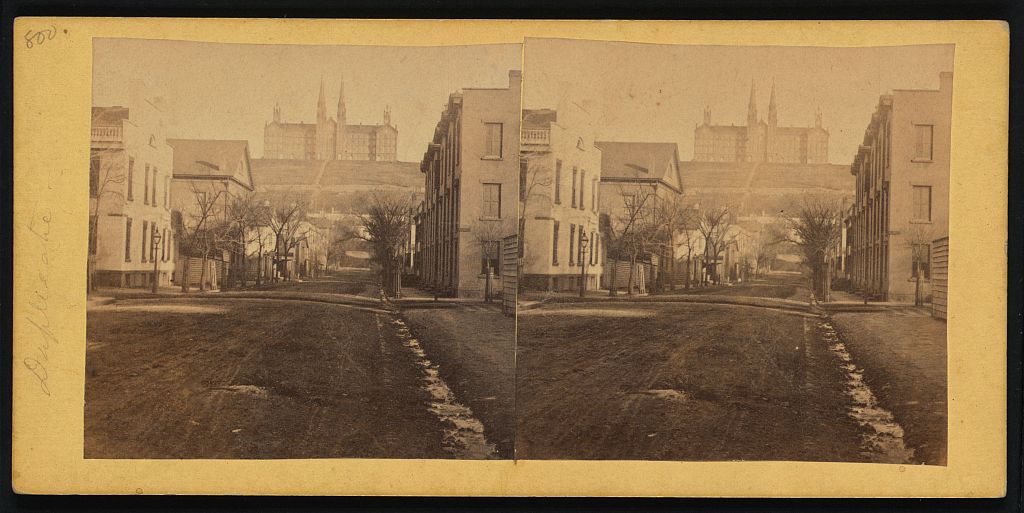
In the 1860 stereograph below, taken from the corner of State and 4th Streets, looking toward Troy University – about which, much more later – the brick sanctuary can be seen and beside it, a little harder to discern, is a much smaller, white wooden clapperboard building… standing there until the site construction of the current limestone sanctuary, which began 7 years after the photo was taken.

Dr. Loudon, his dream of pigeons, his work as one of Troy’s earliest doctors, and his importance to the congregation will all be covered in a later post.

The main historical source for the congregation is Joseph Hillman’s 1888 book “Methodism in Troy.” Other histories of Troy and Rensselaer County, many of which, like Hillman’s book, were published around the 100th year anniversary of the naming of Troy, include similar information. These include several books by A.J.Weise and also Rutherford Haynes and Sylvester Peck. All are available to read at no cost online. The Library of Congress site is a good place to start, but Google books and various university libraries also have digital versions. The stereograph above is from the Library of Congress archive, and is available for free use as part of the Charles F. Himes collection (Library of Congress Control Number 2005687324.)

The Methodist Episcopal Churches of Troy, NY: Trinity M.E. Church, Congress St M.E. Church, the Hemlock Church.

Extended notes on State Street Methodist Episcopal Church (now Christ Church United Methodist) and the buildings and congregations that came from it.

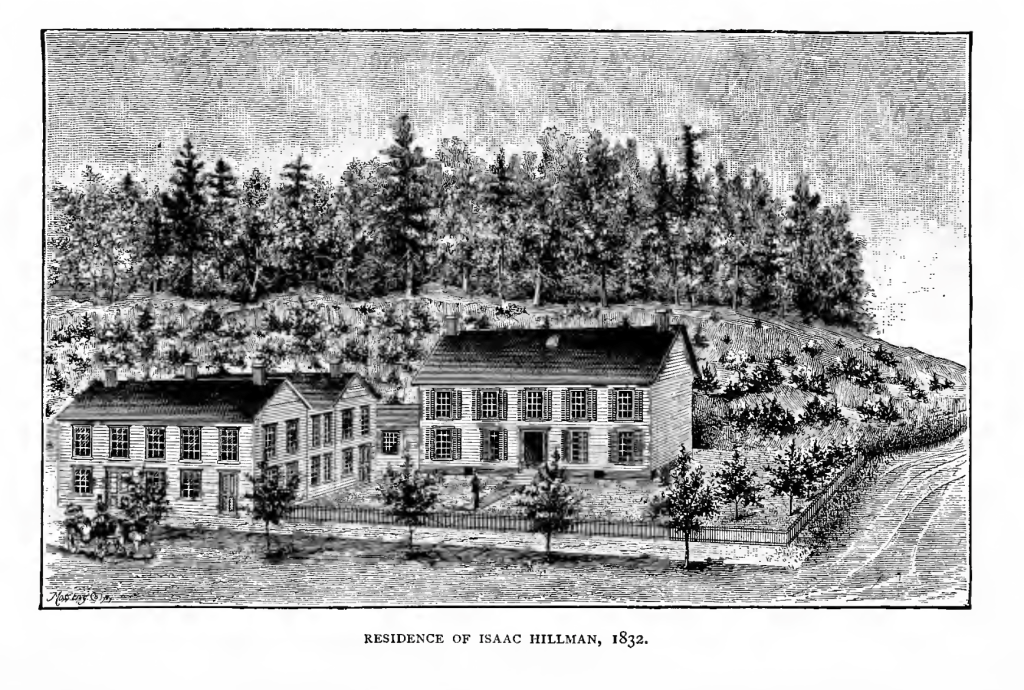
“The circumstances attending the organization of Trinity Church are briefly detailed in the first records of the society. ‘ The Methodist Episcopal Church in Congress Street, Troy, N. Y., was organized in the month of October, 1846’ (…) In June (1847), an old blacksmith- shop, a wooden building, on the south side of Congress Street, at its intersection with Ferry Street, was reconstructed for a house of worship, which was thereafter familiarly called the “Hemlock Church,” Hillman adds, “The organization of the Congress Street Church may be traced to a prayer-meeting first held about the year 1832 (…)  at the house of Isaac Hillman, standing a short distance east of the site of the Hemlock Church on Congress Street.(…)The small building proving inadequate for the uses of the congregation, the society determined to build a larger edifice of brick, and purchased the site of the present church, on the north side of Thirteenth Street, near its intersection with Congress Street.” The building was dedicated in  1849. (Hillman, pp 102-111)

With the Hillman family so invested in this particular congregation, it is not surprising that the main historical source book for these essays (Methodism in Troy by Joseph Hillman, 1888) has a lot to say about it. Indeed, Hillman and his sister donated a lot of money to complete its construction. Despite the family’s involvement, finding the site of the Hemlock/ Congress Street building as well as the Hillman home, has proved tricky.

The full account of the congregation’s beginnings, once again, hints at some disagreements or jealousies that may have been behind the organization of the new society on Congress Street. The prayer meetings, held at the Hillman residence, twice described as bring a short distance east of the site of the Hemlock Church, were held 3 times a week. Hillman reports with a modest pride: “It was afterwards asserted that more souls had been converted at those prayer-meetings than in the State Street Church, while they were held.” (Hillman, p.105) The meetings were sometimes quite long, and began to interfere with the worship times of the State Street Church, at which point there were several attempts to have them stop earlier, all unsuccessful. Hillman adds: “In fact those prayer-meetings were great feeders to the church.” (Hillman, p.107) Perhaps those attempts to control the prayer-meetings is what made this congregation determined to be separate from the State Street church, which finally happened in 1850, taking a core of members of the North Second Street and State Street congregations to the new church. In another hint of disagreements past, when describing the new building, Hillman adds: “The pews in the church were free, and since its erection no rentals for sittings have been imposed or collected.”(Hillman, p.110.) However, Hillman is not so shy about writing about the major theological disagreement, which necessitated the split: a sermon preached in 1847, by the Rev. John Clark, broke from a key Wesleyan tenet, and despite the conference demanding he never preach that way again, the idea took hold among some State Street members. It proved intolerable to some of the stalwarts of the church.

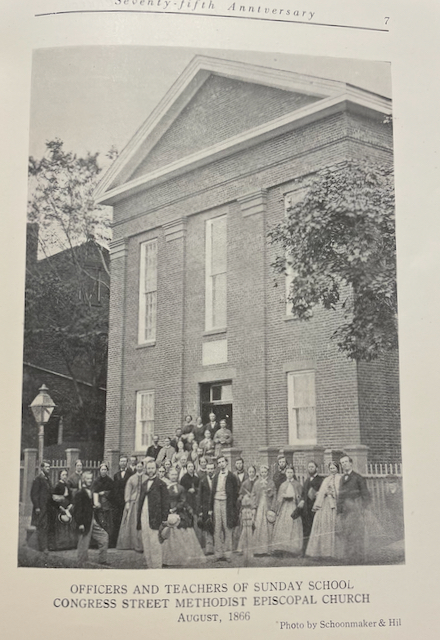
Even this new congregation had an almost immediate split, because in deciding to build a new sanctuary on Thirteenth Street, a faction decided to remain at the Congress Street site and replace the wooden building with a brick one. It was first named the True Wesleyan Methodist Church but the one image this writer located, in the 75th anniversary booklet of Trinity Church, show a brick “Congress Street M.E. Church” in 1866, with the Sunday School class gathered outside – 17 years after Trinity M.E. Church was first opened. By claiming it in the booklet, I can only presume this congregation did return to the Trinity fold not too long after the photograph was taken, unless the original church on 13th Street was very different before it was adapted…still working on that!

Not surprisingly Methodism in Troy includes a number of stories about Hillman family members – stories which deserve their own essay, but which include a treacherous sea journey, in which ship and people were deemed safe only through the prayers of the Troy meeting, to Hillman’s sister giving up her spot on a lifeboat on a burning ship in the Hudson, to save a young servant. The servant survived, Hillman’s sister did not.

The congregation merged with that of State Street-Fifth Ave in 1965, creating Christ Church Methodist Church. A year later, with the denomination’s merger with the United Brethren denomination, the official name became Christ Church, United Methodist, and so it continues to this day.

Arriving in the congregation in the early nineties, the author was told that this merger was seen as one of the most successful of its kind. Nonetheless, members of Trinity Church remained very proud of their association with that society, often referring to themselves as “Trinity members” long after the church had closed. The church was regarded as a good, local, family church with multi-generational friendships between attendees and their families. Its membership was just as dedicated and hard-working, as it had been in 1832, so it is hardly surprising, that although the State Street congregation kept its building, and possibly more important to them its historical site, the leadership quickly incorporated many of the Trinity faithful into influential positions. Even in the 1990’s, many former Trinity members continued in leadership roles.

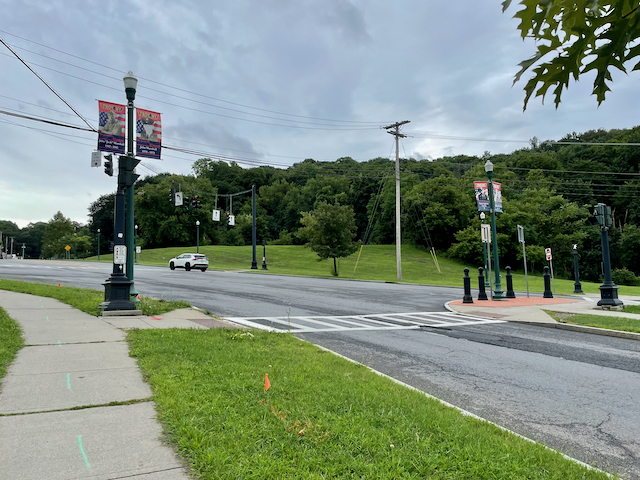
The current junction of Ferry and Congress Streets. Troy NY, with the location of the original junction on the extreme left of the image.

The current junction of Ferry and Congress Streets. Troy NY, with the location of the original junction on the extreme left of the image. The green brick house mentioned, is obscured by trees close and behind the orange road sign, far left.

Finding the exact locations of the 2 earlier buildings, as well as the Hillman home, has proved difficult. The road layout is similar but not exactly the same. Ferry and Congress Streets still merge as they climb the hill going east from the city, but they merge just below Eighth Street now, more than a hundred yards west of the location of Hillman’s day. Numbering has probably been changed, too, as Ferry Street did have its numbers changed – attested by the historical marker for Samuel (“Uncle Sam”) Wilson’s home which is now put as 76 and not the 144 of Sam’s day. In fact reports of the Congress Street M.E. Church being at 22 Congress Street, and Hillman’s home at 188 Congress Street, make them seem not so very close after all: unless one of those refers to the new numbering. The lot numbers on early maps are different again. Some other road layouts in the area have also been changed a little, and, of course, almost all the buildings have been replaced in the area of most interest. Earliest records show Congress Street as a mass of small workshops and stores, many occupied by members of the State Street Church. That the small blacksmith shop was a first location is intriguing, as one of the earliest converts was himself a young blacksmith apprentice on that street: Noah Levings went on to become a well known preacher, teacher and financial secretary of the American Bible Society. It would have been a nice link to the earliest history of Troy Methodists to use that site, but we may not be able to know at this point, if it was the same one – Troy had many small foundries and blacksmiths.

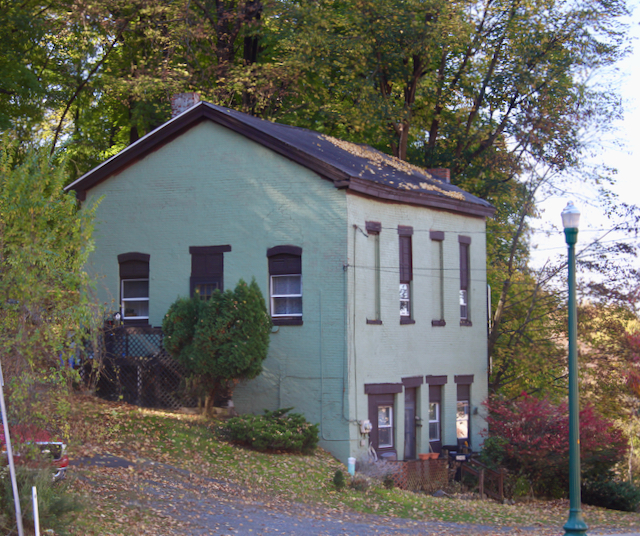
I am going to continue to research this question and will add an update when there are answers – the address of Samuel (“Uncle Sam”) Wilson’s farm, may help, as there has been more research into his history, but he was certainly a near neighbor to the Hillmans at some point. The last reference to the Congress Street, smaller brick church (above), was as it being the location of the Burns & Ryan Undertakers’ business, which may prove useful. It has been suggested it is the one older brick building under the hill at the approximate spot – a green residence with a shape reminiscent of a chapel – but the structure and orientation is not so convincing, when compared with the photo (unless, as commented above, that brick building is the earlier version of the 13th Street church, and the renovations very much more substantial than recorded!) The actual building may have been, like Uncle Sam’s home, pulled down for a road development that never happened, or part of the wider urban renewal project, which almost deprived Troy of so much amazing architecture, but still managed to destroy a lot. Without a mention for over a hundred years, various fates could have befallen the old church.

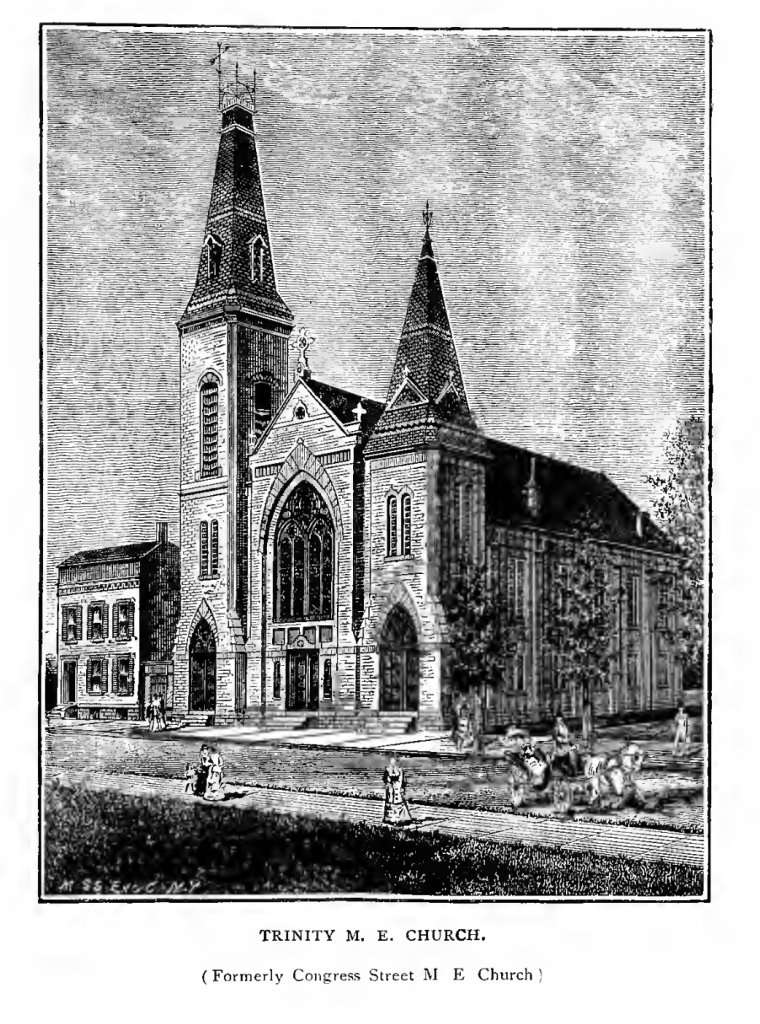
The building pictured at the top of the article shows the church after it was enlarged in 1880. The cornerstone was first laid on 13th Street, just north of its junction with Congress Street, in October 1848. The church was dedicated in 1849, and the following year, the society became an independent congregation with its own minister. It was enlarged, by 200 seats, in 1860, with enlargement to the Sunday School rooms in 1862. Hillman writes: “In 1880, the church was renovated and enlarged and attractively improved in appearance by the addition of corner towers and other architectural features, at a cost of $14,084.94. The building was rededicated December 28, 1880.” (Hillman. pp 110-111.

The structure burned, a decade after the congregation moved out, and was razed. A parking lot partially covers the site, today.

The etchings are from Hillman’s book, Methodism in Troy, 1888, which is available to read free online at various archives, including the Library of Congress. The photograph of the Congress Street Sunday School is from the booklet produced for the 75th Anniversary of Trinity Church, which is owned by Christ Church, United Methodist. A copy can be viewed at Troy Central Library. The photographs are the author’s.

The Methodist Episcopal Churches of Troy, NY: First German Methodist Episcopal Church & St Titus Italian Methodist Mission

Extended notes on State Street Methodist Episcopal Church (now Christ Church United Methodist) and the buildings and congregations that came from it.

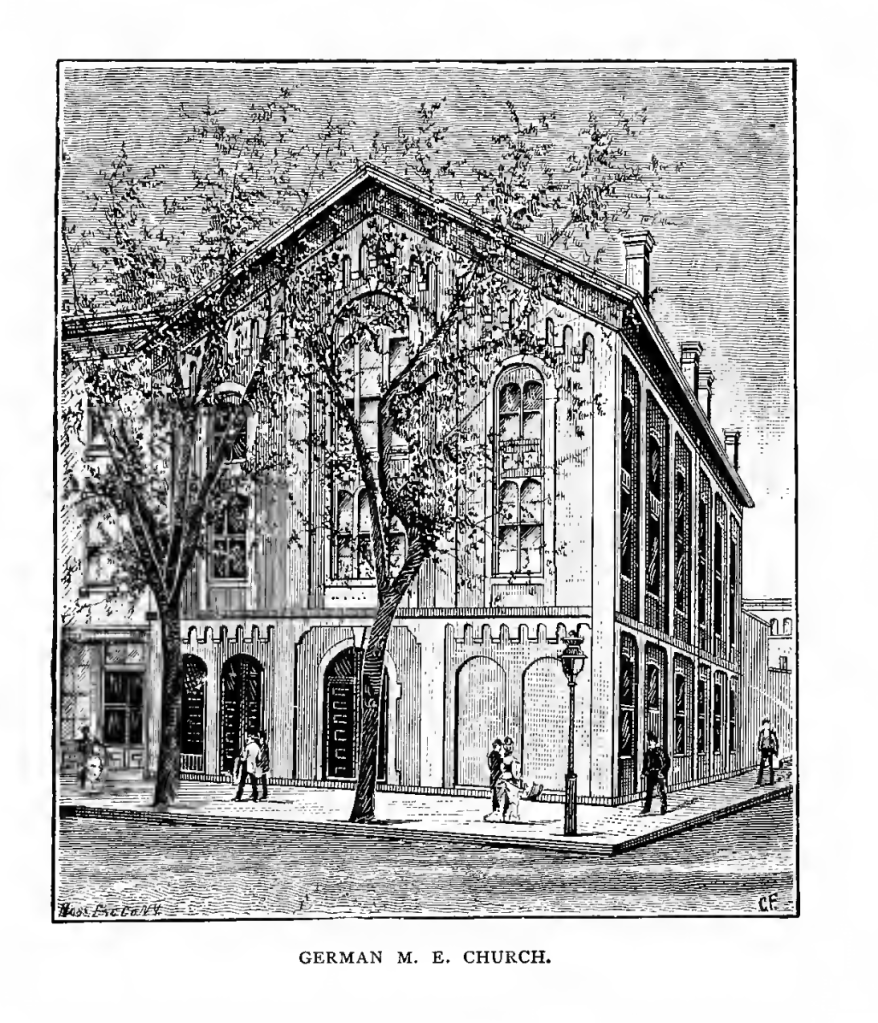
“Although Troy had from a very early date not a few German inhabitants, it was not until 1855 that an effort was made to form a religious society, composed exclusively of German people. At that time it was estimated that there were no less than 2500 Germans in the city. The first German minister, who undertook to form a German society of a religious denomination in Troy, was the Rev. Mr. Swartz, the pastor of the German Methodist Church in Albany, who in 1855 began to conduct religious services in a building on the northwest corner of First and Ferry streets. Some months later, the Rev. F. W. Dinger of the New York Conference continued these services in the True Wesleyan Methodist Episcopal Church, on the south side of Congress Street, at its intersection with Ferry Street. In that building, the First German Methodist Episcopal Church of Troy was organized, on July 25, 1857. The society was incorporated March 31, 1859 (…) Shortly afterward the society purchased two lots on the north-west corner of Union and State streets for $1,500. The buildings on the lots were destroyed in the great fire of May 10, 1862.” (The History of Methodism in Troy, Joseph Hillman, 1888. p. 114-6.)

Interestingly, maps show that was the very point where the fire stopped along State Street, was just half a block from the current Christ Church, making the German Church the last structure lost on that street. The society then rebuilt, on that same lot, creating the church as pictured above, with the front facing State Street. It  was dedicated on March 25, 1863.

This congregation, along with the 5th Avenue/ North-Second Street congregation merged with State Street Methodist Episcopal, in 1925, the three merged societies taking the official title of Fifth Avenue-State Street Methodist Episcopal Church. Many of the leading families of this congregation became leaders in the merged congregation, and their descendants were members until the end of the 20th century.

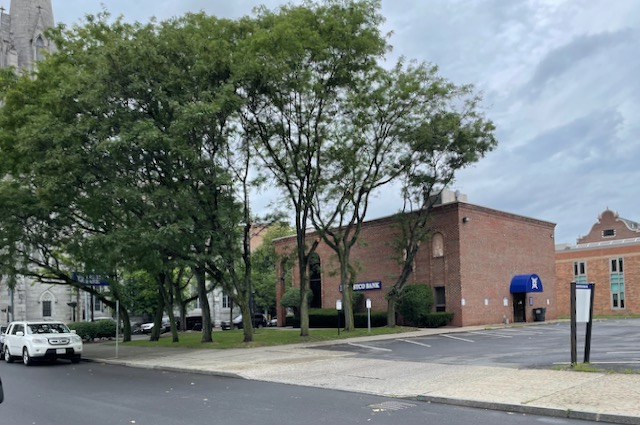
The original meeting house now lies under the car park behind the Central Library. As for the building above, Union Street no longer exists either side of State Street. It was the name for an alley which ran between Fifth and Sixth Avenue (alleys in Troy are named as streets) and this lot is now under the Trustco bank parking lot beside the Court building and Police Station. Maps show the building as one lot wide , but going back the whole two lots, as in the description above.

The spire of Christ Church United Methodist is at the left, the area immediately behind the sign at right is where Union St (alley) was. The black-topped parking lot was the site of the church. Out of site at the right are the municipal buildings and Police Station (corner State and Sixth.)

The spire of Christ Church United Methodist is at the left, the area immediately behind the sign, at right, is where Union St (alley) was. The black-topped parking lot was the site of the church.

The buildings on the east side of Fifth Avenue were removed during the 1960’s as part of an urban renewal program. I suspect this, too, was a victim of urban renewal, as the September 1950 copy “The Spire: Newsletter of Fifth Ave-State St Methodist Church,” lodged at the Troy Central Library, states the Liberty Presbyterian Church was at that time the occupant of the building above. It may have become unstable or in a fire between those two dates – so while that is unclear at time of writing, before that happened it became home to the …

St. Titus Italian Methodist Mission

So little is known of this congregation, that it has not appeared in Christ Church histories until this point. According to the collection of historical materials of Troy Conference, by Samuel Gardiner Ayres, archived at the Hart-Cluett Museum in Troy, St. Titus began as a mission to Italian families in 1913. However, he also states it began at that time in the Third Methodist Episcopal Church, which had been sold 15 years before that to the Ukrainian Orthodox congregation. I suspect this was an error, and the real location is 43 State Street – the German M.E. Church, where they remained after the latter congregation moved out.

The Adirondack Record- ElizabethTown Post newspaper for April 7th, 1932, carries an announcement by the Ausable Forks Methodist Church that: “The Reverend Lucius Martucci of St. Titus Italian Methodist Church, Troy, N.Y.” would give a talk on “The Melting Pot in America” in which he would talk of the pioneering missionary work of his mission among “the Italians of Troy.” The newspaper has another article about how the same church donated money each year to the St. Titus mission, stating it was the “only Church in the Troy Conference area, in which services are conducted in the Italian Language.” it gives the address of the church as 43 State Street, the same address as the building vacated in 1925 by the German Episcopal Church (above.) Interestingly, the author remembers several people named Martucci in the congregation, as well as the Rossi family, whose name is on a brass offering plate in Christ Church, United Methodist, to this today. It may have come along with the families when the congregation merged into State Street, at an unknown date, whether at its demolition, having shared the building with the Liberty Street Presbyterian Church, or before that, leaving the building empty for its new owner. I suspect someone will know…and if so, I will gladly update this mini history.

Line drawings and quotations are from “The History of Methodism in Troy” by Joseph Hillman, 1888, available as a PDF, free of charge, at a number of online archives, including the Library of Congress. Photographs are the author’s.

The Methodist Episcopal Churches of Troy, NY: Fifth Avenue/ North Second Street

Extended notes on the Methodist congregations associated with the State Street Methodist Episcopal Church (now Christ Church, United Methodist.)

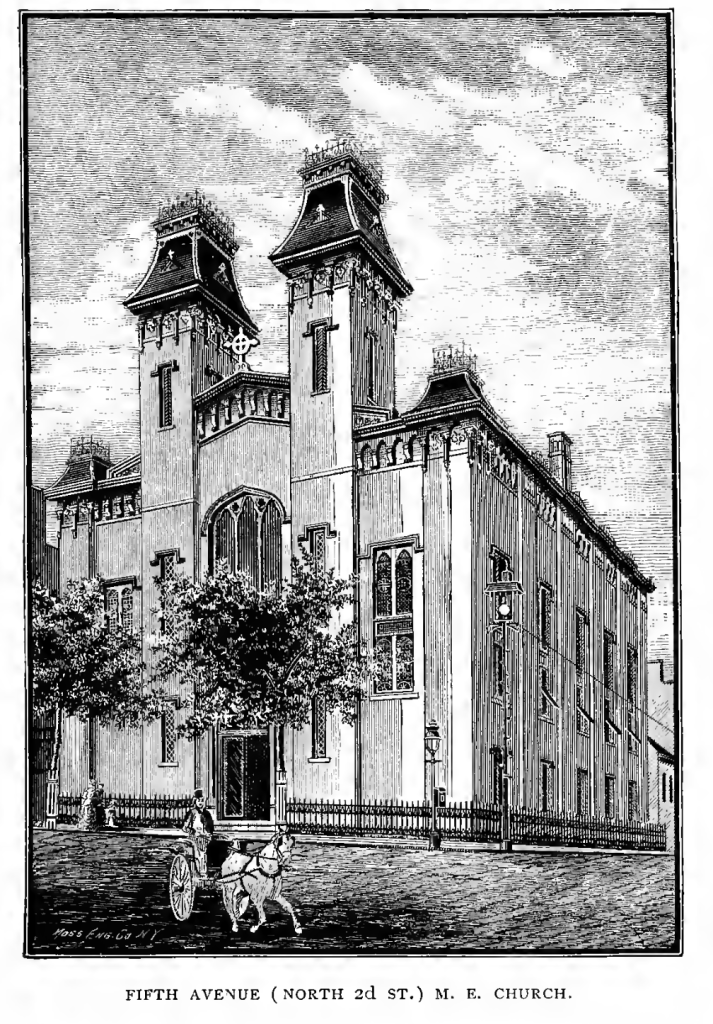
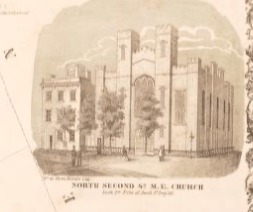
“The expediency of taking advantage of the growth of the city northward of Grand Division Street, and of having a church in which the seats were free, caused the State Street society to give consideration to the project of providing a place of worship in the north part of Troy. On May 23, 1831, the Quarterly Conference appointed a committee ‘to provide a place for preaching somewhere in the bounds of the fourth ward.’ On August 8, that year, the committee reported ‘that the only place to be had ‘ was ‘the dwelling-house’ of Stephen Monroe. A committee of five persons was then appointed ‘to provide a place or places for meetings in the first and fourth wards of the city (…) Considering that the lot on the northeast corner of North Second and Jacob streets would be an eligible site for a church.” (Hillman, pp 87-8)

On the evening August 13, 1831, the trustees of the State Street society “resolved that a subscription should be circulated throughout the City of Troy and elsewhere for the purpose of building a Methodist Episcopal Church in the fourth ward of the city ‘with free seats.” showing that the idea of having paid seating in the “mother church” on State Street had become an issue for some of the congregation.

This building was a brick structure and included a basement. As soon as it was built the Sunday School which had been organized nearby, in the school-room of Miss Annie Manwarring, was moved there and prayer meetings began. “On Sunday afternoon, August 30, 1835, Bishop Elijah Hedding dedicated the church.“ (Hillman 87-88.) The congregation having grown in number, this church building was replaced with a grander structure, which was originally slightly less grand than the drawing found in Hillman’s book. The original aspect of the church can be seen in this 1869 map by William Barton which can be seen online at the New York Public Library website. The private house next door in that drawing, appears have become the parsonage.

The congregation chose to re-merge with the State Street congregation in the 1920’s, at the same time as the German Episcopal Methodist church. The merger of these three churches occurred in 1925, and is recalled by an unknown member of State Street Methodist Episcopal, upon the 125th anniversary of the church in 1939:“Time passed on with greater or less success to Methodism in Troy, until the year 1925 when the mother church grew lonesome for her children and it was decided to unite the congregations of State Street, Fifth Avenue and the German Church under one head whose name should be the Fifth Avenue-State Street Methodist Episcopal Church.”

(quoted by Rev. Dr. James Fenimore in his 1998 paper: “Christ Church, United Methodist – a Church on the Edge of an Apocalypse” from a letter to the church entitled “To the Pastor and People of State St. Methodist Episcopal Church.” This paper is available online.)

The building and its parsonage became the property of St. Peter’s Armenian Apostolic Church in 1927. That congregation left the building when they constructed their new church in Watervliet, in 1971. An African American congregation then worshiped in the church, until it became suddenly and dangerously unstable, and was razed by the City of Troy in the 1999. The parsonage was demolished a little later.

In 2024, the lot which was occupied by the church and parsonage, is used for parking. It is located between Federal and Jacob Streets on Fifth Avenue, in the area now known as Columbus Square.

Line drawings and quotations are from “The History of Methodism in Troy” by Joseph Hillman, 1888, available as a PDF, free of charge, at a number of online archives, including the Library of Congress. Photographs are the author’s.

The Methodist Episcopal Churches of Troy, NY: East Side Church/ Pawling Avenue.

Extended notes on the Methodist congregations associated with the State Street Methodist Episcopal Church (now Christ Church, United Methodist.)

Pawling Avenue/ East Side Methodist Episcopal Church

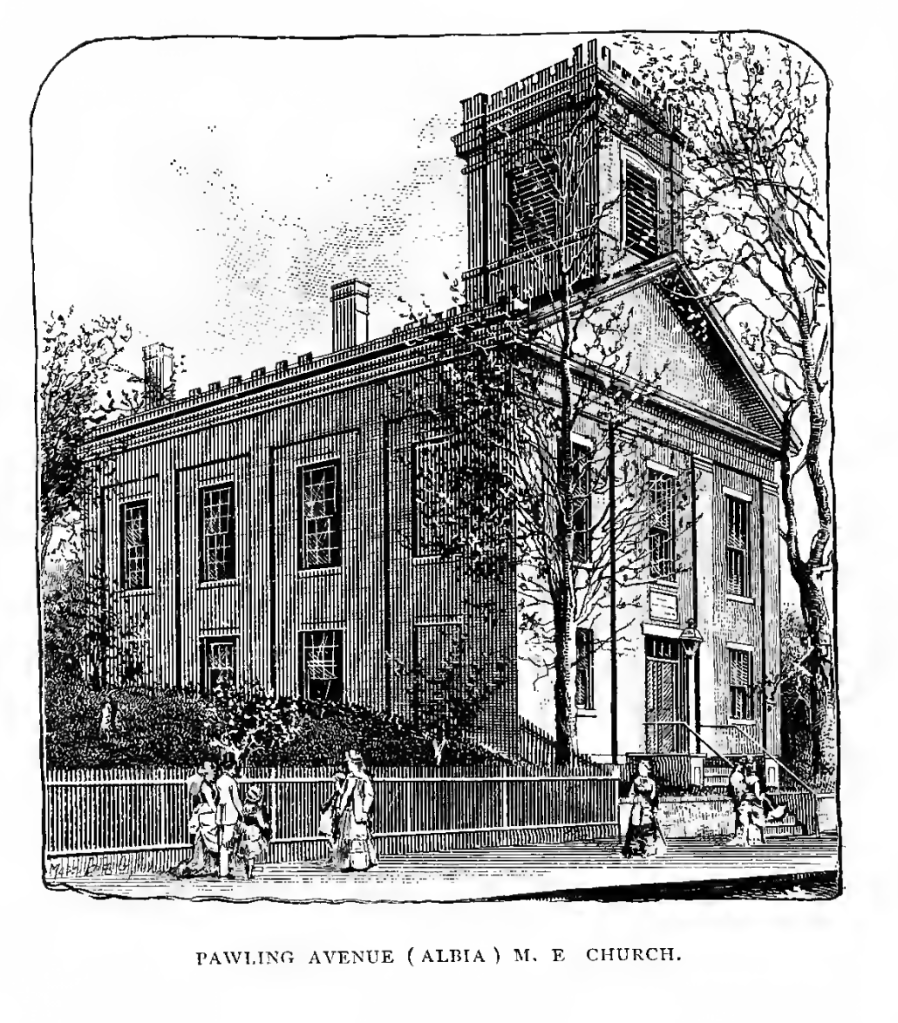
“The first Methodist meeting house at Albia, in the fifth ward of the city, was erected by the trustees of the State street society, for the purpose of providing its members with a convenient place for hearing preaching and for holding prayer -meetings, when they were precluded from attending religious services at the State Street Church.“ The trustees of State Street formed a committee to build a meeting house in Albia, on August 15, 1826. The first reported sermon was preached there in 1829 (Hillman. p 83.)

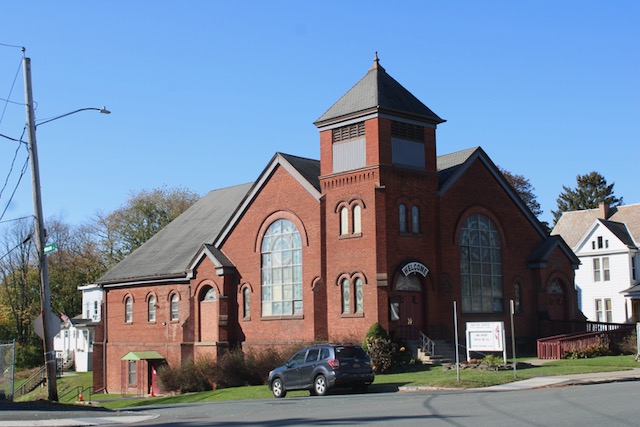
This Methodist “society” – congregation- was not only the the first satellite church of the State Street church, but of all of those churches, is the only one still in operation today, in a building within sight of the location of the original one. It was needed because the mill workers would have had a xxx mile work to downtown Troy, and then walking back up a steep valley side, not only taking a lot of time and effort, but on unpaved roadways and in all weather, it must have been a dangerous and difficult journey. It is remarkable that up to this point some actually had made it!

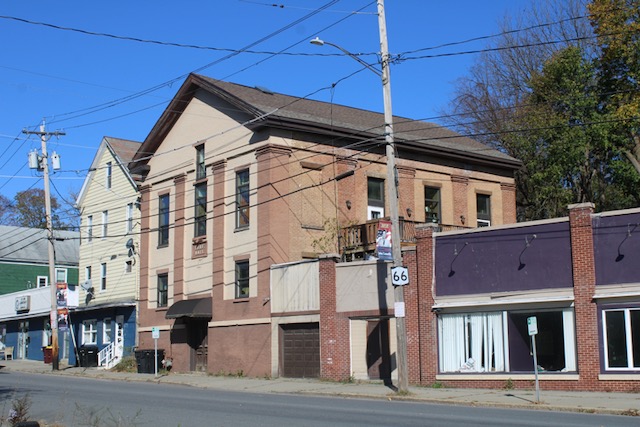
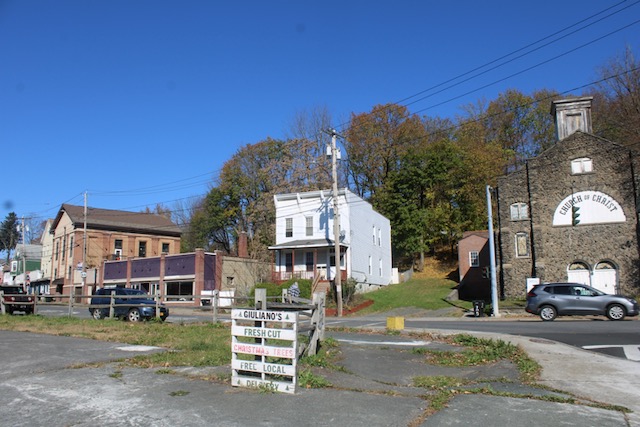
The original building was made of wood, and Hillman reported that the stone tablet above the door read that the church was erected in 1827, and rebuilt in 1858. Maps show it as being a little smaller than the still-standing original Presbyterian Church, now labeled as a Church of Christ, though not in use, just a hundred yards away at the junction of Pawling Avenue and Winter Street. The site of the East Side Methodist Church became home to the Oddfellows Society, and the structure still visible at the site does have the appearance of a chapel, but one made of brick, not wood. It now appears to be a home.

The site of the original East Side Methodist Episcopal Church on the east side of Pawling Avenue.

The view from the junction of Pauling Avenue and Winter Street, with the Wynantskill immediately behind the photographer. These banks were lined with mill buildings, and some remains are visible looking over the bridge as well as on adjacent properties.

The congregation adopted the official name of the “Pawling Avenue Methodist Episcopal Church” in 1868, and in 1888 Hillman reported a membership of 166 persons.

A few years after the publication of Hillman’s book, the current brick church, known locally as “The Welcome Church,” was constructed on the western side of the road, less than half a mile to the north. This congregation continues to welcome neighbors and friend to worship and community meals, and can be contacted on Facebook and the web. If your genealogical search leads you to this congregation, you should start by asking what records they have, as operational UMC churches usually hold their records.

Many of the imposing brick structures of the mills, including those first erected by Mahlon Taylor not long after his arrival in Troy in 1789, and their successors, were still standing beside the Wynantskill into the 21st Century.

Line drawings and quotations are from “The History of Methodism in Troy” by Joseph Hillman, 1888, available as a PDF, free of charge, at a number of online archives, including the Library of Congress. Photographs are the author’s.

The Methodist Episcopal Churches of Troy, NY: Third Street Church.

Extended notes on the Methodist congregations associated with the State Street Methodist Episcopal Church (now Christ Church, United Methodist.)

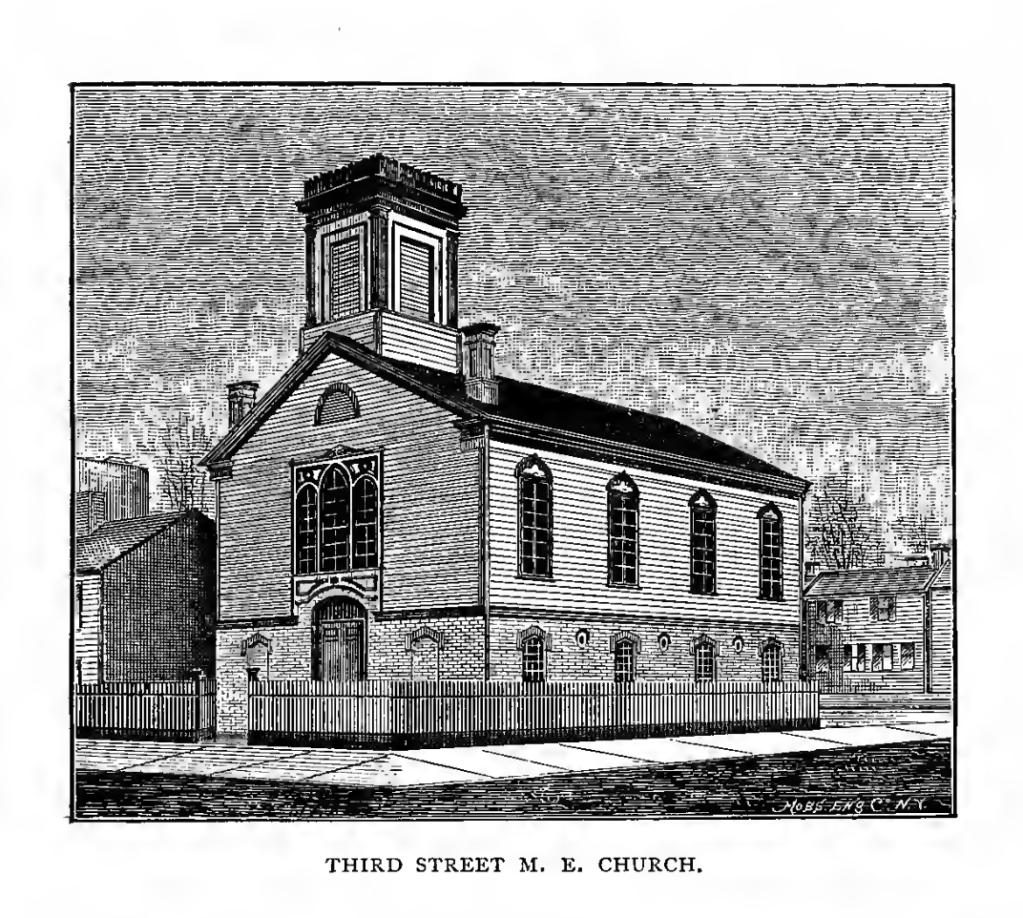
Third Street Methodist Episcopal Church, corner 3rd and Monroe Streets, South Troy.

In March 1844, trustees were elected for a separate congregation named “the Third Street Methodist Episcopal Society of the City of Troy” and a Sunday School was organized. The following year “a lot on the northeast corner of Third and Monroe Streets was purchased by the society to build a church. “  (Hillman, p.96) “The small society which had organized in 1843, began its erection in 1847(…) On Christmas day, that year, the building was dedicated.”  (Hillman p. 66)

“The origin of the Third Street Methodist Episcopal Church can be traced to a statement made by William Barrett, a class-leader of the State Street Church, at the leaders’ meeting held on May 2, 1842 (…) he suggested the suitableness of the house belonging to him in that part of the city for preaching.”  “ In1873, the church was enlarged by the construction of a lower story of brick, on which the wooden structure of the first edifice was placed.” (Hillman, 96-99)

Prayer meetings had been conducted in William Barrett’s house for a while, and when Daniel Hudson, an experienced Sunday School Superintendent, moved “from the northern part of the city,” a class of Methodists was formed. A “class” was the usual Methodist term for a neighborhood group of adults and families with children. The Trustees of the State Street congregation, seeing the success of the class, started to look for a building in earnest, meanwhile paying William Barrett for the use of his house for prayer meetings, preaching and a Sunday School. This saved South Troy participants from trudging the one mile each way to the State Street church, or not quite as far a walk for many – but up a steep hill – to Levings Chapel. 

Like other new congregations, the decision came at a time of dissension that pew rentals were being charged in the State Street building, usually reported by Hillman as temporary fees to pay for new buildings, but always mentioned with hints that the decision was not universally approved.  Certainly the cost to rent a pew could have dissuaded attendance by the workers of South Troy, many of whom worked in the steel mills and foundries of the area. In fact, Hillman tells us this would-be congregation decided not to accept State Street’s appeal for money for their building, but to create its own Board of Trustees and become a separate church. 

In October, 1844, the Sunday School reported having 15 teachers, in addition to two superintendents –  one for males and one for females – and a secretary-librarian, even though Hillman estimates membership of the society being around 35, with 75 students in the Sunday School. The first sermons were preached on the steps of the partially-built church, and the sanctuary was dedicated on Christmas Day, 1847.

After a time as a separate charge, the congregation reunited with State Street and operated under the name of Wesley Chapel. When attendance climbed again, peaking at 151, under the able leadership of its superintendent, Daniel Klock Jr., they once again took a minister and revived their Third Street name. The Sunday School had 288 members in 1888, and the school rooms were enlarged. Sadly, it was not to last. 

The congregation which had struggled, revived, and struggled and thrived for a few years, then struggled again, closing its doors at the end of the19th century, not so long after its best years.

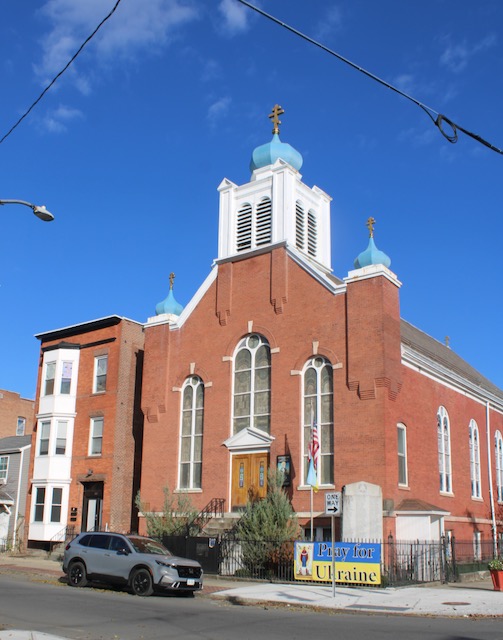
Saint Nicholas Ukrainian Orthodox Church, with a similar shaped, but brick, building now occupies the lot.

Line drawings and quotations are from “The History of Methodism in Troy” by Joseph Hillman, 1888, available as a PDF, free of charge, at a number of online archives, including the Library of Congress. Photographs are the author’s.