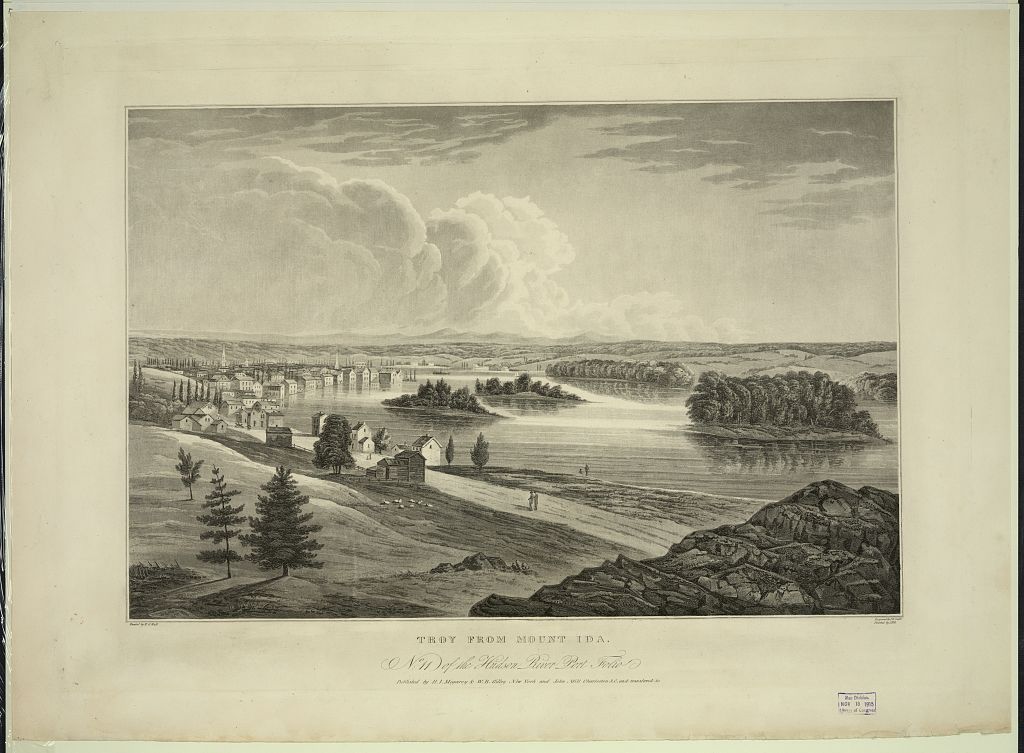
Troy from Mount Ida (*)/ painted by W.G. Wall ; engraved by I.R. Smith ; finished by J. Hill. Available for download at loc.gov (the Library of Congress) -*appears to be from Mt. Olympus not Ida, and is a view of Troy etched the year of Loudon’s death, 1820.
Dr. John Loudon, (1760-1820), the second physician to arrive in Troy, became an important early member of the landowning dignitaries in Troy, known for his generosity and kindness to those with little with which to pay for care. As we shall see, he also took a robust interest in matters of religion.
I have written before of Loudon’s “dream of pigeons,” which seems to have persuaded his very reluctant brother-in-law, Jacob D. Vanderheyden, to let the Methodists buy the land our buildings now sit on. This same landowner had previously either donated land for other denominations, or sold them for one dollar.The fact that only the Methodists had to pay top rate (plus interest in the form of rental until paid off) is one of the many signs of the distrust with which the denomination was treated in the late 18th and early 19th century. Loudon’s dream, when he had not yet officially joined the Methodist Episcopal Church, became such a legend that fifty years after his death,various newspapers nationwide were still reporting the dream story. The Cincinnati Daily , on December 8th, 1873, reported: “The Troy Press says that the site of the State Street ME Church was selected ‘because of a dream’ upward of 50 years ago as reported by Dr. John Louden, a prominent physician(…) who was a leading member and worker of the Methodist denomination(…) the good doctor dreamed he saw a flock of white doves alight on the corner of State and Fifth Streets. The impression was so vivid that the doctor could not shake it off…”.
The seriousness with which Loudon took his decision to join the Methodist movement, despite it being deemed at best unseemly, and dangerous at worst, has left us with documentation on how much emphasis people of the time put on their spiritual wellbeing. At a time when people choose a church, if they choose one at all, on the speed the priest can get through the mass, the ability of the band, or its political bent, the idea of such theological heart-searching seems quite alien.
Loudon was born in 1760 in Dungur, county Antrim, Ireland, of Scottish parents. Sylvester writes: “John Loudon, M. D., on his settlement in Troy as a physician and surgeon made himself known to the public by advertising in the American Spy, published in Lansingburgh, the following card: “The subscriber, having finished the studies of physic, surgery, and man midwifery at the University of Edinburgh, and practiced in Europe for some years past, now offers his services to the inhabitants of Troy. John Loudon, Troy, Feb. 14, 1793.” (p.136) He soon began to work alongside Dr. Gale, Troy’s first physician. In 1794, working together, the two doctors treated a smallpox outbreak,and were reportedly “extremely successful.” They estimated Troy’s population as being 400 and 500 at that point.
A.J.Weise, in the History of the City of Troy from the Expulsion of the Mohegan Indians to the present Centennial year of independence of the United States of America , 1886 (pp 82-3) recounts a story in the Troy Gazette of July 8, 1806, which reminds us how different life in the new settlement was: “It was not an uncommon sight to see bands of wandering Indians in the streets of the village at this day. The Stockbridge tribe was more generally represented than any other of the aboriginal people of Northern New York, for they were claimants of the territory of Reensselaerwyck on the eastern side of the Hudson River, and in this respect were more in favor with the people than the Mohawks of the western side(…) On Friday, 4 July in this village two Indians we believe in the Stockbridge tribe, fell into dispute(…) Participating largely in the liberty and liquor, which usually warms the breasts of independent and unshackled patriots of all professions on the Fourth of July, and not submitting themselves to any laws, they fell into fighting.” The elder stabbed the younger one, who then attacked the elder one with a heavy stone, breaking his skull and beating him with his bow. Bystanders thought him dead, but after a few minutes, he got up and walked away. Having been committed to jail, Dr. John Louden was sent for and he “trepanned the skull of the older Indian, and removed the broken parts.” The ultimate fate of the man is unreported.
The same author in his book, “Troy’s 100 Hundred Years” wrote: “I could name a number of individuals who would be an acquisition to any place, such as (…) Dr John Loudon” one of the 10 names he mentions ( p 46). Loudon had quickly become a respected member of the community. At various times he was a fire warden, village trustee, assistant alderman when Troy was first made a city, a (Methodist) church trustee, previously an elder in the Presbyterian Church, and surgeon for the 1st Regiment, 2nd brigade, under Gilbert Eddy. He was married twice but there is no evidence of him having any surviving children
Like the majority of early arrivals in Troy, Loudon was Presbyterian, and had been a keen student of religion since his teenage years. Like many others he had grown up within strict Scottish Presbyterian traditions: John Knox studied with John Calvin in Geneva in the 16th century, and created the Church of Scotland – the Scottish Presbyterian church – when he returned home. The first dedicated religious building was a small white wooden building in what is now Sage Park, at the corner of Congress Street and 2nd Street. As Troy grew, numerous other Presbyterian churches sprung up, many a couple of hundred yards from another. Gradually other denominations built buildings – the Baptists, Episcopalians and Quakers all built early places of worship. In 1808, the Methodists who had been meeting in private homes in and around State Street for 15 years, decided they wanted to build on a lot beside the common land at Fifth Street (now Avenue.) When they asked to buy the lot, the owner, Jacob D. Vanderheyden refused but John Loudon secured the purchase through his compelling dream – and family influence (his second wife, Blandina Owen, was the sister of Vanderheyden’s second wife, Mary).
Was Dr. Loudon already intrigued by Methodist challenges to Calvin? He would of course have known some of Troy’s leading businessmen who were Methodists, even working in official village business alongside them: Stephen Andres, Le Grand Cannon, Mahlon Taylor, Oliver Boutwell and Samuel Goodrich, the principal of the small school which stood in what is now Sage Park. Did he meet some of the very early but dedicated Irish Methodists before he emigrated? Or was he simply aware that his brother-in-law was singling out this one group in a prejudicial way and it offended his sense of fair play? We cannot know, unless something written by him comes to light. Either way, he came to the aid of the small Methodist society and they were successful in getting the land, even if they paid exorbitantly for it.
Less than two years later, Loudon relinquished his membership in the Presbyterian Church and became a Methodist. The letters he wrote to his Presbyterian pastor, Troy’s first clergyman, Dr. Coe, and his Presbyterian congregation, became the basis for a long obituary written by William Ross. It was published in two parts in the Methodist Review magazine in May and August of 1820, within weeks of his death. The article shows the serious way Loudon made his decision and his careful study of the pertinent differences between the thinking of Calvin and Wesley. Loudon may have been unusual in explaining his thought process as he surrendered his title of elder in the Presbyterian Church, but from the few hints we get from the journals and the books held dear by early Methodists, clergy and lay, his understanding of the theory of religion was not unique: people wanted to be sure their soul was right with almighty God, and they wanted to know it for themself.
So here are some of Loudon’s own words on why he was renouncing a Calvinist world view, for an Arminian understanding (Jan Arminius was a Dutch Reformed Church theologian and influencer of John Wesley.) If you want to know a little bit more about what Loudon is discussing here, or to understand his points, I have posted immediately before this article, on this website, a comparison of Calvinist and Armenian thought in modern language, and includes links to more information.)
In 1810, after sending this letter, Dr. Loudon joined the State Street Methodists. Ross quotes him: “I beg your attention for a few moments, while I address you as the congregation of this church. By your appointment, I’ve had the honor of holding the office of Elder among you, I now resign that office to you, because I cannot in conscience hold the doctrines, which are taught in this church, and which are supported by the Session in general. In the first place, they say God directs by his sovereign agency all things. To this, I reply: though God is the author of every good and perfect gift, yet he neither determines nor directs the sins of any of his creatures.… In the second place, they held that God in the dispensation of his grace through Jesus Christ gives two kinds of grace, the one sovereign and special, and the other common. To this, I answer the grace of God, which brings salvation has appeared unto all men and there are not two kinds of grace, one real, and the other counterfeit, but there is but one kind. It may differ in degree but not in equality (…)They say in the third place, that having received a special grace, they never can fall from it, nor make shipwreck of their faith. In answer to this, I would refer you to all the cautions and admonitions given to the church.(…) To differ in some speculative points and religion has been common in all periods of the church; but for members of the same church to differ in the first and most essential principles of religion, has not been so common.“
Loudon then expanded on these points, adding quotations from the Bible, for each objection.
In the following month’s magazine, the obituary continued with comments on Loudon’s character. Ross writes: “He first became acquainted with the Methodist in this city (…) When he joined us, our church in this place was inconsiderable and obscure(…) Both as a private citizen, and as a practicing physician, he was highly respected. As a citizen in common life, he endeavored to promote peace, propriety, and good order, in every department of society. This he did, not only by precepts, but also by examples of sobriety, industry, and economy. He was a lover of peace; – honesty, plainness, and candour were conspicuous traits in his character. As a physician, he was deservingly honored, not only on account of his knowledge of the healing art, but in consequence of a judicious and successful application of that knowledge. And without derogating from others of the same profession, it may be said he was the poor man’s doctor. Let the poor of Troy testify how often he has entered the habitations, lighted up the lamp of hope, and the blessing of God, restored health to the sick without money and without price. But this is not the best, Dr. Loudon was a Christian. And in him, the Christian graces shone with particular luster(…) Such was the confidence we had in his integrity, that he was considered as a pillar in the church, and as a father in the congregation of the Saints(…) He was, however, particularly united in Christian affection to those with whom he was connected in church fellowship(…) In life and in death he evinced a laudable desire for the temporal, as well as spiritual, prosperity of the church.— For a series of years, he gave liberally of his earthly substance for the support of religious worship, and for the comfort of the servants of Christ, who were engaged in spreading the influence of evangelical truth. And as a monument of his benevolence in death, we are now in possession of a good dwelling-house, together with necessary appurtenances, designed to be a permanent residence for the minister stationed in Troy.“
Ross concludes: “Although God had given him a robust constitution, yet his exposures in the performance of his professional duties were so frequent and great, that a number of times he was brought to the borders of the grave.“ In fact, Loudon had contracted tuberculosis in the exercise of his duty, and a few months before his death, a heavy cold had made his condition worse. For his last four weeks he was bed-bound, where, we are told, he was visited by “people of all classes” with whom he spoke about spirituality. He died in his 60th year, on Saturday, February 12th 1820, at his residence on the northeast corner of Second and Ferry Streets, where his widow lived for twenty years after his death. The Central Library is now at that location.
Dr. Loudon had a considerable list of property from his large practice in and around Troy. The handwritten inventory, which is in the collection of the Hart-Cluett Museum, lists all his possessions at the time of his death. It includes many pages of furnishings, household goods, clothing (6 nightcaps!), and a list of debtors, which show that he loaned money to people as diverse as church members and city entrepreneurs with business ideas, to widows needing help with daily expenses. He also owned several properties at that time: the house he reportedly donated to the church was at 141 3rd Street, and had previously been his surgery.
A few years before his death, Loudon had been named to a committee to organize the laying out of a new cemetery. That plot was plowed over by the city around 1990. It seems possible Loudon and his wife, along with many early Methodists were buried there, as were other Vanderheydens, as many of those early names do not occur in surviving cemeteries, or appear as names of those reinterred when cemetery land was re-purposed. The cemetery is now a patch of empty ground at the end of Cypress Street, just off Congress Street, and is flanked by the Poestenkills Gorge and Falls, and Prospect Park.
Janet Douglass, Troy, May 2026.
The disused cemetery was the subject of a YouTube video by Dr Rubinstein, who has researched many such areas in the city. Search his videos on You Tube under Dr RGST: The Cultural Historian.
The books and magazine quoted are all available online and can be read without charge:
Methodist magazine ran 1818-1828 and is available on Google Books, as are
Troy’s 100 years by A.J. Weise, 1891, and The History of the City of Troy, from the expulsion of the Mohegan Indians to the present centennial year of the independence of the United States of America, also by A.J. Weise, 1876.
A History of Rensselaer County by Nathaniel Bartlett Sylvester,1880
Troy and Rensselaer County, New York; a History: by Rutherford Hayner, 1925 are available at archive.org, the Internet Archive of the Library of Congress
The Hart-Cluett Museum is located on 2nd Street in downtown Troy and researchers can be book time in the Research Library, by going to their website: hartcluett.org
.


