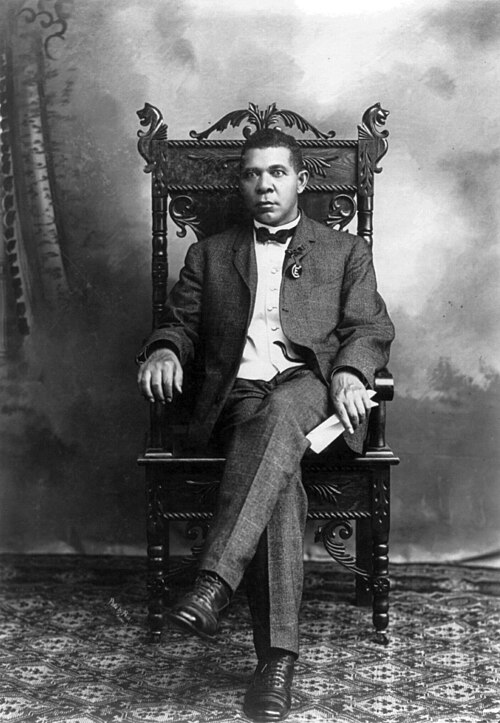
1904 photo by Peck (Akron, Ohio), Public domain, via Wikimedia Commons
Most of the people who could be considered well-known who visited this congregation are now remembered only in quite small and specific circles: they were the then giants of our denomination, when it was just getting established. As a result, there is limited public interest in them. They spoke in private homes, in the open, and in public markets, before we had a church building, and later in one of our first two church buildings. I intend to write about some of them, for anyone interested in the history of Methodism in the United States, because some well known preachers visited and even came from our congregation. (I have already written about one whose preaching is linked with the birth of the Salvation Army: see previous posts.)
However, a little over thirty years ago, I came across a dirty and battered piece of paper and the name on it stuck with me. At the back of the sanctuary, on the Fifth Avenue side, is a small room, which I suspect is rarely visited by anyone, it was certainly the case in the early 1990s when I first came to Christ Church. One day, our then minister, Rev. C. Joseph Ingraham, asked me to check out what was in some closet space at the back of the sanctuary, look inside an old safe back there, and take a brief look at what was in the room. There was to be a Trustees meeting that night, and he wanted to report on anything that might need tackling. There were robes and stoles for a junior choir in a small wooden cupboard, and a few small silverplate bowls of no great value or age in the safe, but the room itself was a heap of …trash. There were boxes that had not too long before held reams of office paper, thrown in from the door, along with their accompanying lids. There were some scrunched up papers, and a few empty potato chip packets and soda cups: none of it made sense – and all of it was pretty recent.
As I was about to go report my findings (verbally, of course – there was no cell phone to photograph the messy scene back then!) I saw a yellowed, torn and dirty poster under a pile of empty boxes: it was advertising an upcoming visit to our church by none other than Booker T. Washington. I was pretty new to the US, but I knew the name and that he had campaigned for better living conditions for African Americans. I filed the information away for a later date.
I don’t know what happened at the Trustees’ meeting or what happened to the contents of the messy, strange little room, but I never saw the poster again – and no one ever mentioned they had seen it. Over the years, however, I have remembered what I saw and thought I should try to find out about that visit.
It proved quite difficult
In the end I found a small “This Day in 1906” article in the Troy Record, which quoted an article in the same newspaper which had been printed exactly one hundred years before, on April 29th, 1906. It stated: ““Booker T. Washington, America’s most prominent black leader, gives two talks in Troy today on the ‘Negro Problem in the South.’” (Booker T. Washington) “has emerged as the leading spokesman for black interests, winning respect among whites for his emphasis on practical self-improvement.” He was to speak first at the 2nd Presbyterian Church recounting stories of his life and founding the Tuskegee Normal and Industrial Technical Institute in Alabama, of which he was still the Principal, and secondly at State St Methodist Episcopal Church (now Christ Church, United Methodist.)
The article also gave quotations from the two upcoming talks, and that was enough for me to locate a copy of the whole speech he would have delivered inside our sanctuary.
On the Hathi Trust website I found a copy of a speech given by Dr. Booker T. Washington and printed in the May 1906 edition of Alexander’s Magazine, which included the parts quoted in The Record. This edition also included several photographs of Washington with government dignitaries, in his office, and images of the Institute, as the magazine was dedicated, on this occasion, to the Institute’s Silver Anniversary.
In the speech, Washington describes there had been five crises for his people. The first crisis came when they were torn from their native country in Africa. The second when when they were introduced into a whole new condition: slavery. The third as slavery ended, when they had to assimilate into a new life of freedom and citizenship. And then he came to the present time, when the fourth and fifth crises of his own lifetime had occurred, the fourth being the period after the Civil War when their race found themselves “used in the game of Battledoor and Shuttlecock between the contending forces of the north and the south,” and now the fifth stage: “that brings us down to the present time in which, in my opinion the race in this country has entered upon a wholly new period – a period in which emphasis is being placed upon a side of life, not covered in any of the previous experiences of my people. I mean the era of free, independent and intelligent, economic and industrial development, accompanied with a growing sense of the worth and value of their own qualities and a desire to make the most of them, under God, for their own good and the welfare of the world.“
Washington continues: “If this country is to continue to be a republic, it’s task will never be completed as long as seven or eight million of its people are in a large degree, regarded as aliens, and are without voice or interest in the welfare of the government. Such a course will not merely inflict great injustice upon these millions of people, but the nation will pay the price of finding the genius and form of its government changed, not perhaps in name, but certainly in reality, and because of this, the world will say that free government is a failure.”
Speaking of the school, Washington says: “As I conceive it, a part of the mission of this school is expressed in the purpose and determination to assist the race in laying such a gradual and permanent foundation in right living, through the accumulation of property, industry, thrift, skill, education of all character, moral, and religious habits, and all that which means our usefulness to the community in which we abide, but naturally, logistically, sympathetically we shall make ourselves grow into the full and rightful enjoyment and intelligent use of the privileges and rewards of citizenship.”
There were presumably some small differences between the one I read, which was delivered to mostly black audience, and that to the church people of Troy. We get one small hint in the article from the Troy Record of 1906: “Washington hopes that black self-improvement will gradually erode white prejudice,” and then quotes from the speech I found: “Weakness invites injustice and just so long as any portion of the human family is weak, the strong will be tempted to actions which blacken their character and base the morals of the community. The lifting of the black man will be a double blessing – a blessing to the weak, a blessing to the strong.”
There is a link below to the full speech, which can be read free of charge, online.
I have one further recollection and if I am right, it would explain why Dr. Washington was invited to State Street. I believe the poster mentioned the Epworth League – the student fellowship that had, at its peak, several hundred students from RPI and the Sage College in regular attendance. A former landlady of mine, who had herself attended the Epworth League in the 1910s, told me of the many church marriages it had forged over its 100+ year history. Not only had she met her husband there, when she was training to be a nurse at Sage, and her husband was at RPI, but he had subsequently become one of the leaders of it. She told me how they would pay for important speakers from around the country to address the whole group several times a year. If they really are the one who invited Dr. Booker T. Washington, I cannot help wondering who else paid us a visit during that long history.
Janet Douglass, Troy, NY, August 2026
Visit Hathitrust.org and search for Alexander’s Magazineif the link does not work. The speech begins on page 61 of the May, 1906 edition. https://catalog.hathitrust.org/Record/012499691
Alexander’s Magazine was published monthly in Boston from 1905 to 1909, by Charles Alexander. It has the byline: ‘This Magazine Gives the Negro’s Point of View Regarding His Own Problems” and focused on ways to alleviate those problems, through education and industry.
The congregation of Second Presbyterian Church, Troy, met in the current building two blocks along Fifth Avenue, now known as First United Presbyterian Church. Like State St. Methodist Episcopal (Christ Church) and FUPC have a long history of supporting minorities and promoting the discussion of social issues.

