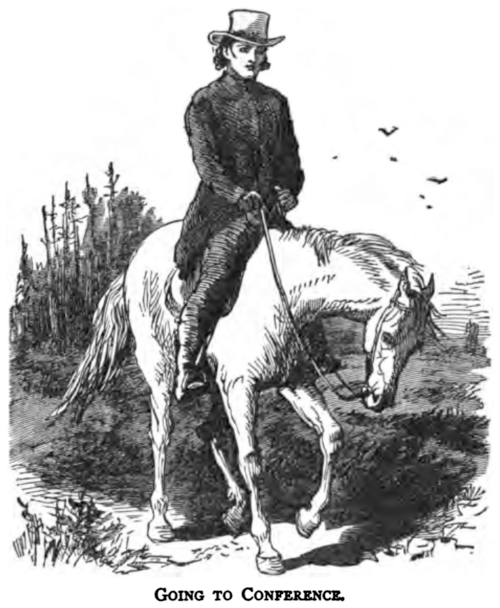
Illustration from The Circuit Rider: A Tale of the Heroic Age by Edward Eggleston depicting a Methodist circuit rider on horseback. Public Domain.
Nothing illustrates the seriousness of religious belief in the lives of 18th and early 19th century Christians so well as the violence which befell the earliest followers of John Wesley, in both Wesley’s native Britain and in America. Traveling preachers were especially at risk, whether from a mob or passing strangers, but regular Methodist adherents could face everything from petty acts of bias, mockery, persistent slander and social ostracism, to losing a job or inheritance.
Animosity came from a variety of causes, and in the run up to the Revolution and the early years of the new nation, it is hardly surprising if Methodist Episcopals were regarded as Tory sympathizers and loyal to the Crown, whether it was true or not. The pacifism espoused by many early preachers may have added to this suspicion.The denomination obviously had its beginnings in English Anglican tradition and, after the fight for independence, it can be imagined that anything from England was not appreciated, but the Episcopal Church – the name of the Anglican tradition in America – did not suffer the same violence.There was also longlasting hostility over the Methodist stance against the owning of humans as property, and the church’s popularity, therefore, among both free and enslaved persons of color, caused resentment on this side of the Atlantic, but that also does not explain the hostility faced in both the USA and UK by Methodist adherents.
The followers of John Wesley had a very different way of expressing their Christian faith than that of the then-dominant Calvinist traditions. My previous essay, ”All Means All” , tries to put that in context for 21st Century readers – a discussion which seems quite irrelevant to most people today, even churchgoers. However, back in the 18th century, even in communities where people were less versed in theological intricacies, bias and threats were common, on both sides of the Atlantic on account of its divergence from the Calvinist norm. In England, the charge against the Methodists was that they were too “enthusiastic” and in the State Street congregation the charge, according to a story in Hillman, was “witchcraft.” Phebe Curtis related a “ludicrous incident to show the singular conceptions which some people then had of the character of the Methodists…Our landlord, in 1802, was a German, who resided a few miles east of Troy. Soon after we became occupants of his house, his wife called upon my mother. In their conversation she warned my mother against Methodism, saying that it was a dangerous religion, that Methodists were witches, and that if a person were to go among them he could not get away from them until he had joined them. My mother surprised her by saying,’ Why, Mrs. C, I am a Methodist!’ The old lady, terrified by this unexpected information, hurried out of the house without ceremony lest a spell might be put upon her before she could take her leave.” (Hillman, p.16) There was something seemingly “bewitching” about the way these people experienced, expressed and lived their faith!
Within Troy, physical attacks on Methodist were either non-existent, or unrecorded, except for one. In 1808, when Robert Dillion was preaching on the Common – the land just east of what is now the church – and although “the Trojans were not famous for that kind of persecution, he had a spoiled egg cast at him.” (Hillman, p.18) That incident aside, local attacks were more passive-aggressive, than violent: the Lansingburgh congregation arrived to find a cow tied to the communion table, and early Trojans found other ways to deride the small Methodist society and dissuade people from joining. Phebe Curtis wrote about the common site used for worship by all denominations in Troy’s earliest days: “In the court-room sometimes on summer evenings, it would be nearly nine o’clock before the congregation could be seated. This was not owing to the slackness of the brethren in making timely application for its use, but because the person who had the key, or the one who rang the bell, had no interest in our prosperity.” (Hillman p 23.) Of all those wanting a place to meet with fellow adherents of their faith understanding, Methodists were simply the least favored. Hillman recounts how, in 1804, John Wright, newly emigrated from England with his wife Hannah, arrived in Troy and began making inquiries about a Methodist society in the village. “One day when he was crossing the ferry to Gibbonsville, now West Troy, he was told that the last member of the Methodist society had been sent to state prison.” Fifteen months later, on their return to Troy (…) a colored woman informed Mrs. Wright that she knew an Irishman, named William McBurney, who was a Methodist. While in search of his house, John Wright heard a number of persons singing together a familiar Methodist hymn, and without attempting to repress his joyful feelings he abruptly opened the door of the dwelling in which the voices were united in praise, and identifying the small company of men and women as Methodists, he gladly exclaimed,” Now I have found you!” (Hillman p.16-18)
It is hardly surprising this was a woman of color who shared the necessary information, because the multi-volume history of Methodism published by Rev. Nathan Bangs in the mid-19th century, shows that many American congregations were reporting almost equal attendance of the two races, before the African American Methodist denominations were created. State Street, like other churches in the North, may not have had such equality in membership, but enough that it caused comments about the nature of the Methodist congregation. Phebe Curtis felt it necessary to respond to negative comments about the racial make-up of State Street, with a list of the prominent Trojans who had joined the church, after which she writes: ”I have thus been particular because it was asserted at a love-feast that the first society was composed of the lower order of persons, and, at the same time, it was said that the time was when there was no place to hold prayer-meetings except in the basement of a house occupied by a black family. It is true that the prayer-meetings were held there sometimes. Ritta (the negro woman) was considered pious and had considerable gift in prayer. Her room was ample and decent. The person who made the statement must have been misinformed.” (Hillman, p.14) It further cements the notion that race would remain a longstanding issue for the national church. By way of proof that Methodists were less respectable and probably not the right people to associate with, some people were obviously using the congregation’s mix of races against it.
While Trojans generally used only their words to attack the fledgling church, the preachers traveling to Troy for Sunday services are not so fortunate. These preachers – named circuit riders as they mostly traveled on horseback between a number of widely spread young churches – encountered far worse opposition.
Freeborn Garretson founded many congregations during his constant travels. Rev Stephen Parks writes:”Some idea of what (Garrettson) passed through during the 52 years of his itinerant life may be gathered from the following extract of a letter written to Mr. Wesley when he had traveled but nine years “my lot has mostly been cast in new places, to form circuits, which much exposed me to persecution. Once I was imprisoned; twice beaten; left on the highway speechless and senseless (…); once shot at; guns and pistols presented at my head; once delivered from an armed mob, in the dead of night, on the highway, by a surprising flash of lightning; surrounded frequently by mobs; stoned frequently; I have had to escape for my life, at dead of night.” (Parks, p31.)
Quoting from the journals of other preachers, Park continues: “Persecution in Thurman’s Patent (Washington County – ed.) was truly grievous. Many young people that experienced religion were turned out of doors by their parents. Some of them were whipped cruelly; Mr Hibbard recounted that two young women were so whipped by their father that the blood ran down to their feet, and he turned them out of doors, and they walked fifteen miles to a Methodist society.” The father was a member of another church, and when 8 of his 10 children came under the influence of the Methodists, he drove 6 away from the family and whipped two other sons, but let them stay. Parks comments that “he did not whip Methodism out of his children, for some of their descendants are now among our wealthy, influential and devoted members.” (Parks, p.41) A Mr Washburn wrote: ”I have had stones and snowballs cast at me in volleys. I have had great dogs sent after me, to frighten my horse, as I was peacefully passing through small villages.”(Parks, p.50) And he quotes Peter Vannest’s writing about the Pittsfield Circuit,in 1799, where a young woman was thrown out of the house after joining with the Methodists. Her father called in a Presbyterian minister first to get her to change her mind, who told her that his church “more honorable than the Methodist” but when he failed, the young girl was thrown out by the father who said he would not have the “whore of Babylon in his house.” Her mother followed the young woman at a distance and saw her get shelter in the “house of poor man” a few miles away.(Parks p.39) The same preacher details walking 17 miles through woods in deep snow, stepping into springholes filled with water and mud up to his knees, wearing only shoes, as he had no boots – a reminder that these preachers had little pay and relied on fellow Methodists for food and shelter. As if all the attacks were not enough, many a preacher traveling on horseback between small communities, on rough roads and tracks through forests, found themselves lost, fell off horses, were caught in thunderstorms and snowstorms, trapped by flooded rivers, or set upon by a local farmer. Some left their families to go to preach at a church, never to be seen alive again.
The overarching reason for the rough treatment they received was simply the message of these early preachers: followers of John Wesley challenged the core tenets of Calvinism. Calvin had become the leading influence in Protestantism by the time of Wesley. It included all the Reformed, Congregational, Baptist and Presbyterian traditions, and its effect could be seen in Episcopalian and, through the effects of the Counter Reformation, even in Catholicism*. 200 years ago you were supposed to know the difference. Your theology was Calvinist or you were Arminian, like the Methodists. It was such a major difference that for someone to leave the more established stance for the newer one, Methodism, was seen as risking your very soul and eternal destination. As a result, the spread of Methodist ideas were greatly feared. This was surely the major impetus for the physical and verbal attacks on early members.
Thankfully, this situation changed and fairly quickly in the growing city, due in no small part because of the character of early attendees. Doctors, educators and city leaders joined the church, and the population grew to depend on the hard, skilled work of many Methodists. They made shoes and work boots, clothing and metal goods and they worked in the factories. Some of the mills were owned by Methodists, but other factory owners in Troy allowed Methodist gatherings on their premises, and even in one case – stunningly – closed the factory for the duration of a Methodist “revival” so workers could attend. All this is testimony of a different spirit in this small but rapidly developing city. Testimony, too, of the good character of those early members – who they were and how they behaved.They were a people who took their faith seriously. Wesley’s teaching was about seeking a genuine faith experience, but also about improving the lot of regular people and caring for your neighbor. From its earliest beginnings it insisted on linking activities in the sanctuary with working in society for the common good, for ordinary people, for poorly-treated workers, for those incarcerated, for those needing education and medical help – and for those enslaved. It would take almost one hundred years for the number of Methodist churches in Troy to exceed the number of Presbyterian ones, and become the most dominant denomination in the city, with the State Street congregation known as “mother church” of them all.
Janet Douglass, Troy, July 2026
TCM is the “Troy Conference Miscellany-containing an historical sketch of Methodism” by Rev. Stephen Parks, pub. Lord, Albany, 1854. It is available to read, free of charge at the link below, or by searching in Google Books, and go through the list to find the copy that is archived and freely available.https://www.google.com/books/edition/Troy_Conference_Miscellany/sdwQAAAAIAAJ?hl=en&gbpv=1&dq=Stephen+Parks+troy+Miscellany&printsec=frontcover
Hillman refers to the main source for the congregation’s research of its history: Methodism in troy by Joseph Hillman, self-published in Troy, in 1888. It is available to read onilne at no charge at the link below on the Internet Archive and on a number of university library sites: https://archive.org/details/historyofmethodi00hilliala
*To this day, many of the Calvinist positions Wesley refuted are part of common parlance – and many modern Methodists probably mouth them, too. Common platitudes at times of crisis or disaster: “God is in control” or “It was God’s will” when tragedy has occurred, can shock Wesleyan ears with their acceptance of God as cruel, vindictive or uncaring.

