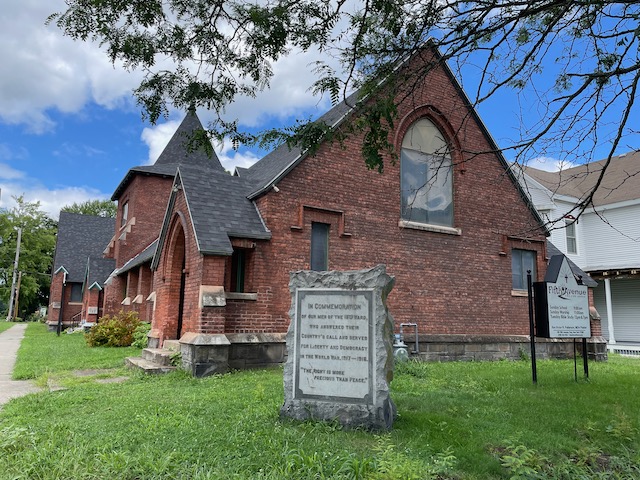
The Methodist Episcopal Churches of Troy: State Street/ Fifth Avenue-State Street/Christ Church United Methodist

Part of the series of extended essays on the early Methodist societies of Troy, New York.
The current sanctuary is the third building to house the Methodist congregation on State Street in Troy, NY, but it was a private home on State Street, which was regarded as the site of Troy’s first Methodist gatherings in the earliest days of the community, which would become the City of Troy. Records suggest Methodists first met on State Street in 1793. It is not yet possible to determine whose home that was and the location, but at that time there were few domestic buildings, and they centered on River, First and Second Streets. So, presumably where one of those crossed State there was a home where early Methodists found themselves welcome – which could never be assumed. Early Methodists were met with much opposition.

After its rocky start – Methodism did not have as many adherents as other protestant denominations at this point, and avowed Methodists were subjected, to ridicule, name-calling and outright violence for their beliefs – the congregation became sufficiently large and established, to need its own building. Lingering prejudice about the denomination is witnessed in the difficulty in obtaining the land to build. Jacob D. Vanderheyden, the landowner, had donated land for other denominations, or made the land extremely inexpensive for them to purchase, but he refused to sell land to the Methodists for a long time. It was the intervention of his brother-in-law, Dr. John Loudon, who shared his dream of pigeons “flocking” to the desired site, that is credited for Vanderheyden’s change of heart. Nonetheless, the Methodists paid top dollar for their piece of land.

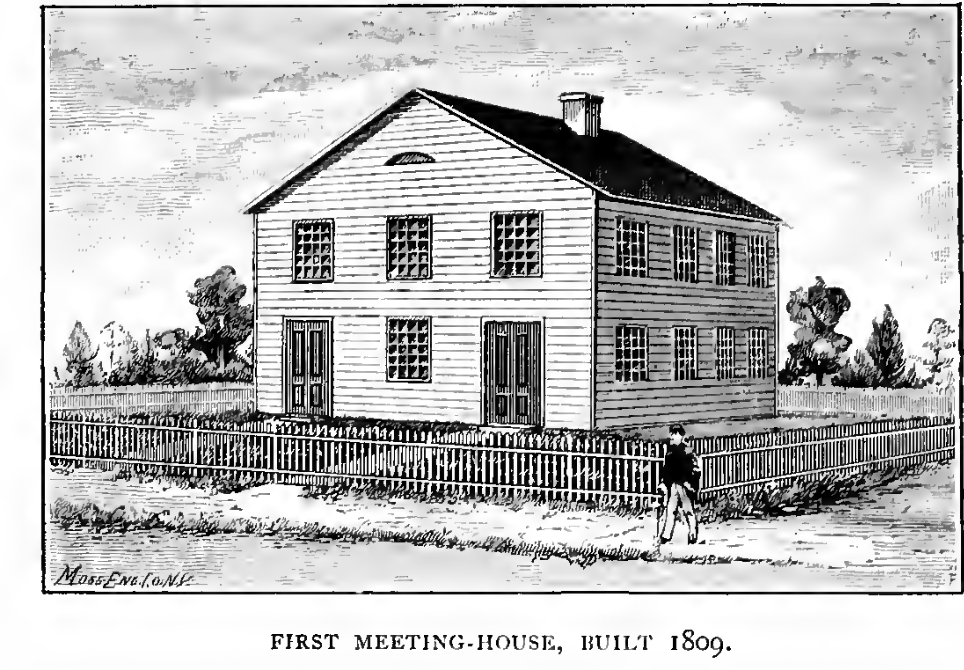
The congregation was incorporated as “The Methodist Episcopal Church of the Village of Troy” on November 29th, 1808, and a few weeks later, on Christmas Day, Vanderheyden conveyed the land to the trustees, having agreed to sell the land for $500, though with a $35 annual interest fee until paid off in full. The piece of land they acquired was the western half of the current site: two narrow lots, which has been designated the previous year as city lots 743 and 744, on the north east corner of State Street and Williams Street (the alley.) The building stood in what is now the small garden area in front of the parish house. It was two stories tall, plain, weatherboarded and painted white. The subscription started to pay for the construction of this modest building, despite having masons and carpenters in the congregation who gave their skills at no cost, still meant that the church was not ready to use for worship until 1811. Hillman reports that one of the largest sums donated came from Phebe, the daughter of Caleb Curtis: $5. He hints that there were very many, but very small donations, from those with less to give. The list of donations in the subscription book closed at $557.82.

The earliest drawing of that first clapperboard building is in A.J. Weise’s ‘Troy’s One Hundred Years” in which the building stands open on all sides. Weise describes the location as being built next to the common land. This was the land, donated by the Vanderheydens, for the annual Pingster or Pinkster Fest. Each Pentecost, both enslaved and free African Americans would gather for their annual celebration on this land, which included plenty of eating, drinking, music, singing and dancing…(See my essay on the African Zion congregation.)

The building was opened, still unfinished, with rough benches having been hurriedly made from planks by the congregation’s carpenters, just in time for the first service. Hillman reports the land around was not inviting and consisted of thick weeds and briars and patches of bare earth. The remains of a small stream passed by the eastern side of the building and when it iced over in winter, the narrow strip made for “good sliding” for the children.

Over time, the hurriedly made rough benches were replaced with slightly better plain pine benches, backed with a narrow board, but still at that time the pulpit was a a plainly-constructed desk on a small platform with several chairs. Tallow candles in tin sconces along the walls of the church lit it when evening meetings took place. By 1817, the church had a fence, which Hillman reported was to be “painted either all red or Spanish brown except the front part which was to be white”, as in the etching above from Hillman’s book. At the same time seats were added to the gallery and were likely the ones removed from the main auditorium. Women and girls sat on the east side, and men and boys took seats on the west side. The pulpit too had been replaced, Hillman reporting that there not being enough space, the children sat on the kneeling-step which surrounded the “altar.” (Hillman,p 46)

Frederick Garrettson – a man of great renown in the history of American Methodism – whose daughter traveled with him and acted as a secretary for his travels passed this on to his biographer:

” From Schenectady they returned to Troy, and put up at the house of the Hon. George Tibbits, whose hospitable mansion is delightfully situated on the side of a sloping hill ascending from the eastern part of the city, denominated Mount Ida. On the Sabbath, Mr. Garrettson preached in the Methodist Church, in this city, morning, afternoon, and evening, to an attentive congregation; and ‘truly’ says he, ‘it was a good day.’

He remarks that when he visited this place about thirty years before (in 1788) , there were only a few scattering of houses, and no Methodist society; but that he now rejoices to find a flourishing little city, in which there were four houses of worship, and not less than three hundred members of the Methodist Episcopal Church. what seemed to add to his religious enjoyment was the catholic and friendly spirit manifested by the several religious denominations toward each other. (Hillman, p 45-6.)


Even so, it was not until 1823 that the congregation secured sufficient money to pay off the debt on that first building. Only 16 years after its opening for worship, the congregation had outgrown their space: a new, larger sanctuary was required. On February 28th, 1827, the building was sold to Thomas Read and Sterling Armstrong for $500, only taking possession on November 1st. The first building had been moved to the corner plot, immediately east of its original location, the common land no longer being used for its intended purpose. So it looks like they shuffled the clapperboard building along, and worshiped there, while the brick chapel was being built. There, it was afterward used as a temporary court house, while the first court house on 2nd Street was being constructed, and then as a grocery store, until the erection of the current stone church in 1867. (Hillman p. 48 and p.52).

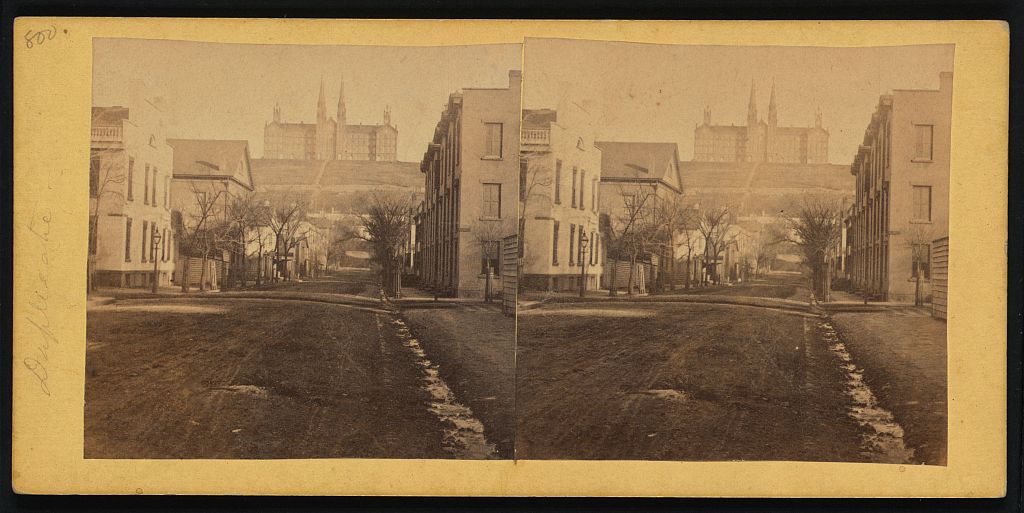
In the 1860 stereograph below, taken from the corner of State and 4th Streets, looking toward Troy University – about which, much more later – the brick sanctuary can be seen and beside it, a little harder to discern, is a much smaller, white wooden clapperboard building… standing there until the site construction of the current limestone sanctuary, which began 7 years after the photo was taken.
Dr. Loudon, his dream of pigeons, his work as one of Troy’s earliest doctors, and his importance to the congregation will all be covered in a later post.

The main historical source for the congregation is Joseph Hillman’s 1888 book “Methodism in Troy.” Other histories of Troy and Rensselaer County, many of which, like Hillman’s book, were published around the 100th year anniversary of the naming of Troy, include similar information. These include several books by A.J.Weise and also Rutherford Haynes and Sylvester Peck. All are available to read at no cost online. The Library of Congress site is a good place to start, but Google books and various university libraries also have digital versions. The stereograph above is from the Library of Congress archive, and is available for free use as part of the Charles F. Himes collection (Library of Congress Control Number 2005687324.)
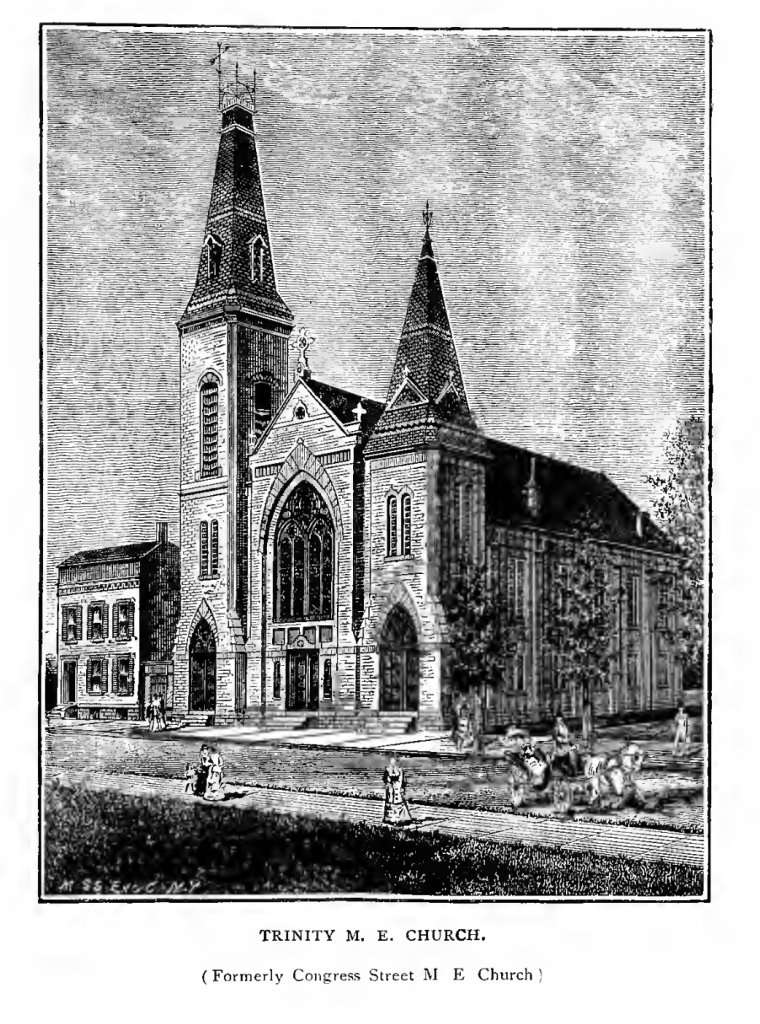
The Methodist Episcopal Churches of Troy, NY: Trinity M.E. Church, Congress St M.E. Church, the Hemlock Church.

Extended notes on State Street Methodist Episcopal Church (now Christ Church United Methodist) and the buildings and congregations that came from it.

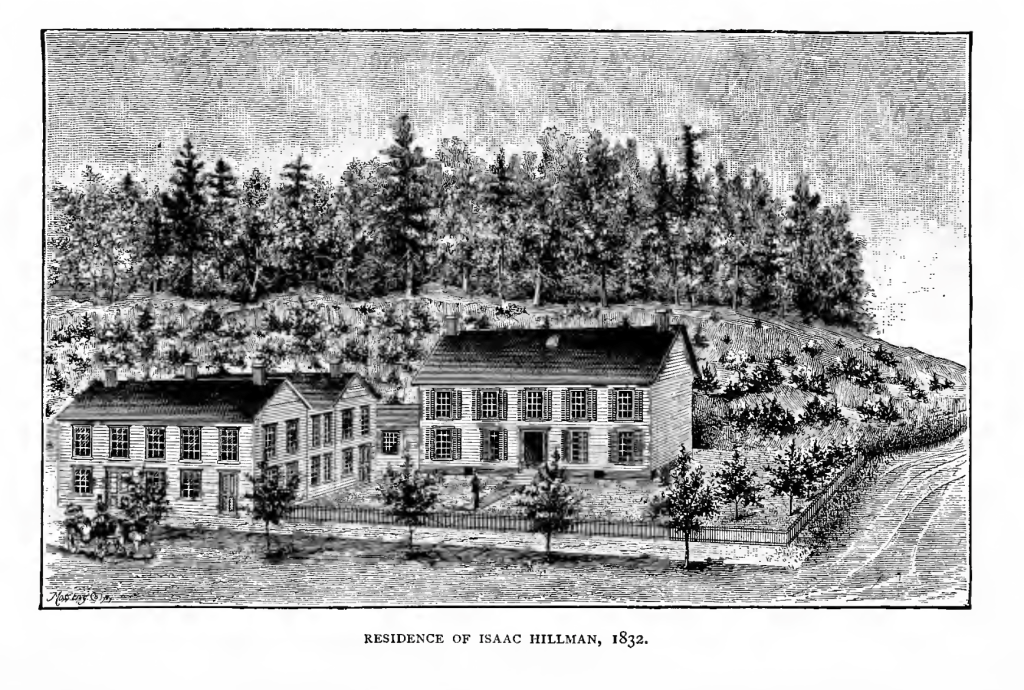
“The circumstances attending the organization of Trinity Church are briefly detailed in the first records of the society. ‘ The Methodist Episcopal Church in Congress Street, Troy, N. Y., was organized in the month of October, 1846’ (…) In June (1847), an old blacksmith- shop, a wooden building, on the south side of Congress Street, at its intersection with Ferry Street, was reconstructed for a house of worship, which was thereafter familiarly called the “Hemlock Church,” Hillman adds, “The organization of the Congress Street Church may be traced to a prayer-meeting first held about the year 1832 (…)  at the house of Isaac Hillman, standing a short distance east of the site of the Hemlock Church on Congress Street.(…)The small building proving inadequate for the uses of the congregation, the society determined to build a larger edifice of brick, and purchased the site of the present church, on the north side of Thirteenth Street, near its intersection with Congress Street.” The building was dedicated in  1849. (Hillman, pp 102-111)

With the Hillman family so invested in this particular congregation, it is not surprising that the main historical source book for these essays (Methodism in Troy by Joseph Hillman, 1888) has a lot to say about it. Indeed, Hillman and his sister donated a lot of money to complete its construction. Despite the family’s involvement, finding the site of the Hemlock/ Congress Street building as well as the Hillman home, has proved tricky.

The full account of the congregation’s beginnings, once again, hints at some disagreements or jealousies that may have been behind the organization of the new society on Congress Street. The prayer meetings, held at the Hillman residence, twice described as bring a short distance east of the site of the Hemlock Church, were held 3 times a week. Hillman reports with a modest pride: “It was afterwards asserted that more souls had been converted at those prayer-meetings than in the State Street Church, while they were held.” (Hillman, p.105) The meetings were sometimes quite long, and began to interfere with the worship times of the State Street Church, at which point there were several attempts to have them stop earlier, all unsuccessful. Hillman adds: “In fact those prayer-meetings were great feeders to the church.” (Hillman, p.107) Perhaps those attempts to control the prayer-meetings is what made this congregation determined to be separate from the State Street church, which finally happened in 1850, taking a core of members of the North Second Street and State Street congregations to the new church. In another hint of disagreements past, when describing the new building, Hillman adds: “The pews in the church were free, and since its erection no rentals for sittings have been imposed or collected.”(Hillman, p.110.) However, Hillman is not so shy about writing about the major theological disagreement, which necessitated the split: a sermon preached in 1847, by the Rev. John Clark, broke from a key Wesleyan tenet, and despite the conference demanding he never preach that way again, the idea took hold among some State Street members. It proved intolerable to some of the stalwarts of the church.

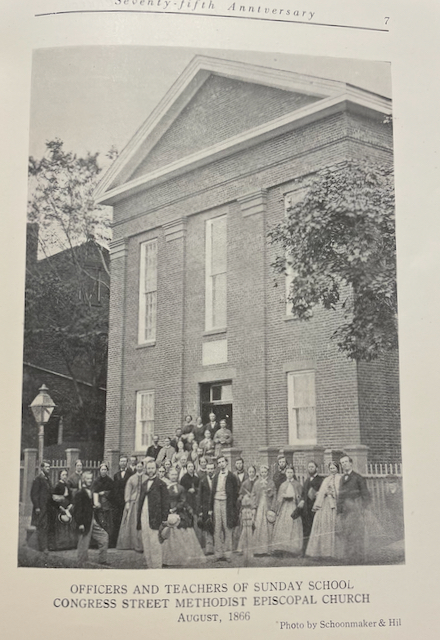
Even this new congregation had an almost immediate split, because in deciding to build a new sanctuary on Thirteenth Street, a faction decided to remain at the Congress Street site and replace the wooden building with a brick one. It was first named the True Wesleyan Methodist Church but the one image this writer located, in the 75th anniversary booklet of Trinity Church, show a brick “Congress Street M.E. Church” in 1866, with the Sunday School class gathered outside – 17 years after Trinity M.E. Church was first opened. By claiming it in the booklet, I can only presume this congregation did return to the Trinity fold not too long after the photograph was taken, unless the original church on 13th Street was very different before it was adapted…still working on that!

Not surprisingly Methodism in Troy includes a number of stories about Hillman family members – stories which deserve their own essay, but which include a treacherous sea journey, in which ship and people were deemed safe only through the prayers of the Troy meeting, to Hillman’s sister giving up her spot on a lifeboat on a burning ship in the Hudson, to save a young servant. The servant survived, Hillman’s sister did not.

The congregation merged with that of State Street-Fifth Ave in 1965, creating Christ Church Methodist Church. A year later, with the denomination’s merger with the United Brethren denomination, the official name became Christ Church, United Methodist, and so it continues to this day.

Arriving in the congregation in the early nineties, the author was told that this merger was seen as one of the most successful of its kind. Nonetheless, members of Trinity Church remained very proud of their association with that society, often referring to themselves as “Trinity members” long after the church had closed. The church was regarded as a good, local, family church with multi-generational friendships between attendees and their families. Its membership was just as dedicated and hard-working, as it had been in 1832, so it is hardly surprising, that although the State Street congregation kept its building, and possibly more important to them its historical site, the leadership quickly incorporated many of the Trinity faithful into influential positions. Even in the 1990’s, many former Trinity members continued in leadership roles.

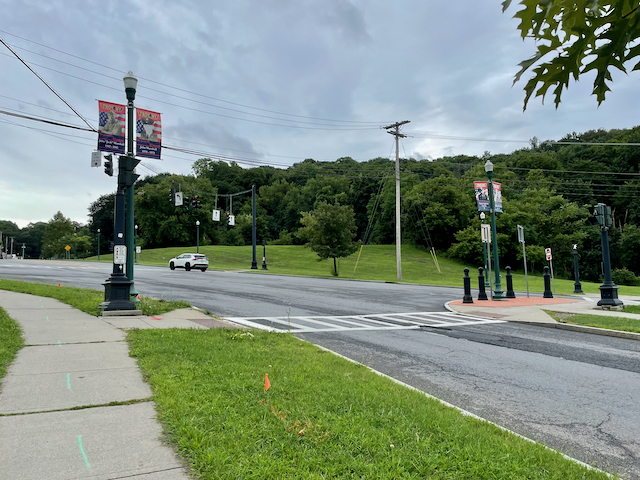
The current junction of Ferry and Congress Streets. Troy NY, with the location of the original junction on the extreme left of the image.

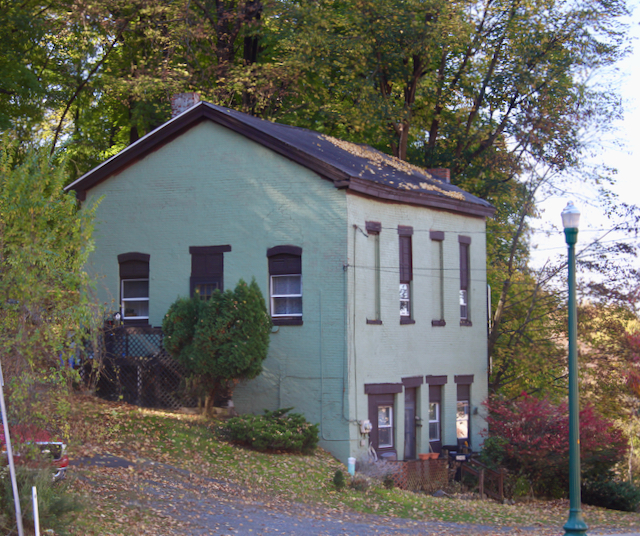
The current junction of Ferry and Congress Streets. Troy NY, with the location of the original junction on the extreme left of the image. The green brick house mentioned, is obscured by trees close and behind the orange road sign, far left.

Finding the exact locations of the 2 earlier buildings, as well as the Hillman home, has proved difficult. The road layout is similar but not exactly the same. Ferry and Congress Streets still merge as they climb the hill going east from the city, but they merge just below Eighth Street now, more than a hundred yards west of the location of Hillman’s day. Numbering has probably been changed, too, as Ferry Street did have its numbers changed – attested by the historical marker for Samuel (“Uncle Sam”) Wilson’s home which is now put as 76 and not the 144 of Sam’s day. In fact reports of the Congress Street M.E. Church being at 22 Congress Street, and Hillman’s home at 188 Congress Street, make them seem not so very close after all: unless one of those refers to the new numbering. The lot numbers on early maps are different again. Some other road layouts in the area have also been changed a little, and, of course, almost all the buildings have been replaced in the area of most interest. Earliest records show Congress Street as a mass of small workshops and stores, many occupied by members of the State Street Church. That the small blacksmith shop was a first location is intriguing, as one of the earliest converts was himself a young blacksmith apprentice on that street: Noah Levings went on to become a well known preacher, teacher and financial secretary of the American Bible Society. It would have been a nice link to the earliest history of Troy Methodists to use that site, but we may not be able to know at this point, if it was the same one – Troy had many small foundries and blacksmiths.

I am going to continue to research this question and will add an update when there are answers – the address of Samuel (“Uncle Sam”) Wilson’s farm, may help, as there has been more research into his history, but he was certainly a near neighbor to the Hillmans at some point. The last reference to the Congress Street, smaller brick church (above), was as it being the location of the Burns & Ryan Undertakers’ business, which may prove useful. It has been suggested it is the one older brick building under the hill at the approximate spot – a green residence with a shape reminiscent of a chapel – but the structure and orientation is not so convincing, when compared with the photo (unless, as commented above, that brick building is the earlier version of the 13th Street church, and the renovations very much more substantial than recorded!) The actual building may have been, like Uncle Sam’s home, pulled down for a road development that never happened, or part of the wider urban renewal project, which almost deprived Troy of so much amazing architecture, but still managed to destroy a lot. Without a mention for over a hundred years, various fates could have befallen the old church.

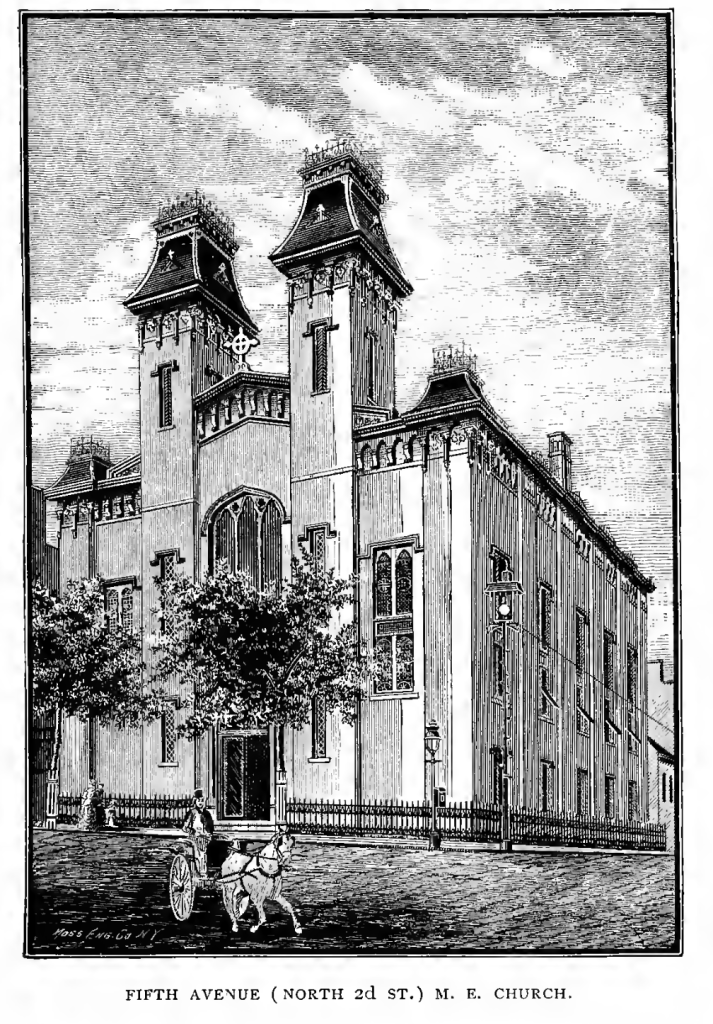
The building pictured at the top of the article shows the church after it was enlarged in 1880. The cornerstone was first laid on 13th Street, just north of its junction with Congress Street, in October 1848. The church was dedicated in 1849, and the following year, the society became an independent congregation with its own minister. It was enlarged, by 200 seats, in 1860, with enlargement to the Sunday School rooms in 1862. Hillman writes: “In 1880, the church was renovated and enlarged and attractively improved in appearance by the addition of corner towers and other architectural features, at a cost of $14,084.94. The building was rededicated December 28, 1880.” (Hillman. pp 110-111.

The structure burned, a decade after the congregation moved out, and was razed. A parking lot partially covers the site, today.

The etchings are from Hillman’s book, Methodism in Troy, 1888, which is available to read free online at various archives, including the Library of Congress. The photograph of the Congress Street Sunday School is from the booklet produced for the 75th Anniversary of Trinity Church, which is owned by Christ Church, United Methodist. A copy can be viewed at Troy Central Library. The photographs are the author’s.

The Methodist Episcopal Churches of Troy, NY: First German Methodist Episcopal Church & St Titus Italian Methodist Mission

Extended notes on State Street Methodist Episcopal Church (now Christ Church United Methodist) and the buildings and congregations that came from it.

“Although Troy had from a very early date not a few German inhabitants, it was not until 1855 that an effort was made to form a religious society, composed exclusively of German people. At that time it was estimated that there were no less than 2500 Germans in the city. The first German minister, who undertook to form a German society of a religious denomination in Troy, was the Rev. Mr. Swartz, the pastor of the German Methodist Church in Albany, who in 1855 began to conduct religious services in a building on the northwest corner of First and Ferry streets. Some months later, the Rev. F. W. Dinger of the New York Conference continued these services in the True Wesleyan Methodist Episcopal Church, on the south side of Congress Street, at its intersection with Ferry Street. In that building, the First German Methodist Episcopal Church of Troy was organized, on July 25, 1857. The society was incorporated March 31, 1859 (…) Shortly afterward the society purchased two lots on the north-west corner of Union and State streets for $1,500. The buildings on the lots were destroyed in the great fire of May 10, 1862.” (The History of Methodism in Troy, Joseph Hillman, 1888. p. 114-6.)

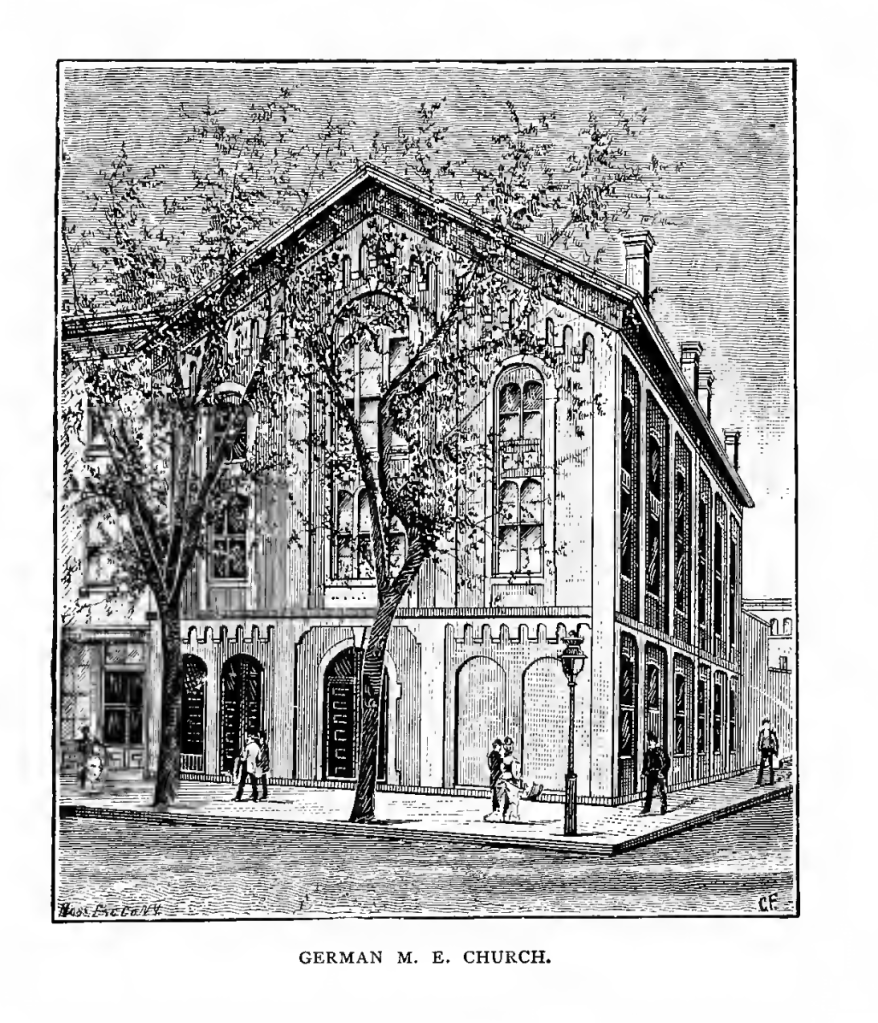
Interestingly, maps show that was the very point where the fire stopped along State Street, was just half a block from the current Christ Church, making the German Church the last structure lost on that street. The society then rebuilt, on that same lot, creating the church as pictured above, with the front facing State Street. It  was dedicated on March 25, 1863.

This congregation, along with the 5th Avenue/ North-Second Street congregation merged with State Street Methodist Episcopal, in 1925, the three merged societies taking the official title of Fifth Avenue-State Street Methodist Episcopal Church. Many of the leading families of this congregation became leaders in the merged congregation, and their descendants were members until the end of the 20th century.

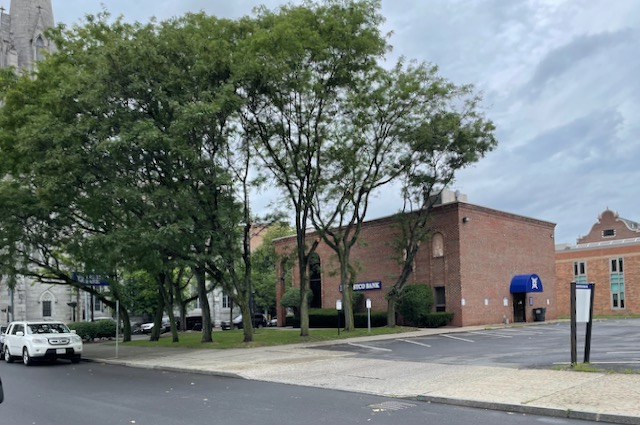
The original meeting house now lies under the car park behind the Central Library. As for the building above, Union Street no longer exists either side of State Street. It was the name for an alley which ran between Fifth and Sixth Avenue (alleys in Troy are named as streets) and this lot is now under the Trustco bank parking lot beside the Court building and Police Station. Maps show the building as one lot wide , but going back the whole two lots, as in the description above.

The spire of Christ Church United Methodist is at the left, the area immediately behind the sign at right is where Union St (alley) was. The black-topped parking lot was the site of the church. Out of site at the right are the municipal buildings and Police Station (corner State and Sixth.)

The spire of Christ Church United Methodist is at the left, the area immediately behind the sign, at right, is where Union St (alley) was. The black-topped parking lot was the site of the church.

The buildings on the east side of Fifth Avenue were removed during the 1960’s as part of an urban renewal program. I suspect this, too, was a victim of urban renewal, as the September 1950 copy “The Spire: Newsletter of Fifth Ave-State St Methodist Church,” lodged at the Troy Central Library, states the Liberty Presbyterian Church was at that time the occupant of the building above. It may have become unstable or in a fire between those two dates – so while that is unclear at time of writing, before that happened it became home to the …

St. Titus Italian Methodist Mission

So little is known of this congregation, that it has not appeared in Christ Church histories until this point. According to the collection of historical materials of Troy Conference, by Samuel Gardiner Ayres, archived at the Hart-Cluett Museum in Troy, St. Titus began as a mission to Italian families in 1913. However, he also states it began at that time in the Third Methodist Episcopal Church, which had been sold 15 years before that to the Ukrainian Orthodox congregation. I suspect this was an error, and the real location is 43 State Street – the German M.E. Church, where they remained after the latter congregation moved out.

The Adirondack Record- ElizabethTown Post newspaper for April 7th, 1932, carries an announcement by the Ausable Forks Methodist Church that: “The Reverend Lucius Martucci of St. Titus Italian Methodist Church, Troy, N.Y.” would give a talk on “The Melting Pot in America” in which he would talk of the pioneering missionary work of his mission among “the Italians of Troy.” The newspaper has another article about how the same church donated money each year to the St. Titus mission, stating it was the “only Church in the Troy Conference area, in which services are conducted in the Italian Language.” it gives the address of the church as 43 State Street, the same address as the building vacated in 1925 by the German Episcopal Church (above.) Interestingly, the author remembers several people named Martucci in the congregation, as well as the Rossi family, whose name is on a brass offering plate in Christ Church, United Methodist, to this today. It may have come along with the families when the congregation merged into State Street, at an unknown date, whether at its demolition, having shared the building with the Liberty Street Presbyterian Church, or before that, leaving the building empty for its new owner. I suspect someone will know…and if so, I will gladly update this mini history.

Line drawings and quotations are from “The History of Methodism in Troy” by Joseph Hillman, 1888, available as a PDF, free of charge, at a number of online archives, including the Library of Congress. Photographs are the author’s.

African Methodist / Wesleyan Methodist Episcopal Zion/ AME Zion Church of Troy

Extended notes on State Street Methodist Episcopal Church (now Christ Church United Methodist) and the buildings and congregations that came from it.

Of all the societies that came out of the State Street Methodist Episcopal congregation, this is the one that has had the most locations, all but the current one, having disappeared in the 190+ years since its formation.

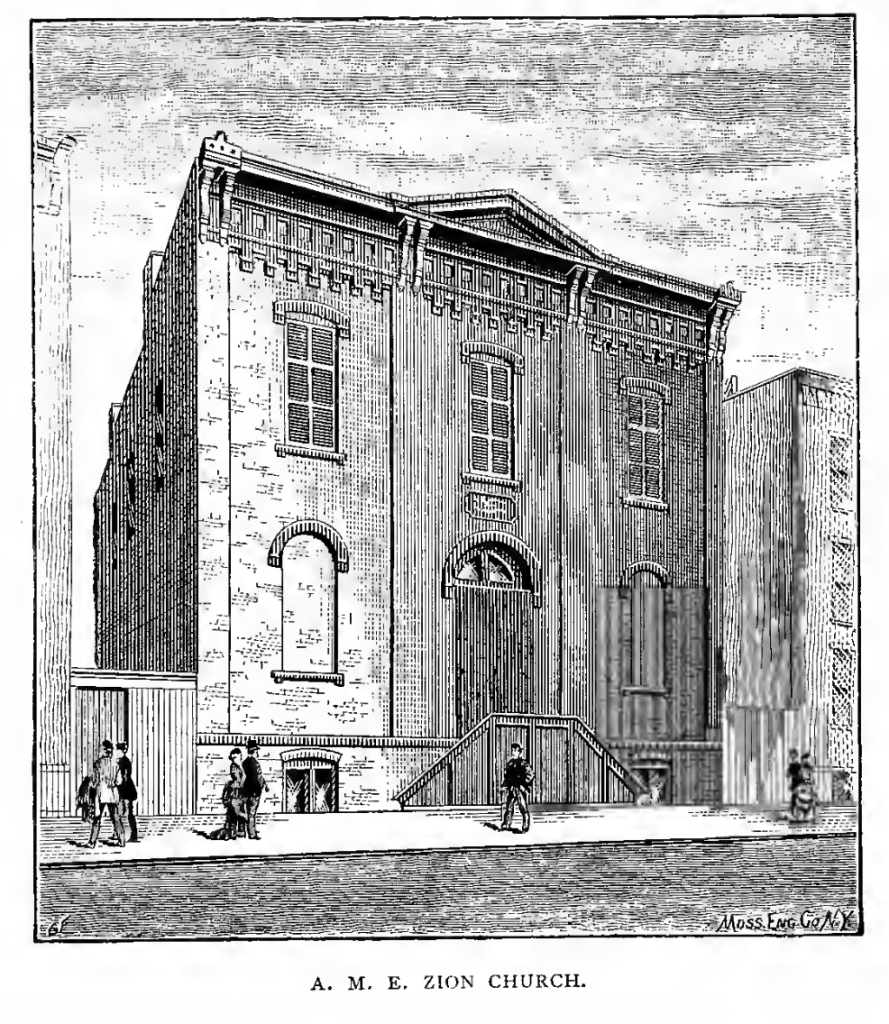
Joseph Hillman in his History of Methodism Troy from 1888, which includes the engraving of their third location as seen above, writes:

“The origin of the African Zion Methodist Episcopal Church, is traceable to a class connected with the State Street Church, called “the colored class,” which was led in 1830, by John Dungy, an intelligent and pious man of African descent, who in 1831 became the pastor of the small congregation of colored people, which that year was known as the African Methodist Church of Troy. In 1832 the society took the name of the Wesleyan Methodist Episcopal Zion Church of Troy. A small wooden dwelling, on Fifth Street, north of Liberty Street, was fitted for a house of worship for the congregation. In 1841, the society purchased a lot and building on Fifth Street, and altered the structure into a church. On February 23, 1842, William Meads, Jacob Brown, Lewis Butler, Littleton Becket, and Lewis Jones were elected trustees of the Wesleyan Methodist Zion Church of the city of Troy. The property was sold about the year 1863. In the spring of 1864, George Bristol purchased for the congregation, the property on the east side of Seventh Street, between State Street and Broadway, the title of which was afterward conveyed to Joseph Hillman, Reuben Peckham, and Adam C. Fellows as trustees. On the resignation of A. C. Fellows, H. Clay Bascom, was elected his successor, and he in turn was succeeded by Henry C. Curtis. On the death of Reuben Peckham, Edward O.House was appointed to fill his place. On the brown stone tablet in the front wall of the brick building, in which the congregation worships, is inscribed : A. M. E. Zion Church, organized, A. D., 1832, erected A. D., 1865. The present membership is 79.” (Hillman. pp 118-20

I have included the entirety of that text, because it illustrates the issues that surface in writing about this congregation: we do not know in what spirit the separation of the State Street society, along lines of race and color, took place. The history gives us tantalizing, but contradictory, information. And when the author was invited to give a historical address in the current Fifth Avenue AME Zion, at one of their historical celebrations, the pastor did so explaining the congregation had few records – other than a founding date a few years earlier than the one mentioned by Hillman.

But the real puzzle for us today, stems from the photograph of the trustees of the congregation as preserved in Hillman’s book: the trustees include two men from the State Street leadership. Was their presence paternalistic? Was their presence altruistic, wanting to advertise the continued friendship of the two congregations, at a time when America was recovering from civil war, but hurtling into its ugly era of Jim Crow laws? Or somewhere between those options: they considered themselves as simply protecting their investment, both financial and emotional, with the African American society? Unless we get a lot of new information we can only guess.

Before we add just a little more information to that discussion, let’s talk about the origins of the congregation, and its various locations.

After looking at the various early maps, and not finding the first two churches named anywhere, all I can conclude from Hillman and other texts, is that the first location: “the small wooden dwelling on Fifth Street and north of Liberty” was a small wooden house typical of the neighborhood at the time – a worker’s home, which later made way for the breweries and factories that would be built there. The congregation had, in any case moved to their next location, also on Fifth Street, according to Hillman. They moved there in 1842. There may yet be records of the location for the sale of that second church, around 1863, as this was a time of massive rebuilding after the Great Fire of 1862. That fire engulfed a huge area, stopping half a block short of the State Street M.E. Church, but engulfing the site of the German M.E. Church, and a Presbyterian Church less than a block away. The biggest clue to location, however, is that in 1834, Troy’s very first church building, a Presbyterian church which stood on Congress Street in what is now Sage Park, was physically moved to Liberty Street, and began to be used as a day school for children of color, with evening classes for their elders. This in turn led to the building becoming the Liberty Street Presbyterian Church – a famous African American congregation. It would make sense that these locations were not too far apart. A number of buildings still standing could be imagined as being modified for a church, as there are a few wooden ones to this day, as well as what could be early brick buildings on the street. Most of that block became industrial buildings around this time: the purchase of the property around 1863 could have been to raze it to build a factory or a brewery, or could still be there, obscured by later renovations

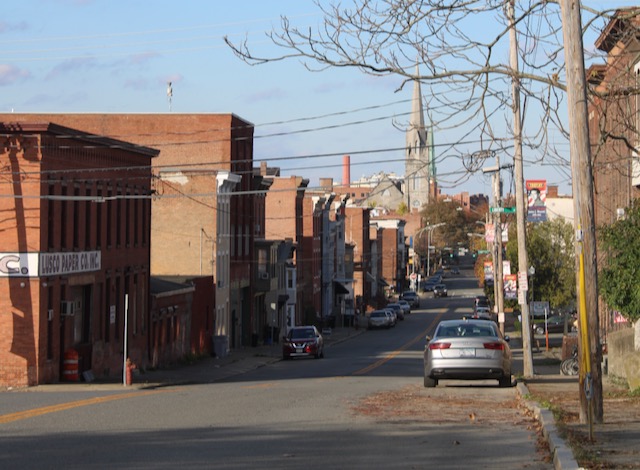
The view north from Liberty Street along Fifth Avenue towards the current Christ Church, United Methodist, on State Street.

Their third church was the brick edifice, in the engraving at the top of the article.It was on the east side of what was Seventh Avenue, between State Street and Broadway, an area just north of the current County Buildings (formerly a school). The 1885 Sanford map, which can be viewed online at the Library of Congress, shows it in the center of that street, at a location very similar to one which had previously been used by the Ladies’ Home Mission, which Weise tells us was burned in the Great Fire of 1862. The whole area was rebuilt after that massive devastation, which destroyed homes, businesses, churches, the RPI building of that time, and the train station.

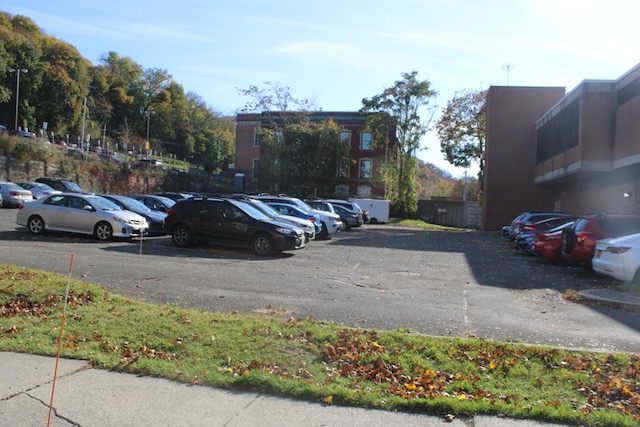
The Hart Cluett website has a page on Black Religious Societies with some information, which differs from my research, especially on the location of Troy High School and this church at the time – but thought that it was razed for the High School. Today, the site is under a parking lot, behind mid twentieth century offices.

From there, the AME Zion congregation moved to the former Ninth Presbyterian Church, in North Central Troy. It stood on a now empty lot at the NW corner of 5th Avenue and Jay Street, having burned down in 1969. The next – and current – home of the Fifth Avenue A.M.E. Zion Church of Troy, is in what had been St. Savior’s Lutheran Church, (formerly a Unitarian Church), which had closed in 1968. The vibrant and socially active A.M.E.Zion congregation has served the local community from this building, at the corner of Fifth Avenue and 103rd Street, for over 50 years.

It is so appropriate that the history of this congregation has mostly centered on Fifth Street (now Avenue.) Fifth Street was one of the boundaries of the two fields where Jacob D. Vanderheyden, allowed the annual 6-day Pinkster or Pingster festival – meaning Whit Sunday or Pentecost in Dutch. Sylvester, in his book “The History of the City of Troy”(1880) quotes Henry Rousseau, who recalled: “In my early days there were many slaves in the state of New York. “Pingster” was the slave’s great holiday. The slaves of the four counties – Columbia, Albany, Schenectady, and Rensselaer – united in its celebration.”

As for the split between their congregation and the downtown Methodist congregation, historians of African Americans church history write that, by the 1820’s, all Protestant denominations were starting the process of splitting into separate white and black denominations. The State Street congregation seems to have done so later than many, but its timing, not longer after building a new brick sanctuary with a gallery level, does make me ponder if the church also introduced segregated seating at the end of the 1820’s, as that was one of the reasons other non-Methodist congregations had split a few years earlier. However, with the introduction of pew fees in the lower sanctuary space, to pay off the debt on the construction, I suspect there was plenty of reason for discontent. All we know, is, that the trend that had begun a few years earlier, spread to State Street.

I can imagine there was sadness when it happened, especially for the oldest members. Race – or class-based racism – may have been a matter of conversation for some Trojans, but was not seen as a subject of contention within the congregation. Hillman reports: “From the organization of the society not a few colored people were members of the church.”  The inclusion of Africans in the congregation from the earliest days is corroborated by the “young daughter” of Caleb Curtis, an early founder of the society. She felt the need to defend the congregation from outsiders criticizing it, and at least some of those attacks were based on the racial identity of the members, as she felt the need to give a list of the notable person of the then village who attended, concluding:“I have thus been particular because it was asserted at a love-feast that the first society was composed of the lower order of person, and, at the same time, it was said that the time was when there was no place to hold prayer- meetings except in the basement of a house occupied by a black family. it is true that the prayer-meetings were held there sometimes. Ritta (the negro woman) was considered pious and had considerable gift in prayer. Her room was ample and decent. The person who made the statement must have been misinformed” (Phebe Curtis, quoted by Hillman, pp 13-4) Of course she knew the group actually chose to meet in Ritta’s room – her short history of the congregation, so often quoted by other authors in the following century, was based on the meetings often held in her father’s home, but also in other homes; at the very least the Curtis home was always available.

It is not surprising that African Americans, whether enslaved or free, were attracted to this young denomination: slave-owners were simply not allowed to be members of the society, following the work of the founder of Methodism. John Wesley had long campaigned for a law preventing the owning of slaves in Britain, while fighting a moral battle with those who profited from shipping slaves from Africa to the New World, many of whom lived in Bristol, where he spent much time.

As for John Dungy, “A class exclusively formed of persons of African descent was led, in 1830-31, by John Dungy, an intelligent and pious colored man.” (Hillman, pp 55) He includes him in the list of leaders of the State Street M.E. church in 1830-1 (p.176) and in the list of Methodist ministers, he is listed as the pastor of the African M. E church for 1831, 1832, 1833 and 1834 (Hillman, p. 288) after which the ministers no longer appear in his book. “The History of Troy and Lansingburgh” by A. J. Weise (1886), as well as the website of the current A.M.E. Zion congregation, lists the first minister appointed by their conference to the Zion M.E. Church of Troy, in 1834, as being Rev. R. Noyes. The only other reference found for John Dungy was a listing in the Troy City Directories for 1830, where he is listed as living at 4 Franklin St, occupation: shoemaker, and then for the years, 1831,1832,1833 and 1834 as the Rev. John Dungy, Pastor of the African Church, still living at the same address. His name is italicized which indicates him being a free person of color. He appears neither in the first city directory of 1829, nor in the 1835 one.

Nothing is known of the relationship between the white and black congregations after Hillman wrote his book in 1888, but it was doubtless far from ideal. However, during the author’s time with Christ Church, there were three occasions where the AME Zion congregation hosted its multi-district annual conference at the State Street location, where they filled the sanctuary and balcony with energetic singing, enthusiastic preaching, loud hallelujahs. It was a sight to behold, and an experience we were glad to participate in – not to mention the great smells coming from the busy kitchen and Fellowship Hall! It seemed a fitting time to welcome them back on site – and of course, the usual, mostly white, Christ Church congregation rejoiced to have their turn at being seated in the balcony…

The source book for most of the quotations is Joseph Hillman’s 1888 book ‘Methodism in Troy” which can be read online free of charge at a number of websites, including the Library of Congress. It includes the photograph of the 1887-8 Trustees of American Zion Church, with their names. Original Troy City Directories can be viewed at the Troy Central Library, and in facsimile at the Hart-Cluett Museum. Photographs are by the author.

Maggie Van Cott (Margaret Newton Van Cott): early woman preacher & evangelist.

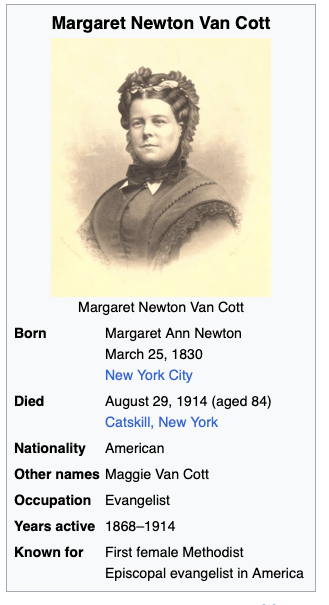
Maggie van Cott (1830-1914), seen here in a screen shot of her biography on Wikipedia.com, was the first woman in Troy Conference to be given a license to preach, and became famous throughout the North East as a leader of revivals, and even made tours out West. She received her license to preach in 1869, which was obviously controversial, and yet also very popular. In the book “The Harvest and the Reaper” written from her recollections,  there are contemporary reviews of her preaching, and whilst some criticize her lack of training as an orator and theologian, (and talk about her “womanly logic” – meaning lack of it,)  they all have to admit to her success at her goal of “bringing souls to Christ.”

 In March and April,1876, Maggie van Cott visited the State Street, Troy, NY congregation, staying with the Hillman family. Both Maggie and the Troy Praying Band, under Hillman,  had visited the Springfield, MA Methodists in the past to run revivals. 

The Troy Daily Times reports the revival events, reporting that the church was full for some, and that the one – weekday – afternoon, when they reported a smaller crowd, it still numbered several hundred. The pastor’s wife, Mrs. Kimball, and Mrs Joseph Hillman held some women only events, in addition to those open to the general public.

Joseph Hillman records in his book, Methodism in Troy, both his home and that of the pastor, Rev. H.D.Kimball, were robbed during the revival at the church: “the writer took the most complacent view of the loss as was possible, and proposed that the hymn “Hallelujah, ‘tis done” should be sung.” (Hillman, p.73.) He then continues to speak of the revival being a “glorious success” and how it also gave the Presbyterian church some new members.* Several of the revivals, at State Street Methodist Episcopal do appear to have been led with some support from the local Baptists congregations.

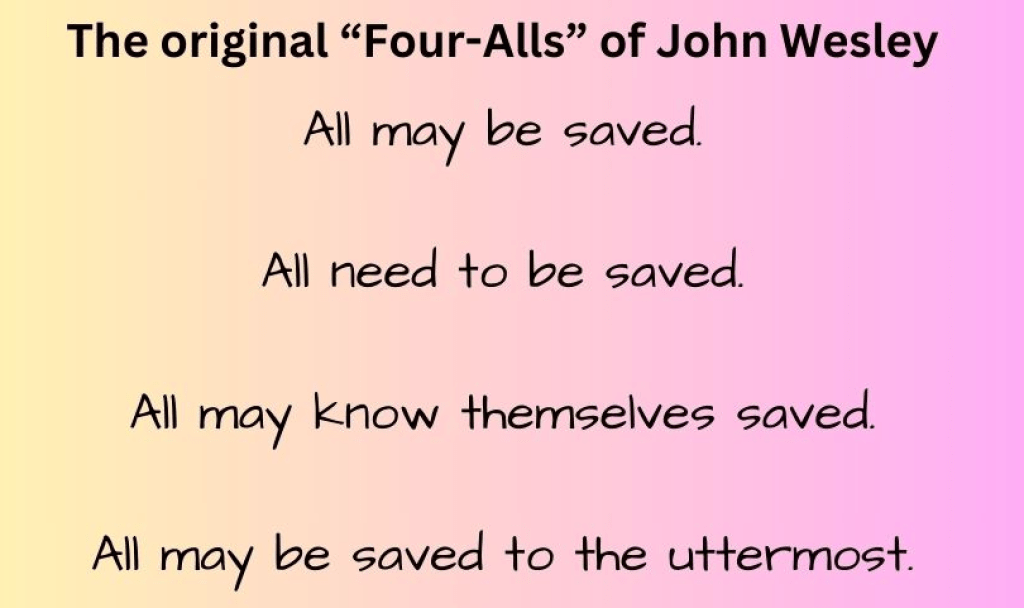
Revivals were not always seen positively in the Presbyterian denomination, as can be read at the link below, so it is interesting that the friendly relationships between denominations, praised more than half a century earlier by Frederick Garresttson when visiting Troy, seems to have continued to some extent.  The objections by the Presbyterian denomination included the inordinate “enthusiasm” which so often was a criticism of Methodist worship, but also the preaching. The nature of revival preaching made it less likely to be on the theology of Calvin. Revivalists were often Methodists, and their founder, John Wesley, had written many treatises in direct opposition to Calvinism, contrasting it with his own theology of the Four Alls, a traditional summary of Methodism teaching which underpins British Methodism to this day: 

She was born in New York City, but it is widely reported that, on the death of her husband,  moved to Greene County, which she deemed a better base for her revival work, and died at Catskill. A Maggie Van Cott does appear on the list of city residents in the 1830s, which hints that maybe she moved first to Troy and, as her travels and fame grew, moved  to Greene County. 

 By her 50th birthday she had supposedly traveled 143,417 miles, held 9,933 revival meetings, and given 4,294 sermons, but the total was far greater as continued her work until her eighties.

The New York Annual Conference of the Methodist Church created a bulletin insert for Women’s History Month in 2016, and it can be accessed at their site.

Online copy of her book: The Harvest and the Reaper can be read online, free of charge, at Google.com/books

Online copy of The Life and Labors of Mrs. Maggie Van Cott by John Onesimus Foster can be read free of charge, online, at Google.com/books

For more information on the Four Alls, one resource is the “What is Distinctive about methodism” page of the British Methodist Church.please visit the Methodist Church site at methodist.org.uk

The image at the top of the page comes from Wikipedia.com and is the title of their boigraphical sketch of the Mrs. Van Cott. The image of the “Four Alls” was created by the author.

The Methodist Episcopal Churches of Troy, NY: Fifth Avenue/ North Second Street

Extended notes on the Methodist congregations associated with the State Street Methodist Episcopal Church (now Christ Church, United Methodist.)

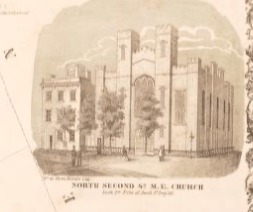
“The expediency of taking advantage of the growth of the city northward of Grand Division Street, and of having a church in which the seats were free, caused the State Street society to give consideration to the project of providing a place of worship in the north part of Troy. On May 23, 1831, the Quarterly Conference appointed a committee ‘to provide a place for preaching somewhere in the bounds of the fourth ward.’ On August 8, that year, the committee reported ‘that the only place to be had ‘ was ‘the dwelling-house’ of Stephen Monroe. A committee of five persons was then appointed ‘to provide a place or places for meetings in the first and fourth wards of the city (…) Considering that the lot on the northeast corner of North Second and Jacob streets would be an eligible site for a church.” (Hillman, pp 87-8)

On the evening August 13, 1831, the trustees of the State Street society “resolved that a subscription should be circulated throughout the City of Troy and elsewhere for the purpose of building a Methodist Episcopal Church in the fourth ward of the city ‘with free seats.” showing that the idea of having paid seating in the “mother church” on State Street had become an issue for some of the congregation.

This building was a brick structure and included a basement. As soon as it was built the Sunday School which had been organized nearby, in the school-room of Miss Annie Manwarring, was moved there and prayer meetings began. “On Sunday afternoon, August 30, 1835, Bishop Elijah Hedding dedicated the church.“ (Hillman 87-88.) The congregation having grown in number, this church building was replaced with a grander structure, which was originally slightly less grand than the drawing found in Hillman’s book. The original aspect of the church can be seen in this 1869 map by William Barton which can be seen online at the New York Public Library website. The private house next door in that drawing, appears have become the parsonage.

The congregation chose to re-merge with the State Street congregation in the 1920’s, at the same time as the German Episcopal Methodist church. The merger of these three churches occurred in 1925, and is recalled by an unknown member of State Street Methodist Episcopal, upon the 125th anniversary of the church in 1939:“Time passed on with greater or less success to Methodism in Troy, until the year 1925 when the mother church grew lonesome for her children and it was decided to unite the congregations of State Street, Fifth Avenue and the German Church under one head whose name should be the Fifth Avenue-State Street Methodist Episcopal Church.”

(quoted by Rev. Dr. James Fenimore in his 1998 paper: “Christ Church, United Methodist – a Church on the Edge of an Apocalypse” from a letter to the church entitled “To the Pastor and People of State St. Methodist Episcopal Church.” This paper is available online.)

The building and its parsonage became the property of St. Peter’s Armenian Apostolic Church in 1927. That congregation left the building when they constructed their new church in Watervliet, in 1971. An African American congregation then worshiped in the church, until it became suddenly and dangerously unstable, and was razed by the City of Troy in the 1999. The parsonage was demolished a little later.

In 2024, the lot which was occupied by the church and parsonage, is used for parking. It is located between Federal and Jacob Streets on Fifth Avenue, in the area now known as Columbus Square.

Line drawings and quotations are from “The History of Methodism in Troy” by Joseph Hillman, 1888, available as a PDF, free of charge, at a number of online archives, including the Library of Congress. Photographs are the author’s.

The Methodist Episcopal Churches of Troy, NY: East Side Church/ Pawling Avenue.

Extended notes on the Methodist congregations associated with the State Street Methodist Episcopal Church (now Christ Church, United Methodist.)

Pawling Avenue/ East Side Methodist Episcopal Church

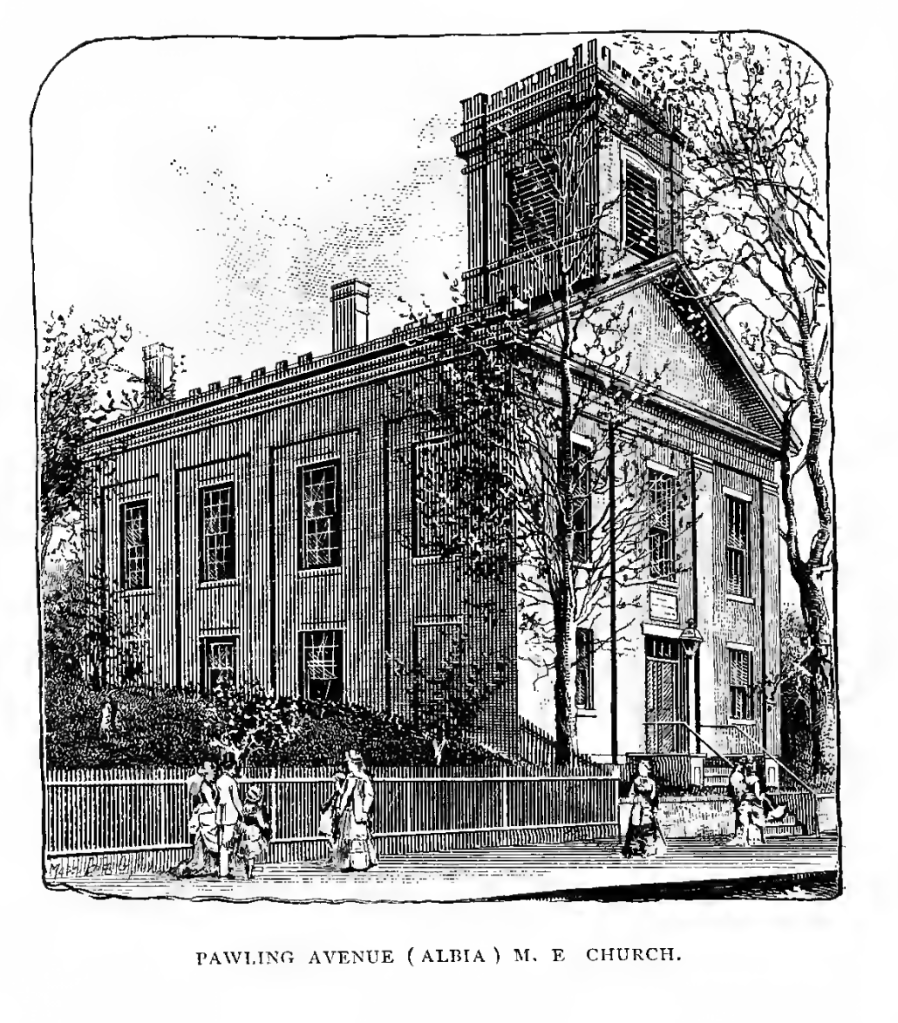
“The first Methodist meeting house at Albia, in the fifth ward of the city, was erected by the trustees of the State street society, for the purpose of providing its members with a convenient place for hearing preaching and for holding prayer -meetings, when they were precluded from attending religious services at the State Street Church.“ The trustees of State Street formed a committee to build a meeting house in Albia, on August 15, 1826. The first reported sermon was preached there in 1829 (Hillman. p 83.)

This Methodist “society” – congregation- was not only the the first satellite church of the State Street church, but of all of those churches, is the only one still in operation today, in a building within sight of the location of the original one. It was needed because the mill workers would have had a xxx mile work to downtown Troy, and then walking back up a steep valley side, not only taking a lot of time and effort, but on unpaved roadways and in all weather, it must have been a dangerous and difficult journey. It is remarkable that up to this point some actually had made it!

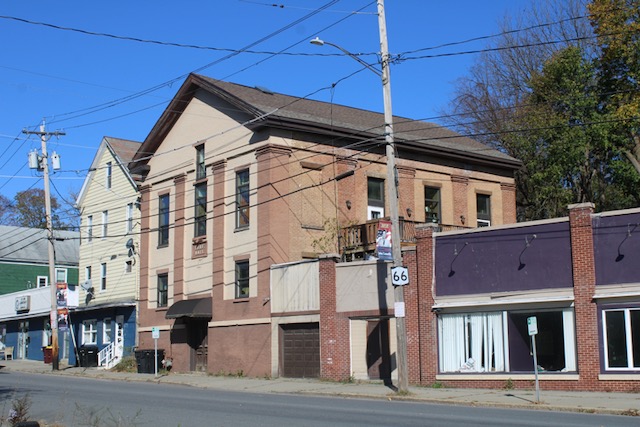
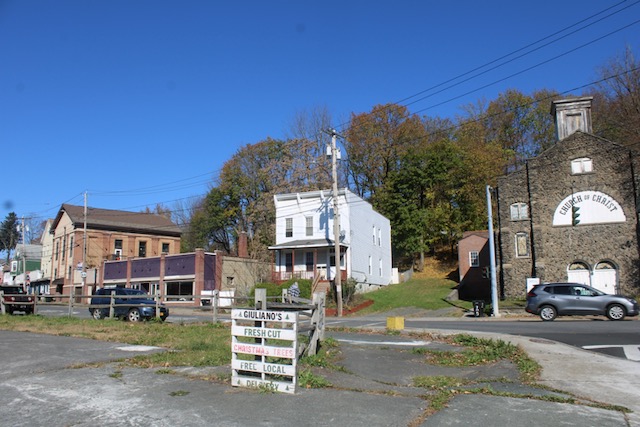
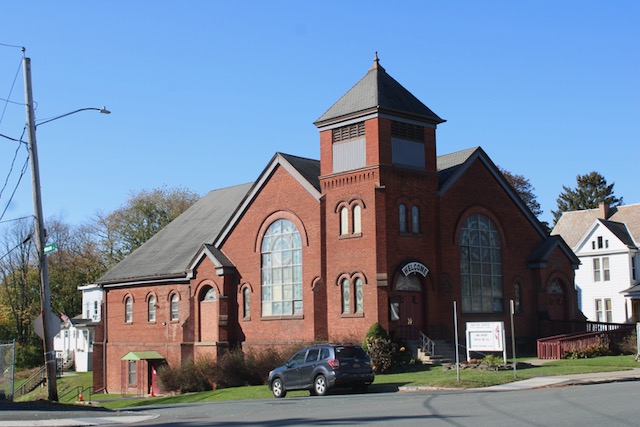
The original building was made of wood, and Hillman reported that the stone tablet above the door read that the church was erected in 1827, and rebuilt in 1858. Maps show it as being a little smaller than the still-standing original Presbyterian Church, now labeled as a Church of Christ, though not in use, just a hundred yards away at the junction of Pawling Avenue and Winter Street. The site of the East Side Methodist Church became home to the Oddfellows Society, and the structure still visible at the site does have the appearance of a chapel, but one made of brick, not wood. It now appears to be a home.

The site of the original East Side Methodist Episcopal Church on the east side of Pawling Avenue.

The view from the junction of Pauling Avenue and Winter Street, with the Wynantskill immediately behind the photographer. These banks were lined with mill buildings, and some remains are visible looking over the bridge as well as on adjacent properties.

The congregation adopted the official name of the “Pawling Avenue Methodist Episcopal Church” in 1868, and in 1888 Hillman reported a membership of 166 persons.

A few years after the publication of Hillman’s book, the current brick church, known locally as “The Welcome Church,” was constructed on the western side of the road, less than half a mile to the north. This congregation continues to welcome neighbors and friend to worship and community meals, and can be contacted on Facebook and the web. If your genealogical search leads you to this congregation, you should start by asking what records they have, as operational UMC churches usually hold their records.

Many of the imposing brick structures of the mills, including those first erected by Mahlon Taylor not long after his arrival in Troy in 1789, and their successors, were still standing beside the Wynantskill into the 21st Century.

Line drawings and quotations are from “The History of Methodism in Troy” by Joseph Hillman, 1888, available as a PDF, free of charge, at a number of online archives, including the Library of Congress. Photographs are the author’s.