Extended notes on the Methodist congregations associated with the State Street Methodist Episcopal Church (now Christ Church, United Methodist.)
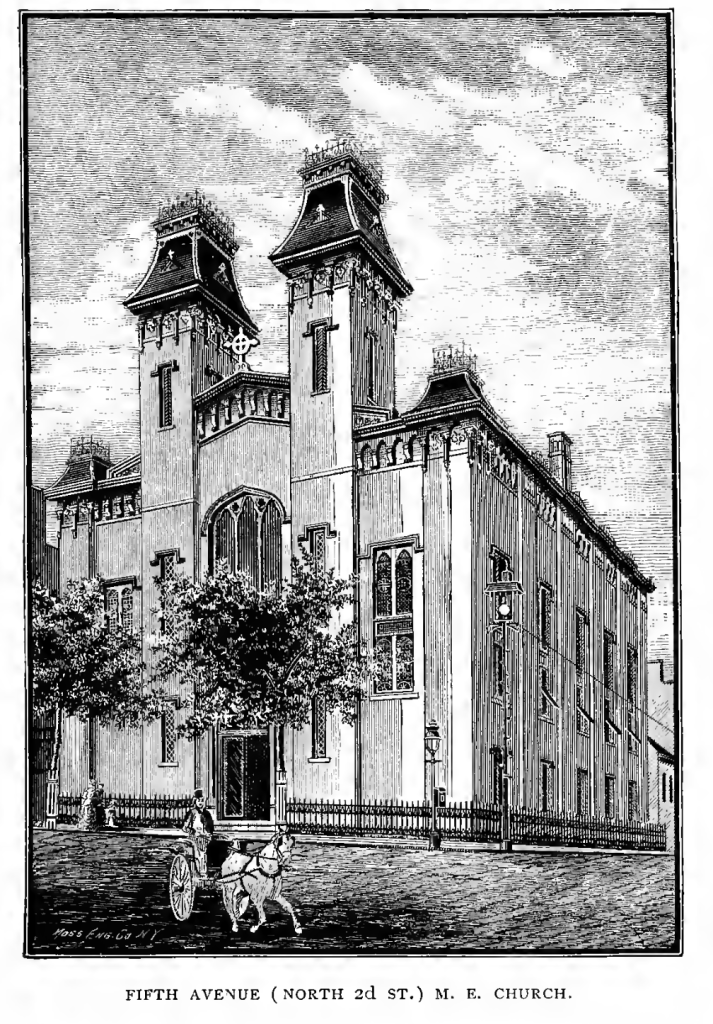
“The expediency of taking advantage of the growth of the city northward of Grand Division Street, and of having a church in which the seats were free, caused the State Street society to give consideration to the project of providing a place of worship in the north part of Troy. On May 23, 1831, the Quarterly Conference appointed a committee ‘to provide a place for preaching somewhere in the bounds of the fourth ward.’ On August 8, that year, the committee reported ‘that the only place to be had ‘ was ‘the dwelling-house’ of Stephen Monroe. A committee of five persons was then appointed ‘to provide a place or places for meetings in the first and fourth wards of the city (…) Considering that the lot on the northeast corner of North Second and Jacob streets would be an eligible site for a church.” (Hillman, pp 87-8)
On the evening August 13, 1831, the trustees of the State Street society “resolved that a subscription should be circulated throughout the City of Troy and elsewhere for the purpose of building a Methodist Episcopal Church in the fourth ward of the city ‘with free seats.” showing that the idea of having paid seating in the “mother church” on State Street had become an issue for some of the congregation.
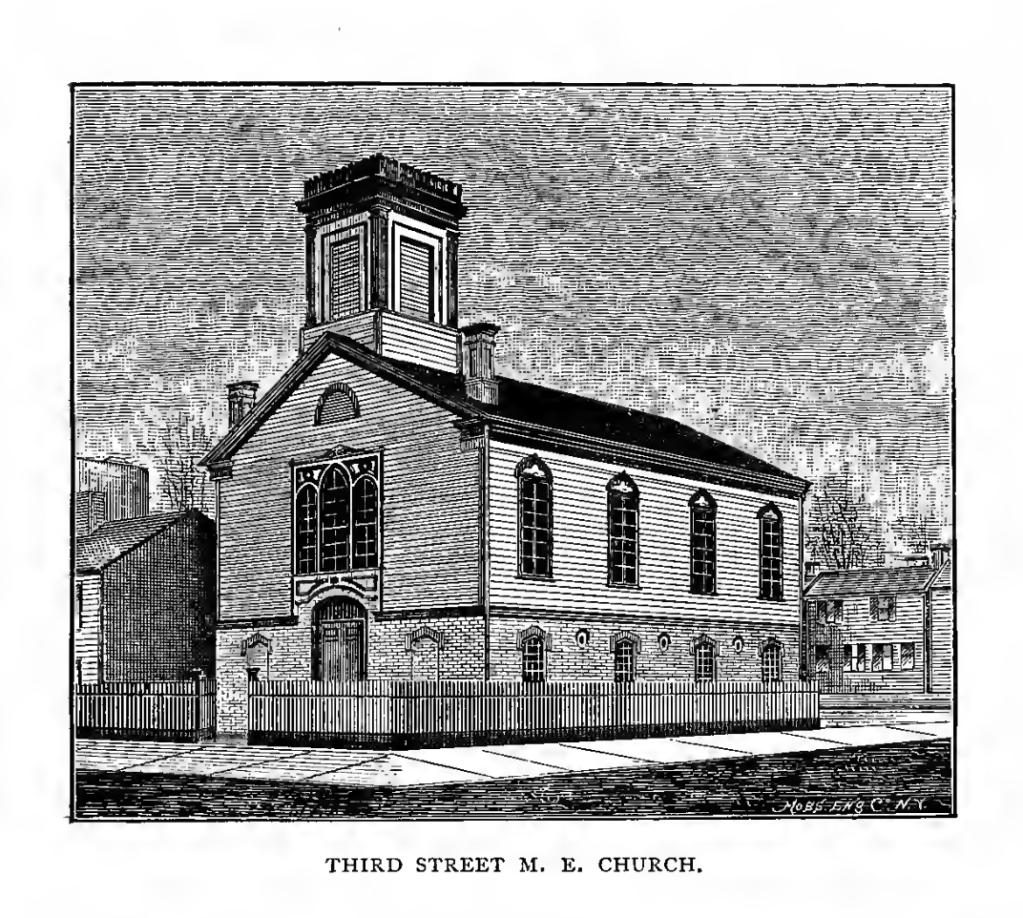
This building was a brick structure and included a basement. As soon as it was built the Sunday School which had been organized nearby, in the school-room of Miss Annie Manwarring, was moved there and prayer meetings began. “On Sunday afternoon, August 30, 1835, Bishop Elijah Hedding dedicated the church.“ (Hillman 87-88.) The congregation having grown in number, this church building was replaced with a grander structure, which was originally slightly less grand than the drawing found in Hillman’s book. The original aspect of the church can be seen in this 1869 map by William Barton which can be seen online at the New York Public Library website. The private house next door in that drawing, appears have become the parsonage.
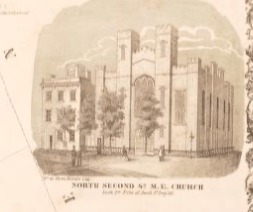
The congregation chose to re-merge with the State Street congregation in the 1920’s, at the same time as the German Episcopal Methodist church. The merger of these three churches occurred in 1925, and is recalled by an unknown member of State Street Methodist Episcopal, upon the 125th anniversary of the church in 1939:“Time passed on with greater or less success to Methodism in Troy, until the year 1925 when the mother church grew lonesome for her children and it was decided to unite the congregations of State Street, Fifth Avenue and the German Church under one head whose name should be the Fifth Avenue-State Street Methodist Episcopal Church.”
(quoted by Rev. Dr. James Fenimore in his 1998 paper: “Christ Church, United Methodist – a Church on the Edge of an Apocalypse” from a letter to the church entitled “To the Pastor and People of State St. Methodist Episcopal Church.” This paper is available online.)
The building and its parsonage became the property of St. Peter’s Armenian Apostolic Church in 1927. That congregation left the building when they constructed their new church in Watervliet, in 1971. An African American congregation then worshiped in the church, until it became suddenly and dangerously unstable, and was razed by the City of Troy in the 1999. The parsonage was demolished a little later.
In 2024, the lot which was occupied by the church and parsonage, is used for parking. It is located between Federal and Jacob Streets on Fifth Avenue, in the area now known as Columbus Square.
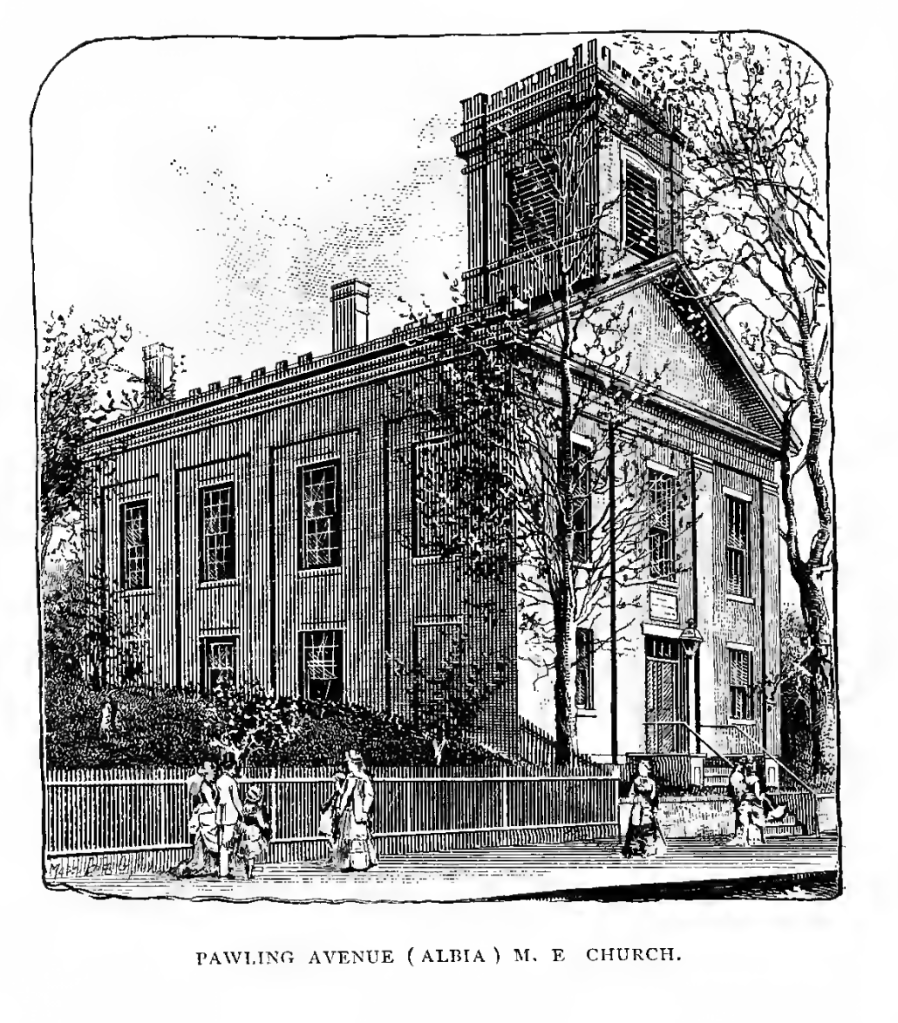
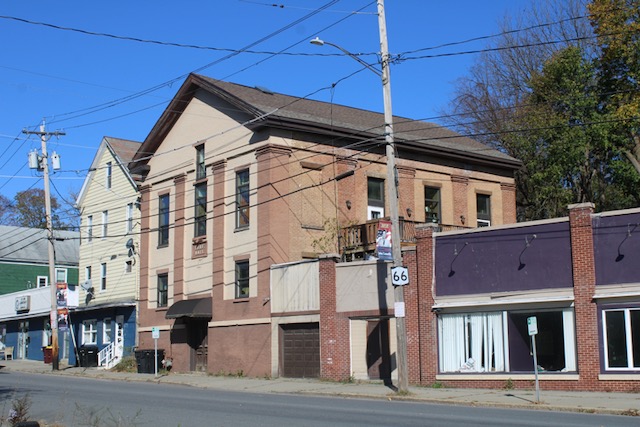
Line drawings and quotations are from “The History of Methodism in Troy” by Joseph Hillman, 1888, available as a PDF, free of charge, at a number of online archives, including the Library of Congress. Photographs are the author’s.
 janetintroy