Extended notes on State Street Methodist Episcopal Church (now Christ Church United Methodist) and the buildings and congregations that came from it.
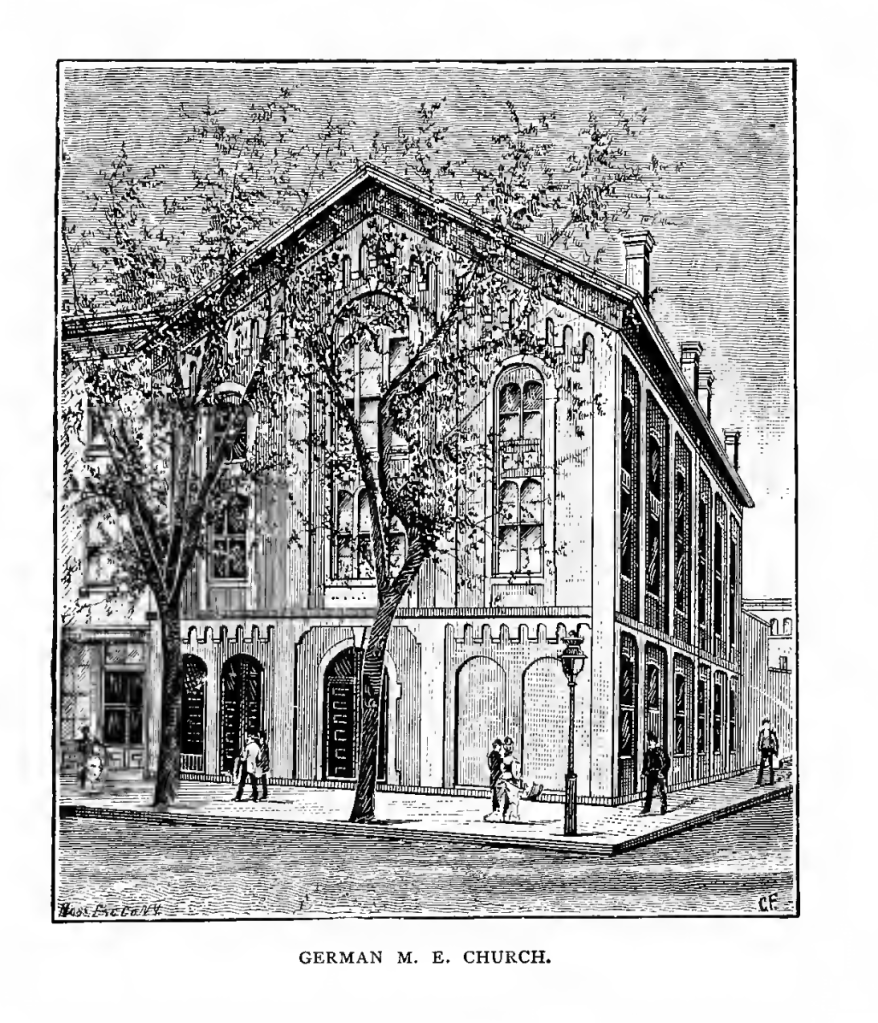
“Although Troy had from a very early date not a few German inhabitants, it was not until 1855 that an effort was made to form a religious society, composed exclusively of German people. At that time it was estimated that there were no less than 2500 Germans in the city. The first German minister, who undertook to form a German society of a religious denomination in Troy, was the Rev. Mr. Swartz, the pastor of the German Methodist Church in Albany, who in 1855 began to conduct religious services in a building on the northwest corner of First and Ferry streets. Some months later, the Rev. F. W. Dinger of the New York Conference continued these services in the True Wesleyan Methodist Episcopal Church, on the south side of Congress Street, at its intersection with Ferry Street. In that building, the First German Methodist Episcopal Church of Troy was organized, on July 25, 1857. The society was incorporated March 31, 1859 (…) Shortly afterward the society purchased two lots on the north-west corner of Union and State streets for $1,500. The buildings on the lots were destroyed in the great fire of May 10, 1862.” (The History of Methodism in Troy, Joseph Hillman, 1888. p. 114-6.)
Interestingly, maps show that was the very point where the fire stopped along State Street, was just half a block from the current Christ Church, making the German Church the last structure lost on that street. The society then rebuilt, on that same lot, creating the church as pictured above, with the front facing State Street. It was dedicated on March 25, 1863.
This congregation, along with the 5th Avenue/ North-Second Street congregation merged with State Street Methodist Episcopal, in 1925, the three merged societies taking the official title of Fifth Avenue-State Street Methodist Episcopal Church. Many of the leading families of this congregation became leaders in the merged congregation, and their descendants were members until the end of the 20th century.
The original meeting house now lies under the car park behind the Central Library. As for the building above, Union Street no longer exists either side of State Street. It was the name for an alley which ran between Fifth and Sixth Avenue (alleys in Troy are named as streets) and this lot is now under the Trustco bank parking lot beside the Court building and Police Station. Maps show the building as one lot wide , but going back the whole two lots, as in the description above.
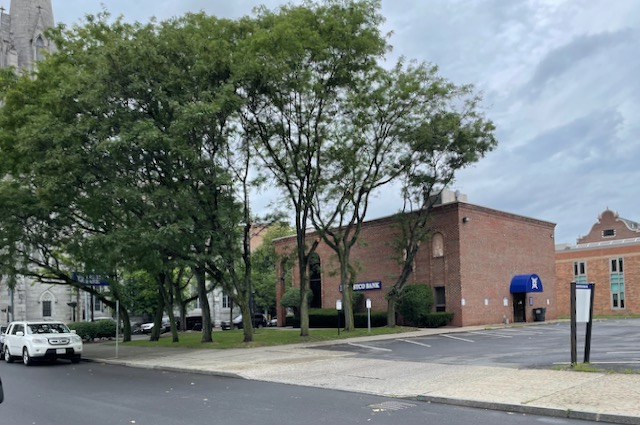
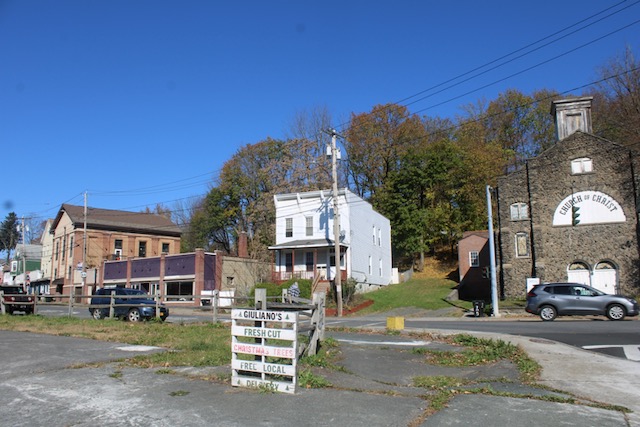
The spire of Christ Church United Methodist is at the left, the area immediately behind the sign, at right, is where Union St (alley) was. The black-topped parking lot was the site of the church.
The buildings on the east side of Fifth Avenue were removed during the 1960’s as part of an urban renewal program. I suspect this, too, was a victim of urban renewal, as the September 1950 copy “The Spire: Newsletter of Fifth Ave-State St Methodist Church,” lodged at the Troy Central Library, states the Liberty Presbyterian Church was at that time the occupant of the building above. It may have become unstable or in a fire between those two dates – so while that is unclear at time of writing, before that happened it became home to the …
St. Titus Italian Methodist Mission
So little is known of this congregation, that it has not appeared in Christ Church histories until this point. According to the collection of historical materials of Troy Conference, by Samuel Gardiner Ayres, archived at the Hart-Cluett Museum in Troy, St. Titus began as a mission to Italian families in 1913. However, he also states it began at that time in the Third Methodist Episcopal Church, which had been sold 15 years before that to the Ukrainian Orthodox congregation. I suspect this was an error, and the real location is 43 State Street – the German M.E. Church, where they remained after the latter congregation moved out.
The Adirondack Record- ElizabethTown Post newspaper for April 7th, 1932, carries an announcement by the Ausable Forks Methodist Church that: “The Reverend Lucius Martucci of St. Titus Italian Methodist Church, Troy, N.Y.” would give a talk on “The Melting Pot in America” in which he would talk of the pioneering missionary work of his mission among “the Italians of Troy.” The newspaper has another article about how the same church donated money each year to the St. Titus mission, stating it was the “only Church in the Troy Conference area, in which services are conducted in the Italian Language.” it gives the address of the church as 43 State Street, the same address as the building vacated in 1925 by the German Episcopal Church (above.) Interestingly, the author remembers several people named Martucci in the congregation, as well as the Rossi family, whose name is on a brass offering plate in Christ Church, United Methodist, to this today. It may have come along with the families when the congregation merged into State Street, at an unknown date, whether at its demolition, having shared the building with the Liberty Street Presbyterian Church, or before that, leaving the building empty for its new owner. I suspect someone will know…and if so, I will gladly update this mini history.
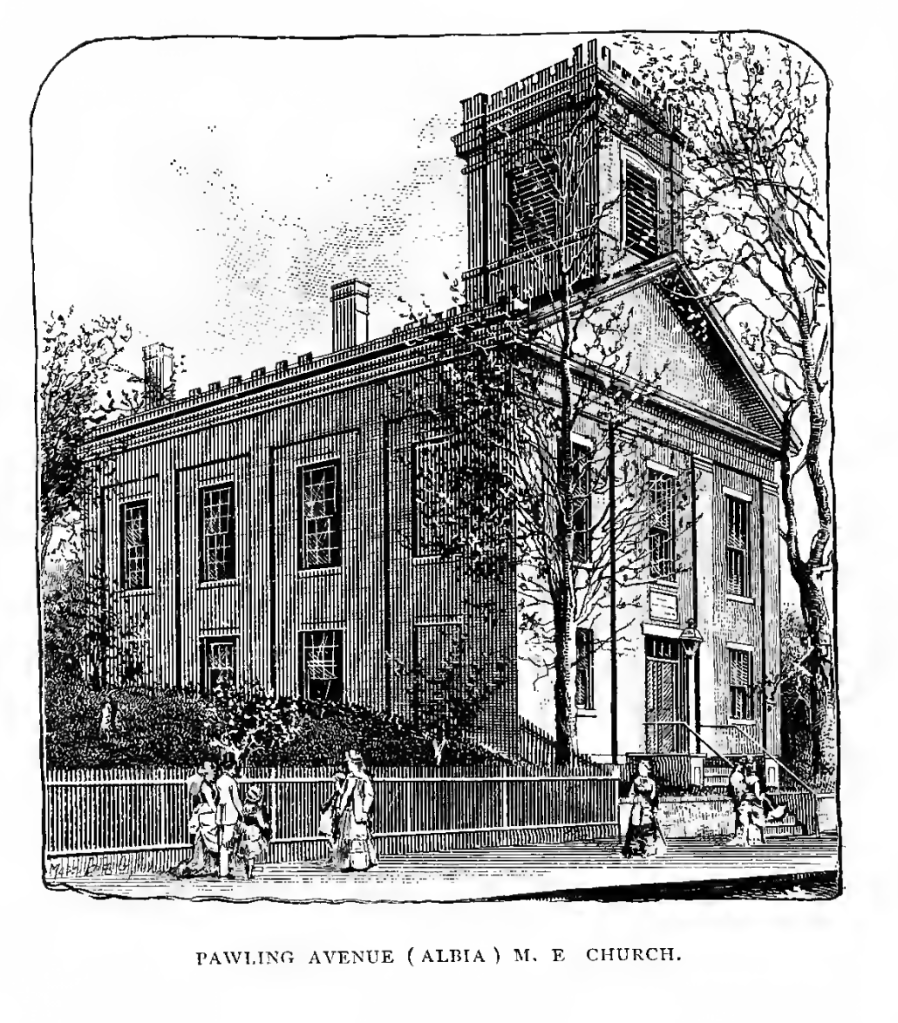
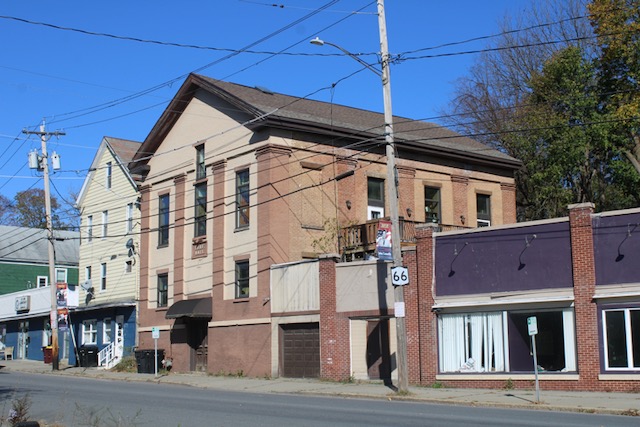
Line drawings and quotations are from “The History of Methodism in Troy” by Joseph Hillman, 1888, available as a PDF, free of charge, at a number of online archives, including the Library of Congress. Photographs are the author’s.
 janetintroy