A remarkable Troy woman and the burning of the Henry Clay

A story about the remarkable early Methodists of Troy, NY and especially those associated with the State Street Methodist Episcopal Church and its branches.
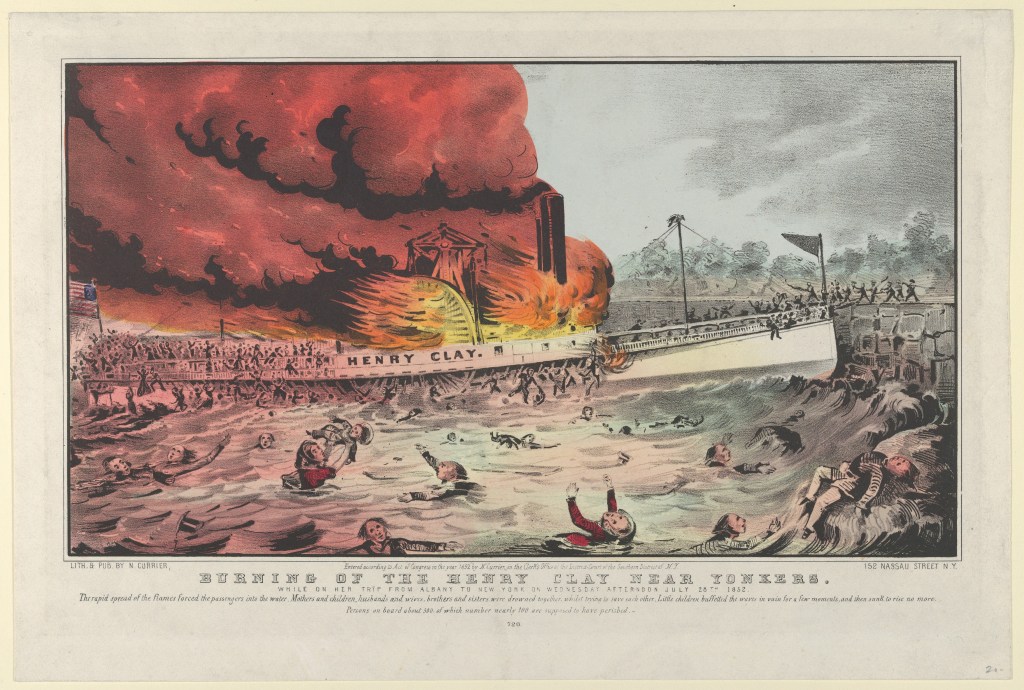
Nathaniel Currier (American, Roxbury, Massachusetts 1813–1888 New York)
Burning of the Henry Clay Near Yonkers–While on Her Trip From Albany to New York on Wednesday Afternoon July 28th, 1852.–The rapid spread of the flames forced the passengers into the water. Mothers and children, husbands and wives, brothers and sisters were drowned together, whilst trying to save each other. Little children buffetted the waves in vain for a few moments, and then sunk to rise no more. Persons on board about 500 of which number nearly 100 are supposed to have perished., 1852
American,
Hand-colored lithograph; Image: 7 9/16 × 13 1/2 in. (19.2 × 34.3 cm) Sheet: 10 1/16 × 14 15/16 in. (25.5 × 38 cm)
The Metropolitan Museum of Art, New York, Bequest of Adele S. Colgate, 1962 (63.550.101)
http://www.metmuseum.org/Collections/search-the-collections/662253 (Public domain.)

“One of the most touching incidents illustrative of the sanctifying power of God’s grace and the Christian fortitude of a pious woman, I may here relate as a tribute to the memory of a much- loved relative and an estimable member of the State Street and Congress Street societies, Miss Elizabeth Hillman, familiarly called Aunt Betsey Hillman, who was well-known to all its people as an earnest Christian and a zealous worker in the Lord’s vineyard. During revivals she frequently gave evidence of her joyous exaltation of soul with loud shouts of praise and hallelujahs. On

Tuesday evening, July 27, 1852, while present at a prayer-meeting held at the residence of Noah Clapp, a member of the State Street Church, she led in prayer. One of the special favors which she solicited of the Great Ruler and Disposer of events was that when her work was done on earth she might be called quickly to heaven, for she dreaded the pains of a prolonged illness.

On the following morning she took passage on the boat Henry Gay (sic), plying between Albany and New York. On the way the boat began racing with another steamboat, the Armenia, on the opposition line. The excited passengers became greatly alarmed for their safety. A young woman from Albany was much frightened and Miss Hillman, in her endeavors to calm her apprehensions, spoke to her about the salvation of her soul. Discovering that she had not yet accepted Christ as her Saviour, and was wholly unprepared to die, Aunt Betsy urged her to give her heart to God. This she promised to do, if she should be permitted to get off the boat alive. Shortly afterward the boat was discovered to be on fire, and was steered toward the shore. In attempting to save their lives about fifty of the passengers were burned or drowned. The young woman and Miss Hillman, in seeking a way of escape, were compelled to decide which one of the two should perish on board the burning boat. Aunt Betsy at once urged her dismayed and sorely-distressed companion to leave her, saying: “I am prepared to die, and you are not.” The young woman fortunately escaped and afterward obtained that peace of soul, of which she

delighted to speak when tearfully telling of the noble unselfishness of the Christian woman who went to Heaven in a bright mantle of flame. Her age was fifty -seven(sic.)” (Methodism in Troy, Joseph Hillman, 1888, pp79-80. She was actually 67. )

Joseph, the author of the seminal work on the history of our congregation, was the nephew of the woman in the story. He writes that the The Hillman* family, Isaac and his second wife, Nancy Hillman joined the church in 1827, as the second church structure, the “brick church,” was being built. Isaac had come under the influence of the renowned Methodist preacher, Lorenzo Dow, when the family still lived in Vermont, and became a fully confessing member of the Methodist Church in 1809, at the age of 12. In reality, as a family of German Palentines finding refuge in Ireland, his whole community was already allied with the Methodists before many migrated to America, many settling in the area of the New York-Vermont border. While Isaac and his wife immediately appear in the official membership records of the church, the first time Elizabeth HIllman is mentioned, in the surviving records, is in 1835, though she may have joined earlier. City Directories show that this extended family lived in adjoining lots on Congress Street, with Elizabeth and their brother David first appearing in the Troy City Directory in the 1837-8 edition, which says that she is “boarding” at 190 Congress Street Extended, with the rest of the family, including David. Another brother, John Hillman, a physician, appears in the Troy listing for only one edition.  

In Ireland, the family had kept their German name of Bergmann, but used various versions of the last name until the contingent who moved to Troy translated it, quite literally, into English as Hill-man. Elizabeth was born on July 1st, 1784, the fourth of 8 children born to John (see below for versions of his last name) and Mary –  also recorded as Maritia and Calreana – Miller. A book tracing the family line of her brother Isaac down to current survivors (“A Few More Left: The Story of Isaac Hillman” by Henry Z. Jones ,Jr.)  reveals that there was something of a scandalous break up between her parents, with her mother being disowned by her husband at least twice, and even by her own father who, at his death, divided her one-sixth share of his wealth between John and Mary’s 8 children, leaving none to his errant daughter. 

Her childhood went through other troubled times. In 1785, the parents and their four oldest children – including Elizabeth –  were asked to “depart the town immediately” (Bennington, VT Official records) and again in 1808 when the family were “warned out” of Shaftsbury – something that happened when a family was in danger of becoming a financial burden on a community. At the age of  24, you would expect Elizabeth to no longer be living with them, most typically already married, but a notification in the Vermont Gazette, in 1791, could explain why she might be needed with her father: her mother had left the family home. She later returned for a while, during which time their youngest child, Isaac, was born, but left again in 1799. It is tempting to play amateur psychologist on the subject of why Elizabeth never married!  Did Mary Miller reconcile with her children after their father had died? Enough, at least they buried her in the Mount Ida Cemetery inTroy, but I could find no evidence that she was living with any of them before that. 

As for Elizabeth, “Aunt Betsey”, what we do know is that she was baptized as Elisabetha Barrackman, later Hillman,  and is recorded in the Gilead Lutheran Church books of Center Brunswick, NY. which is intriguing, but there is family history linking the family to that area, including her mother’s family being in Brunswick. At the time of her birth, the family was living in Shaftsbury, VT and attending the Fourth Church, which later became the Shaftsbury Baptist congregation. Baptism In Center Brunswick would suggest this did not happen when she was a baby. Other siblings spent time with Isaac at various points of his life, in Middleburgh and then Lansingburgh, which is when Elizabeth reappears in records in1824. This was where Jerusha Sweet Hillman, Isaac’s first wife died, shortly after their second child was born – did she move in to help care for the children until he remarried? Either way Elizabeth was then to remain close to Isaac for the rest of her life.

During her life, Elizabeth conducted various property transactions, and at her death still owned a house in Lansingburgh, as well as being the owner of land on Congress Street, though she had previously sold some of the lots. There is no mention of any work she was undertaking in the city directories, but may have helped Isaac in his on-site business endeavors. She seems to have been left with sufficient money by earlier family members – her maternal grandfather is the one we know about –  in order to buy land. It was enough for her to be generous, too: Elizabeth is listed as one of three major benefactors of the Congress St, later Trinity, Methodist Episcopal Church on 13th Street. The cost of building the church was $6,199.84 , but half the cost was donated by just three people: Elizabeth, Isaac and Alvin Williams. It faced the entrance to Prospect Park, and burned after the congregation had merged with the State Street church in 1965. (I have an essay about the church on this site.) 

It is easy to presume she was a dour, unmarried, and hyper-religious presence, but her appellation of “Aunt Betsey” by church members and the fondness felt by her nieces and nephews belie that idea. Joseph Hillman calls her a “much loved relative.” She was certainly fiscally astute, especially in comparison to Isaac, who was far more prone to taking risks, making and losing and remaking his fortune on several occasions, though he was not to blame for them all! 

Elizabeth’s life is a reminder of the danger** of the only feasible way for people in Troy and environs to travel to New York City, which they did, in surprisingly large numbers: by boat. It was a cut-throat business. Numerous companies rushed from port to port trying to get ahead of a rival boat to get all the passengers.  Elizabeth’s final voyage, indeed, was not the only time she was involved with a ferry boat disaster on the Hudson.

A report in The Daily Whig newspaper in April, 1845, has Elizabeth Hillman of Troy, who was rescued from the The Swallow when a sudden snow squall caused the boat to strike a  rock near Athens, NY, and within 5 minutes the boat was at the bottom of the river. A long list of passengers were rescued, but a few drowned, including Elizabeth Spencer, a “young convert” according to Joseph Hillman, who had only 8 days earlier united with the State Street congregation. (Methodism inTroy, p.63) Was she traveling with Elizabeth? We do not know, but  how could that event not have influenced Elizabeth’s decision the next time she faces tragedy on the Hudson?

The New Yorker magazine in 1938 published a dramatic description of the fatal trip which claimed Elizabeth’s life (see link below.) The burning of the Henry Clay was the catalyst for a state law finally banning the racing of commercial ferry boats down the Hudson. It was too late for 50-80 souls (reports vary) including Elizabeth, though her brother Jacob, who was also traveling, did survive, and brought her body back to Troy.

Her death was officially given as drowning, although the telling of the story by her nephew makes it sound like she burned. A photo of her body in Jones’ book, taken after her recovery from the water, shows some dark marks, like soot, but is basically intact: she must have jumped or fallen from the boat, as others did, and drowned.

After her funeral, held at the Congress St Methodist Episcopal Church, Elizabeth was buried in the Mount Ida Cemetery, where her mother, brother David, and sister-in- law, Nancy, had all been buried before her. The memorial on her gravestone is quoted in the 1923 book, “Inscriptions of Graves from Mt. Ida Cemetery, Pawling Ave, Troy N.Y.” recorded by the Daughters of the American Revolution: “Elizabeth Hillman, one of the sufferers by the burning of the Steamboat Henry Clay, on the passage from Albany, N.Y. July 28, 1852. Aged 67 years.” 
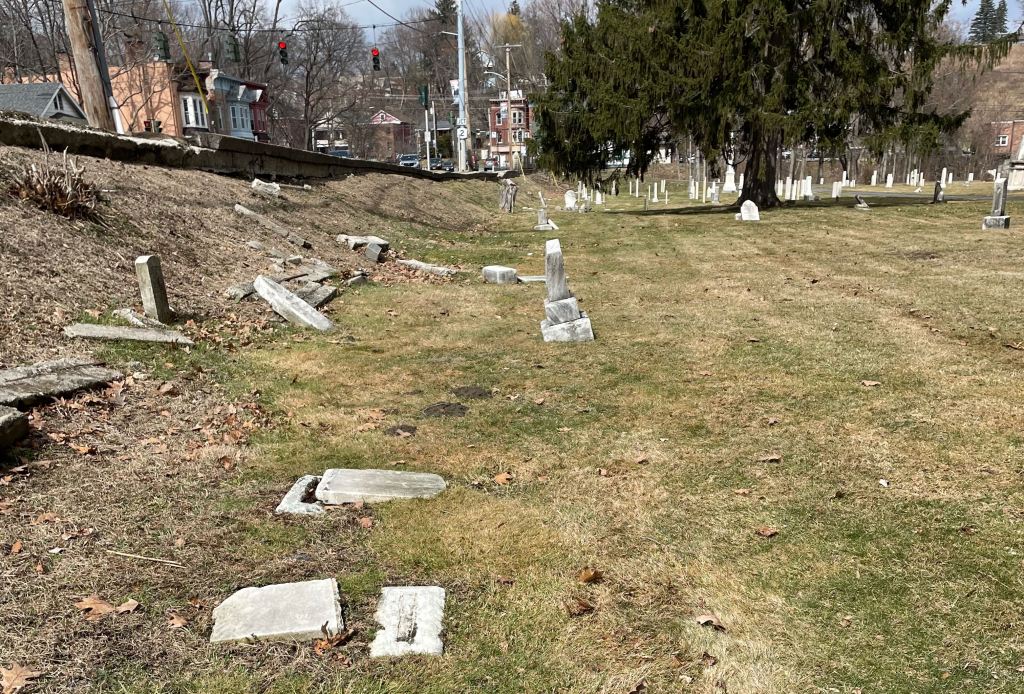
With no photos on the Find-a-Grave site of these four Hillman graves, I presumed the sites had been lost, and an hour’s walk around the site on a recent cold, wintery day, proved what a small percentage of the hundreds of graves are visible. Many stones have fallen, even in the past one hundred years since the DAR, with difficulty, recorded the inscriptions. Stones are broken, fallen on their face, have been completely covered by grass, have fallen down the hill and onto the walk beside the Poestenkill or become victim to subsidence at the edge of the road. Those that stand are frequently so worn by wind and rain as to be illegible. Volunteers continue to work on the site to restore and preserve the stones of hundreds of early residents of Troy, including many from the State Street congregation. So, it remains with us to remember this courageous and faithful woman, who, with her family, became such an important part of the State Street, and Congress Street, congregations. In the third quarter of the 19th century, Troy was an overwhelmingly Methodist city – hard to imagine, I know! – and Elizabeth and her family surely played a large part in that, through their financial support, but also through their dedicated demonstration of a faithful Methodist way of living. 

Janet Douglass, Troy, NY, March 2026.

*Her father’s last name and some of the older children’s, was variously recorded as  Birkman, Barckman(n), Barkman(n), Barkemann, Barrackmann, Barrickman, and Banackman but Isaac and the family, including Elizabeth, her brothers David and Jacob, and mother Mary, seem to have chosen the literal translation from the German – Hillman – at the time they move to Lansingburgh and Troy. 

**In a sad postscript, this was not the last family tragedy caused by a racing steamboat. Her nephew, Isaac’s son born to his third wife after they moved to California, died when a racing ferry boat caused numerous passengers to be drowned, and nearly cost the boy’s mother life, too. Indeed Isaac himself had earlier been at risk of dying in a weather-related disaster at sea.. Isaac Hillman is such an interesting character he easily deserves an essay of his own: stay tuned!

An online copy of the DAR record of inscriptions at Mt. Ida Cemetery, Troy, NY.

Dramatic description of the race and the ship’s burning, when 50-80 of the 500 passengers died, the boat finally crashing near Yonkers. 

https://www.newyorker.com/magazine/1938/07/23/the-fatal-hudson-river-steamboat-race

Also see the Wikipedia page for the boat and the disaster (Henry Clay 1851 steamboat)

The Swallow ferry boat disaster is described here:

The quoted biography of Isaac Hillman and his descendants is:

“A Few More Left: The Story of Isaac Hillman” by Henry Z. Jones ,Jr pub. Penobscot Press, 2005.

The County land records office in Troy, is the source for land transactions deeds for the family.  The Central Library’s Troy Room holds all City Directories, since they began in 1829. 
A curious link between Troy, NY State Street Methodists & the Birth of the Salvation Army

Stories from the lives of members of the State Street Methodist Episcopal Church

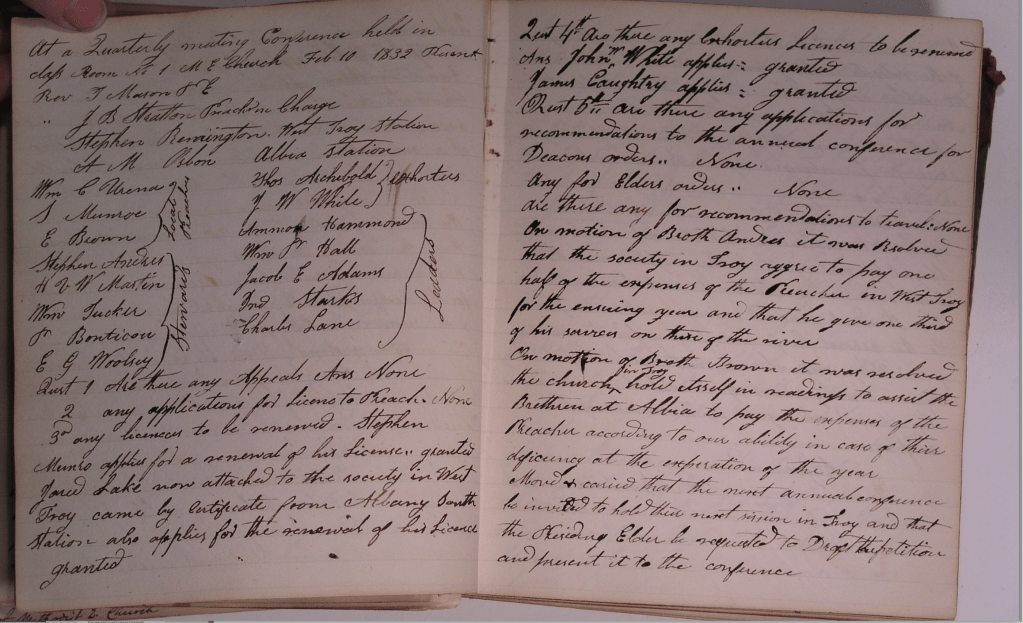
Minutes of the Quarterly Meeting of the State Street ME Church, Troy, NY February 10th, 1832, showing the approval of our subject as an exhorter (top right.)

What name links the State Street Methodists to the very beginnings of the Salvation Army? We should start with a little background: you may have heard that the Salvation Army was founded by William Booth in England, but did you know that before that Booth was a Methodist preacher? Indeed, at one point of his career Booth was preaching in the very same Gateshead Methodist pulpits as your author, as that is where I was living and preaching before moving to Troy…but I am not, of course, the link in question! The link I am writing about goes back to the mid 1800’s, and concerns a preacher, forgotten by most people, but about whom much has been written because of his preaching successes on both sides of the Atlantic. And it’s a story which begins with Troy’s State Street Methodists.

James Caughey’s name is no longer familiar to us, but in his day, his preaching and books were frequently mentioned in pulpits and newspapers, in America, Canada and in Britain, where he was popular with the masses – while being frequently unpopular with the developing hierarchy of the church. He was an old-fashioned revivalist, calling the people to repentance and a new way of life. The Southern Christian Advocate newspaper on Friday, July 23rd, 1852, called him “one of the remarkable men of our time. We suppose him to be the greatest revivalist now in Christendom.” and the Philadelphia Enquirer of April 4th, 1857, wrote: “This distinguished divine has been preaching at the Salem M.E. Church (…) with the most astonishing success.” But as the church moved away from noisy camp meetings and rallies, and moved toward a style more suited to middle class adherents, his methods began to sit uneasily with the leadership, first in England, and later in America, and his achievements were mostly forgotten.

James Caughey was born on April 9, 1810, in northern Ireland. His parents were Scottish, and he was raised, not surprisingly, in the Presbyterian Church. While he was still a boy, the family moved to Troy. There had been a steady flow of Irish protestants to New York for two decades already, attracted by the explosion of industrial jobs to be found. By the time he was 15, Caughey was employed in a local flour mill, where he apparently came into contact with some of the early Methodists of the city. At this point State Street was the only Methodist society in Troy, and was in the process of building its second and larger brick sanctuary, at the front of the lot now occupied by the garden. There is no record which mill he worked in, but there were two families in the congregation with a long history in milling, and the existence of workplace Methodist practice is known to us from the history of Levings Chapel in South Troy, which was set up soon after this time, when a group of workers at the nail factory began to meet in a Methodist class, either before or after their shift. So he may have been encouraged to visit State Street M.E. by his co-workers or management.

For someone who left us so many of his words, Caughey was quite reluctant to offer details of this time in his life, and city directories, which only began in 1829, do not mention where the family was living. However, on several occasions in England, he mentions that he was associated with the Methodists for 3 or 4 years before he received a call to preach. Several biographies explain that change as coming from a revival in 1830 when he was still just 19 years old. The early members of State Street were very fond of holding regular revival meetings led by invited fiery preachers, at which they would record dozens of people joining the congregation at each event, as well as encouraging others to be more fully part of their baptist or presbyterian churches. In various sermons he spoke of attending many meetings and seeking assurance of his place in the family of God. At a camp meeting outside the city, he saw people who had that assurance and decided he would not rest until he found it. Caughey received what he had been craving – a sense of peace and that he was forgiven and at peace with God. It came with a duty to tell others:

“The doctrine of entire sanctification I did not understand ; … I sought the blessing earnestly by day and by night. I fasted, prayed, . and wept, and often entered into an agony of soul for the blessing. Months passed away without any other benefit than an increased spirituality of mind, accompanied by great tenderness of conscience. Sitting one day in a private room alone, reading Mr. Wesley’s Plain Account of Christian Perfection, a heavenly calm, with a consciousness of entire purity, over-spread my heart, and a light like day-dawn beamed upon my placid soul. I exclaimed, in sweet amaze, ” Why,-if this be Christian perfection, which Mr. Wesley describes, — if this be the true Scriptural view, — then I have it ; I do enjoy this very thing. The blood of Jesus Christ has cleansed me !

I held the blessing for some weeks with a trembling hand, and confessed with a faltering tongue, in the assembly of the saints, what God had wrought in my soul. The more frequently I spoke of this great blessing, confessing it, and urging others to press after it, the clearer my evidence became.” from Helps to Life of Faith, p.175

From that point on we can assume Caughey began to take his faith journey more seriously, seriously enough to request the position of exhorter at State Street M.E. Church in Troy. The image above shows his application being accepted. Becoming an exhorter in your home society was the first step in the direction of becoming a local preacher, and then an ordained minister. Exhorters operated only in their own congregation, and encouraged and led people in worship and prayer, between the visits of the traveling ordained clergy. Referring to old Conference records, Caughey’s biographers then record that he was sent by the congregation with a recommendation he receive Deacon’s orders in 1834, and that two years after that he was ordained as a Methodist elder (pastor) and sent to serve at Whitehall, NY . He was then 26 years old, but already in the intervening year, he had accomplished his first evangelical preaching tour in Canada.

On July 9th, 1839, at Whitehall, when he was struggling with the idea of whether it was time to settle down and get married, he had a vivid experience of being called to return to Canada, where he would then receive the financial means to travel to Ireland and England. Instead of choosing marriage and a settled life, he asked permission of the Conference to follow where he felt the Holy Spirit was sending him. He spent March – July 1841 in Montreal, and then sailed for England. His great success in the period between 1841 and 1847 led to him becoming known as the “King of Revivalist Preachers.” The Rhemalogy site quotes Caughey saying that he saw “20,000 profess faith in Christ and 10,000 profess sanctification,” adding that these were conservative numbers, created by carefully adding the names of those who professed faith, meeting after meeting, year after year.

Daniel Wise, who edited and editorialized some of Caughey’s letters and journals in the 19th century, presented the young preacher as a self-educated yet voracious reader but that his early career gave no indication of the huge impact he would later have in England. His Wikipedia page states that later in life “Caughey had an imposing figure and face, a forceful personality, a quick wit and great eloquence.” William Booth’s biographer, Harold Begbie said of Caughey: “He was a tall, thin, smooth-shaven, cadaverous person with dark hair. One who often saw him and well remembers him tells me that he wore a voluminous black cloak folded about him in a Byronic manner; his voice was subdued, he gave no sign of an excitable disposition, his preaching warmed slowly into heat and passion which communicated themselves with magnetic instantaneousness to his audiences.”

His presence in Britain caused enough controversy that after a few years, the leadership there encouraged him to return to the States. His preaching style had brought to a head a discussion between two factions within the British Methodist Church, and many of the leadership belonged to the group which was beginning to become less sensational, dramatic and outwardly “enthusiastic” in style – the complaint the established church had always leveled at John Wesley and his followers – and wanted the church to become more acceptable to the growing middle class. This would shortly begin to affect Methodism in America too. My co-researcher, Alice Rose, and i have both begun to suspect that a rift was growing among Troy’s Methodists by the second half of the 19th century, as the State Street church adopted a system of paid pew rentals, became less interested in revival meetings, and less invested in it evangelical endeavors – and even started using musical instruments in worship! (That is a story for another day.) Those who were unhappy with the direction moved into some of the other congregations State Street had birthed and continued earlier ways at least for a while longer.

So, after 6 years In England and a little time in Ireland, Caughey left Britain in 1847, and he returned to Burlington, Vt. making preaching tours in Canada annually for a time, as well as three more trips across the Atlantic and as an invited preacher up and down the East coast of America, from his base in Burlington, VT.

And the link with the Salvation Army? William Booth attributed his becoming a Methodist, and subsequently a Methodist minister, to the preaching of James Caughey. Booth was just 15 years old when he first heard Caughey. The Wikipedia page for William Booth says: “William styled his preaching after the revivalist American James Caughey, who had made frequent visits to England and preached at Broad Street Chapel, Nottingham, where Booth was a member.”

In his 1920 Life of William Booth, Harold Begbie writes about Caughey’s influence and includes a new paper article describing what it was like to attend one of Caughey’s meetings. The full text is available online (link below) but it begins: “But the greatest influence upon William Booth was exercised, beyond all question, by the American evangelist James Caughey, a minister of the Methodist Episcopal Church. This man attracted enormous crowds to Wesley Chapel, and brought about an undoubted revival of religion in the town.

Eventually, as the tension between the old-time revivalist preachers and the leadership grew, Booth left Methodism and formed his own organization based on the principles and understanding, and even the language, he had first heard from his mentor, James Caughey: the Salvation Army was born.

As for Caughey, ill-health had forced his retirement to Highland Park, NJ, where he became Pastor Emeritus of Highland Methodist Episcopal Church. In 1886, when William Booth visited America on a preaching tour, he came to visit and thank the man he saw as his mentor.

Caughey died at age 80 on 30th January 1891, and is buried in the Elmwood Cemetery in North Brunswick, NJ.

Caughey may not be celebrated in Methodism today, on either side of the Atlantic, but there are traditions who regard him as foundational to their understanding of the work of the Holy Spirit to this day. Among some Evangelical and Pentecostal traditions, Caughey is seen as an early proponent of what they now would call the baptism of, or rebirth in, the Holy Spirit. His influence is celebrated on various websites, and I have named some of those below

Caughey, however, proclaimed himself a traditional Methodist to the end, and disliked any link to schism, believing he was loyal to the words and ethos of its founder, John Wesley. He just saw himself as an old-time preacher in the mold of Wesley. We still have many of his sermons, as his revival meetings always had someone to record his words. He called people to convert to a new way of life, a new focus. He spoke to the workers who were starting to bring great wealth to those in charge, but he encouraged owners and workers to do the right thing. He told them no matter what the rigors of their daily life, God valued them, loved them and always had, and wanted to forgive them and prepare them for a new start. And because he was an old time Wesleyan preacher, he preached on sanctification. John Wesley would have been so proud – as he frequently complained in his final months, that although his preachers did really well talking about prevenient grace, and redeeming grace, they were neglecting the very Methodist notion of sanctifying grace. Caughey really made sanctifying grace, as Wesley first described it, the cornerstone of his work. For, when he was “reading Mr. Wesley’s Plain Account of Christian Perfection, a heavenly calm, with a consciousness of entire purity, over-spread my heart, and a light like day-dawn beamed upon my placid soul. I exclaimed, in sweet amaze, ” Why,-if this be Christian perfection, which Mr. Wesley describes, then I have it.”

And he wanted everyone else to experience it, too.

Janet Douglass, Troy NY. November 2025

And as a final curiosity of a personal nature to me… it was not only William Booth who graced those pulpits I also preached in… James Caughey also spoke in the Methodists chapels of Gateshead, and the style of worship of at least one would still seem familiar to the man who set their hearts on fire long ago! Small world….(JD)

Want to know more?
Search for “King of Revival Preachers” on the Rhemalogy website
Search for “Revival Heroes James Caughey” on the Revival Library site
Beautiful Feet, a website about revivalism in America: https://romans1015.com/tag/rev-james-caughey/page/8/
This description of Caughey includes part of Begbie’s description of what it was like to attend one of his revival meetings: https://ukwells.org/revivalists/james-caughey
Full description of a Caughey revival meeting: Harold Begbie Life of Booth vol 1 p. 9ff (1920.) https://archive.org/details/lifegeneralwill04begbgoog/page/n30/mode/2up
On the changes happening in Methodism during Caughey’s time in England: https://oxford-institute.org/wp-content/uploads/2018/11/2018-05-pedlar.pdf
Wikipedia page for William Booth: https://en.wikipedia.org/wiki/William_Booth
Wikipedia page for James Caughey: https://en.wikipedia.org/wiki/James_Caughey

There are numerous books based on Caughey’s sermons and journals, available free of charge on the internet. Many come in the form of questions and answers and the style conversational. All of the titles below are available free of charge on the internet, in the Google Book Archive or various educational libraries. Search for one by name and add Caughey, they come up easily. They include:
Glimpses of Life in Soul Saving:
Helps to a Life of Holiness and Usefulness, or Revival Miscellanies:
Revival Miscellanies: 11 Revival Sermons of James Caughey
Earnest Christianity
Showers of blessing from clouds of mercy: selected from the journal and other writings of the Rev. James Caughey 

A Congregation where Innovation Runs Deep

Logo for Soul Cafe 1999-2005

In 1999, the pastoral team of Christ Church, United Methodist, Troy, NY, was led by the Rev. James Fenimore, whose first degree had been in Computer Science. Jim arrived at the church, not quite 30 years old, and aware of the possibilities of the new digital world for a downtown city congregation in a city with one of the leading technological institutes of higher education in the country. 

Christ Church became the first local congregation with a church website; the first Troy congregation to record services to CD and copy them for home distribution, then the first to offer DVDs and more…but I am getting ahead of my story.

In 1999, the website was up and running, CDs were, indeed, being produced, but Jim had had an idea based on his reading and conversations with other pastors he met at Drew Theology School, his alma mater…maybe what the church, what the city needed, was a different kind of church event: an evening “service” that did not seem like a church service at all. This would be nothing like a regular service: a dimmed coffeehouse setting, with good coffee and tea & snacks, free of course, live local musicians who could stop by on their way to the local busy bar music scene – paid a decent fee – and a big screen so we could show videos. The local “conference” of Methodist churches had just made it possible to buy into a licensing scheme to screen clips of current movies. Jim set about explaining the idea and winning the budget approval for the expense, which we thought would be near-impossible, but was, in fact, quickly approved, faster than we had dared hope.

We began to plan – and I have to say, there was real excitement about the idea. The upstairs fellowship hall would get round cafe style tables and candles, and a large back-projection screen would be placed on the stage, the projector hanging behind it out of view. Microphones for the musicians would be placed on the main floor of the room at the front, along with a couple of stools for the pastors, and the event run via a computer and sound system at the back of the room. The round tables were placed between those two areas. 

The “service” would have no hymns, no prayers, no spoken appeal for donations. It would begin with a brief introduction to a theme – a guiding metaphor – for the evening, followed by the musicians, at times a Christian rock band or singer, but mostly any local talent who wanted to perform, whether a college a capella group, a blues guitarist or band, a classical musician or even an opera singer. The music would last 20-25 minutes of a 40 – 45 minute gathering. “Soul Cafe” was meant to gather those for whom sitting face forward and being told what to say, sing, think and do, just did not work. The title came – with permission! – from one of Jim’s professors: Leonard Sweet had a magazine for preachers of that name, and it was so perfect for us, we asked to use it.

And the main event of Soul Cafe was always the movie clip. 

We would find a film sequence, often from a movie that was recently released, often days before so people had not had time to see it; where a more usual service would take a Bible passage and relate it to the world, Soul Cafe clips were picked to ask a question of the church. They represented a comment from the society about the society. So what did that society, have to tell us? The reflections would be no more than 5-6 minutes as the “service” ended, and the gathered group were always left with a question posed by the movie.

Well, I think the congregation, not just the leadership, felt we were being pretty “out there” to do this…

As the planning for “Soul Cafe”began,  the church was also starting to use Ebay as a way to sell donated items which had value, though not maybe to those visiting our fundraising events. The leadership team, also being interested in the history of the congregation, would also check Ebay in case State Street Methodist Episcopal items were for sale. Never the best at keeping records, we had found very few historical things in closets, though they included a blueprint from the early 1920’s lining a drawer. Interestingly, it showed that someone at that time was an innovative thinker: one of the plans even showed a ten pin bowling alley being constructed right under the aisles of the sanctuary!

It was a quick glance at Ebay while I was away in the UK that turned up some 80 year-old  bulletins of the church. I emailed the Senior Pastor, he put in a bid, and by the time I returned to Troy, the bulletins were waiting for me.

Imagine our surprise – and delight – to see maybe we were not as innovative as we thought! 

80 years before, in the days of silent movies, the Church had had movies at the evening service, an innovation of the Rev. Mark Kelley DD – probably the man who had the idea of the bowling alley under the church. 

We have only a few bulletins from 1921 and 1922, and many movie titles suggest they came from a religious source: a movie meant to inform about missionary work, or a Sunday School illustration (weren’t they on top of the latest developments!), but some of them seemed to be more about places in the world. I have traced a couple to an archive of educational films: Sights of Suva, Fiji* shown on Feb 19 1922; and Apple Blossom Time in Normandy** shown on May 8 1921.

As yet, I have not found any viewable copies, but wouldn’t it be fun to reenact one of those evening services, complete with their silent movie reel?

In 2005, the very week that the then largest, 50 inch, LED monitors came to market, the church installed two at the front of the sanctuary, along with 2 smaller ones further back, remotely operated digital cameras, a first-rate computer control booth and the latest recording and sound equipment. And so it was that the ability to screen movie clips came to morning worship and Soul Cafe ceased. The expense was considerable, and would have been unimaginable without what had happened in Soul Cafe, but it represented an openness of the congregation to embrace the new. With the new equipment, the congregation could now record CDs of worship, or weddings, or concerts, showing different angles and views. The Senior Pastor, Jim, was working on his Ph.D. on the impact of the digital revolution on church services around the country; the congregation was involved in planning, participating and running our media-rich and metaphor-based worship services. Another new era had begun – but  we now knew we were in a congregation which had valued the spirit of innovation and experimentation for a lot longer than we could have expected, when we started on our digital journey.

Janet Douglass, Troy, NY, March 2025.

Motion Pictures for Instruction 1926 by A.P.Hollis M.S. pub. The Century Co. New York 1926. Available as a Google book at: https://docs.google.com/document/d/1V3gCdNeICZOQdWuz5fckOWVWTcbxrEkaPDjaxNDqMLg/edit?tab=t.0

*reel 2 of 5 :  Fiji Islands by Burton Holmes Lectures,  Chicago; a rental film listed in Hollis p.348

** listed by Hollis, in the Blue-Ribbon List of Films for Cities p.213

The Rev. Dr. James Fenimore’s Ph.D. was awarded by RPI in Troy, and his dissertation “High-Tech worship: Media Technologies and Christian Liturgical Practice” is available on his website: www.JamesFenimore.com. His DMin. thesis: “How a Congregation’s Identity is Affected by the Introduction of Technology-Based Worship”  is also available on his website. He has 2 other theses available: “A church on the Edge of an Apocalypse,” a take on the history of Christ Church, is available online at: https://christchurchtroy.org/wp-content/uploads/2021/06/earlyhistory.pdf. Jim first featured the congregation – before he was appointed as the Pastor – in his thesis From meeting house to house of God : the Gothic revival in the American Methodist tradition of Troy Annual Conference (1870-1879), which is available from Drew University.

Jim’s academic work on digital worship included the benefits and pitfalls of using other people’s images as visual representations. The significance can be easily grasped if you have ever seen a so-called Bible-based commercial film, where white skinned, blonde-haired, blue-eyed males prevail scene after scene  (except maybe for Judas Iscariot…did you notice that?!) Movies can be enormously helpful – but graphical imagery can subtly mislead – or open us to the moviemakers’ biases or poor scholarship! Finding clips we wanted to present was always no quick task but could lead to valuable conversations about whose ideas prevail in society, and how to be a critical viewer of the imagery around us. 

The Methodist Episcopal Churches of Troy: State Street/ Fifth Avenue-State Street/Christ Church United Methodist

Part of the series of extended essays on the early Methodist societies of Troy, New York.

The current sanctuary is the third building to house the Methodist congregation on State Street in Troy, NY, but it was a private home on State Street, which was regarded as the site of Troy’s first Methodist gatherings in the earliest days of the community, which would become the City of Troy. Records suggest Methodists first met on State Street in 1793. It is not yet possible to determine whose home that was and the location, but at that time there were few domestic buildings, and they centered on River, First and Second Streets. So, presumably where one of those crossed State there was a home where early Methodists found themselves welcome – which could never be assumed. Early Methodists were met with much opposition.

After its rocky start – Methodism did not have as many adherents as other protestant denominations at this point, and avowed Methodists were subjected, to ridicule, name-calling and outright violence for their beliefs – the congregation became sufficiently large and established, to need its own building. Lingering prejudice about the denomination is witnessed in the difficulty in obtaining the land to build. Jacob D. Vanderheyden, the landowner, had donated land for other denominations, or made the land extremely inexpensive for them to purchase, but he refused to sell land to the Methodists for a long time. It was the intervention of his brother-in-law, Dr. John Loudon, who shared his dream of pigeons “flocking” to the desired site, that is credited for Vanderheyden’s change of heart. Nonetheless, the Methodists paid top dollar for their piece of land.

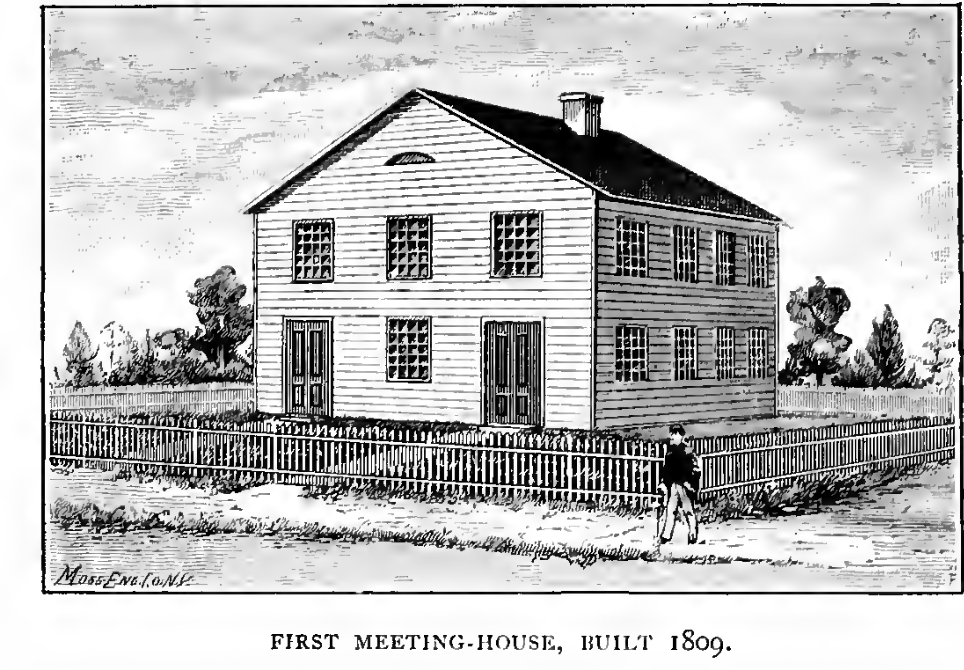
The congregation was incorporated as “The Methodist Episcopal Church of the Village of Troy” on November 29th, 1808, and a few weeks later, on Christmas Day, Vanderheyden conveyed the land to the trustees, having agreed to sell the land for $500, though with a $35 annual interest fee until paid off in full. The piece of land they acquired was the western half of the current site: two narrow lots, which has been designated the previous year as city lots 743 and 744, on the north east corner of State Street and Williams Street (the alley.) The building stood in what is now the small garden area in front of the parish house. It was two stories tall, plain, weatherboarded and painted white. The subscription started to pay for the construction of this modest building, despite having masons and carpenters in the congregation who gave their skills at no cost, still meant that the church was not ready to use for worship until 1811. Hillman reports that one of the largest sums donated came from Phebe, the daughter of Caleb Curtis: $5. He hints that there were very many, but very small donations, from those with less to give. The list of donations in the subscription book closed at $557.82.

The earliest drawing of that first clapperboard building is in A.J. Weise’s ‘Troy’s One Hundred Years” in which the building stands open on all sides. Weise describes the location as being built next to the common land. This was the land, donated by the Vanderheydens, for the annual Pingster or Pinkster Fest. Each Pentecost, both enslaved and free African Americans would gather for their annual celebration on this land, which included plenty of eating, drinking, music, singing and dancing…(See my essay on the African Zion congregation.)

The building was opened, still unfinished, with rough benches having been hurriedly made from planks by the congregation’s carpenters, just in time for the first service. Hillman reports the land around was not inviting and consisted of thick weeds and briars and patches of bare earth. The remains of a small stream passed by the eastern side of the building and when it iced over in winter, the narrow strip made for “good sliding” for the children.

Over time, the hurriedly made rough benches were replaced with slightly better plain pine benches, backed with a narrow board, but still at that time the pulpit was a a plainly-constructed desk on a small platform with several chairs. Tallow candles in tin sconces along the walls of the church lit it when evening meetings took place. By 1817, the church had a fence, which Hillman reported was to be “painted either all red or Spanish brown except the front part which was to be white”, as in the etching above from Hillman’s book. At the same time seats were added to the gallery and were likely the ones removed from the main auditorium. Women and girls sat on the east side, and men and boys took seats on the west side. The pulpit too had been replaced, Hillman reporting that there not being enough space, the children sat on the kneeling-step which surrounded the “altar.” (Hillman,p 46)

Frederick Garrettson – a man of great renown in the history of American Methodism – whose daughter traveled with him and acted as a secretary for his travels passed this on to his biographer:

” From Schenectady they returned to Troy, and put up at the house of the Hon. George Tibbits, whose hospitable mansion is delightfully situated on the side of a sloping hill ascending from the eastern part of the city, denominated Mount Ida. On the Sabbath, Mr. Garrettson preached in the Methodist Church, in this city, morning, afternoon, and evening, to an attentive congregation; and ‘truly’ says he, ‘it was a good day.’

He remarks that when he visited this place about thirty years before (in 1788) , there were only a few scattering of houses, and no Methodist society; but that he now rejoices to find a flourishing little city, in which there were four houses of worship, and not less than three hundred members of the Methodist Episcopal Church. what seemed to add to his religious enjoyment was the catholic and friendly spirit manifested by the several religious denominations toward each other. (Hillman, p 45-6.)


Even so, it was not until 1823 that the congregation secured sufficient money to pay off the debt on that first building. Only 16 years after its opening for worship, the congregation had outgrown their space: a new, larger sanctuary was required. On February 28th, 1827, the building was sold to Thomas Read and Sterling Armstrong for $500, only taking possession on November 1st. The first building had been moved to the corner plot, immediately east of its original location, the common land no longer being used for its intended purpose. So it looks like they shuffled the clapperboard building along, and worshiped there, while the brick chapel was being built. There, it was afterward used as a temporary court house, while the first court house on 2nd Street was being constructed, and then as a grocery store, until the erection of the current stone church in 1867. (Hillman p. 48 and p.52).

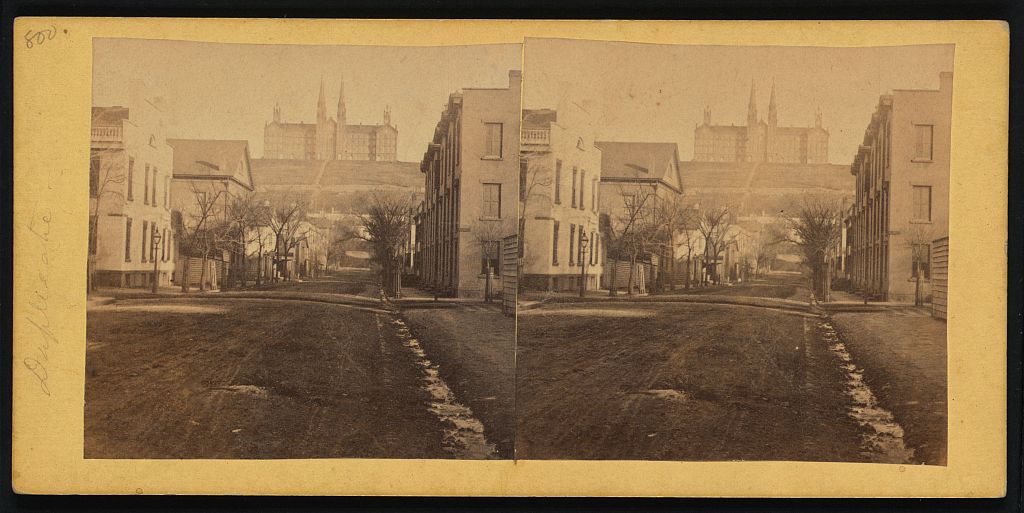
In the 1860 stereograph below, taken from the corner of State and 4th Streets, looking toward Troy University – about which, much more later – the brick sanctuary can be seen and beside it, a little harder to discern, is a much smaller, white wooden clapperboard building… standing there until the site construction of the current limestone sanctuary, which began 7 years after the photo was taken.

Dr. Loudon, his dream of pigeons, his work as one of Troy’s earliest doctors, and his importance to the congregation will all be covered in a later post.

The main historical source for the congregation is Joseph Hillman’s 1888 book “Methodism in Troy.” Other histories of Troy and Rensselaer County, many of which, like Hillman’s book, were published around the 100th year anniversary of the naming of Troy, include similar information. These include several books by A.J.Weise and also Rutherford Haynes and Sylvester Peck. All are available to read at no cost online. The Library of Congress site is a good place to start, but Google books and various university libraries also have digital versions. The stereograph above is from the Library of Congress archive, and is available for free use as part of the Charles F. Himes collection (Library of Congress Control Number 2005687324.)

The Methodist Episcopal Churches of Troy, NY: Trinity M.E. Church, Congress St M.E. Church, the Hemlock Church.

Extended notes on State Street Methodist Episcopal Church (now Christ Church United Methodist) and the buildings and congregations that came from it.

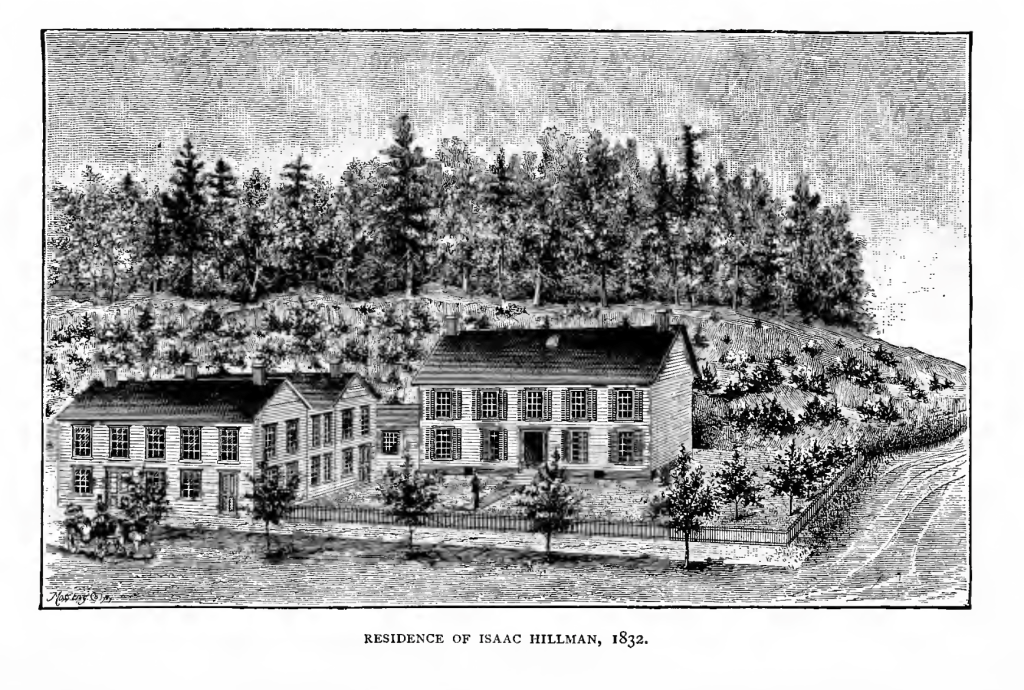
“The circumstances attending the organization of Trinity Church are briefly detailed in the first records of the society. ‘ The Methodist Episcopal Church in Congress Street, Troy, N. Y., was organized in the month of October, 1846’ (…) In June (1847), an old blacksmith- shop, a wooden building, on the south side of Congress Street, at its intersection with Ferry Street, was reconstructed for a house of worship, which was thereafter familiarly called the “Hemlock Church,” Hillman adds, “The organization of the Congress Street Church may be traced to a prayer-meeting first held about the year 1832 (…)  at the house of Isaac Hillman, standing a short distance east of the site of the Hemlock Church on Congress Street.(…)The small building proving inadequate for the uses of the congregation, the society determined to build a larger edifice of brick, and purchased the site of the present church, on the north side of Thirteenth Street, near its intersection with Congress Street.” The building was dedicated in  1849. (Hillman, pp 102-111)

With the Hillman family so invested in this particular congregation, it is not surprising that the main historical source book for these essays (Methodism in Troy by Joseph Hillman, 1888) has a lot to say about it. Indeed, Hillman and his sister donated a lot of money to complete its construction. Despite the family’s involvement, finding the site of the Hemlock/ Congress Street building as well as the Hillman home, has proved tricky.

The full account of the congregation’s beginnings, once again, hints at some disagreements or jealousies that may have been behind the organization of the new society on Congress Street. The prayer meetings, held at the Hillman residence, twice described as bring a short distance east of the site of the Hemlock Church, were held 3 times a week. Hillman reports with a modest pride: “It was afterwards asserted that more souls had been converted at those prayer-meetings than in the State Street Church, while they were held.” (Hillman, p.105) The meetings were sometimes quite long, and began to interfere with the worship times of the State Street Church, at which point there were several attempts to have them stop earlier, all unsuccessful. Hillman adds: “In fact those prayer-meetings were great feeders to the church.” (Hillman, p.107) Perhaps those attempts to control the prayer-meetings is what made this congregation determined to be separate from the State Street church, which finally happened in 1850, taking a core of members of the North Second Street and State Street congregations to the new church. In another hint of disagreements past, when describing the new building, Hillman adds: “The pews in the church were free, and since its erection no rentals for sittings have been imposed or collected.”(Hillman, p.110.) However, Hillman is not so shy about writing about the major theological disagreement, which necessitated the split: a sermon preached in 1847, by the Rev. John Clark, broke from a key Wesleyan tenet, and despite the conference demanding he never preach that way again, the idea took hold among some State Street members. It proved intolerable to some of the stalwarts of the church.

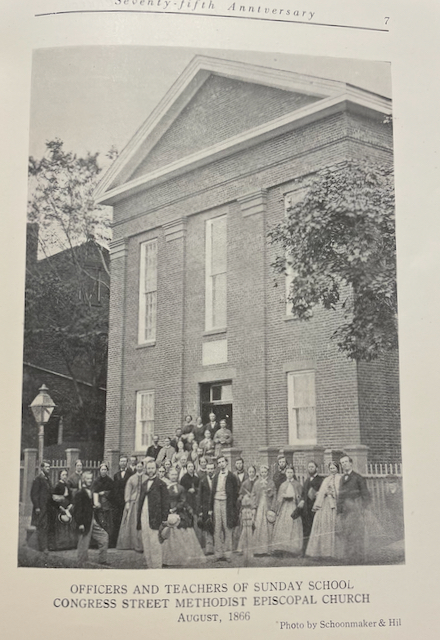
Even this new congregation had an almost immediate split, because in deciding to build a new sanctuary on Thirteenth Street, a faction decided to remain at the Congress Street site and replace the wooden building with a brick one. It was first named the True Wesleyan Methodist Church but the one image this writer located, in the 75th anniversary booklet of Trinity Church, show a brick “Congress Street M.E. Church” in 1866, with the Sunday School class gathered outside – 17 years after Trinity M.E. Church was first opened. By claiming it in the booklet, I can only presume this congregation did return to the Trinity fold not too long after the photograph was taken, unless the original church on 13th Street was very different before it was adapted…still working on that!

Not surprisingly Methodism in Troy includes a number of stories about Hillman family members – stories which deserve their own essay, but which include a treacherous sea journey, in which ship and people were deemed safe only through the prayers of the Troy meeting, to Hillman’s sister giving up her spot on a lifeboat on a burning ship in the Hudson, to save a young servant. The servant survived, Hillman’s sister did not.

The congregation merged with that of State Street-Fifth Ave in 1965, creating Christ Church Methodist Church. A year later, with the denomination’s merger with the United Brethren denomination, the official name became Christ Church, United Methodist, and so it continues to this day.

Arriving in the congregation in the early nineties, the author was told that this merger was seen as one of the most successful of its kind. Nonetheless, members of Trinity Church remained very proud of their association with that society, often referring to themselves as “Trinity members” long after the church had closed. The church was regarded as a good, local, family church with multi-generational friendships between attendees and their families. Its membership was just as dedicated and hard-working, as it had been in 1832, so it is hardly surprising, that although the State Street congregation kept its building, and possibly more important to them its historical site, the leadership quickly incorporated many of the Trinity faithful into influential positions. Even in the 1990’s, many former Trinity members continued in leadership roles.

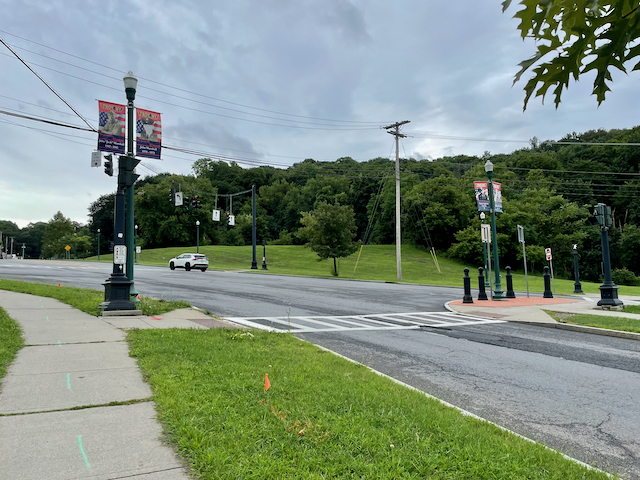
The current junction of Ferry and Congress Streets. Troy NY, with the location of the original junction on the extreme left of the image.

The current junction of Ferry and Congress Streets. Troy NY, with the location of the original junction on the extreme left of the image. The green brick house mentioned, is obscured by trees close and behind the orange road sign, far left.

Finding the exact locations of the 2 earlier buildings, as well as the Hillman home, has proved difficult. The road layout is similar but not exactly the same. Ferry and Congress Streets still merge as they climb the hill going east from the city, but they merge just below Eighth Street now, more than a hundred yards west of the location of Hillman’s day. Numbering has probably been changed, too, as Ferry Street did have its numbers changed – attested by the historical marker for Samuel (“Uncle Sam”) Wilson’s home which is now put as 76 and not the 144 of Sam’s day. In fact reports of the Congress Street M.E. Church being at 22 Congress Street, and Hillman’s home at 188 Congress Street, make them seem not so very close after all: unless one of those refers to the new numbering. The lot numbers on early maps are different again. Some other road layouts in the area have also been changed a little, and, of course, almost all the buildings have been replaced in the area of most interest. Earliest records show Congress Street as a mass of small workshops and stores, many occupied by members of the State Street Church. That the small blacksmith shop was a first location is intriguing, as one of the earliest converts was himself a young blacksmith apprentice on that street: Noah Levings went on to become a well known preacher, teacher and financial secretary of the American Bible Society. It would have been a nice link to the earliest history of Troy Methodists to use that site, but we may not be able to know at this point, if it was the same one – Troy had many small foundries and blacksmiths.

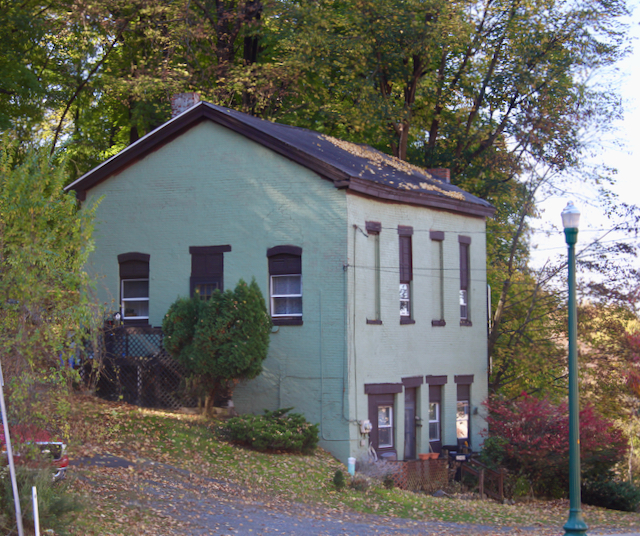
I am going to continue to research this question and will add an update when there are answers – the address of Samuel (“Uncle Sam”) Wilson’s farm, may help, as there has been more research into his history, but he was certainly a near neighbor to the Hillmans at some point. The last reference to the Congress Street, smaller brick church (above), was as it being the location of the Burns & Ryan Undertakers’ business, which may prove useful. It has been suggested it is the one older brick building under the hill at the approximate spot – a green residence with a shape reminiscent of a chapel – but the structure and orientation is not so convincing, when compared with the photo (unless, as commented above, that brick building is the earlier version of the 13th Street church, and the renovations very much more substantial than recorded!) The actual building may have been, like Uncle Sam’s home, pulled down for a road development that never happened, or part of the wider urban renewal project, which almost deprived Troy of so much amazing architecture, but still managed to destroy a lot. Without a mention for over a hundred years, various fates could have befallen the old church.

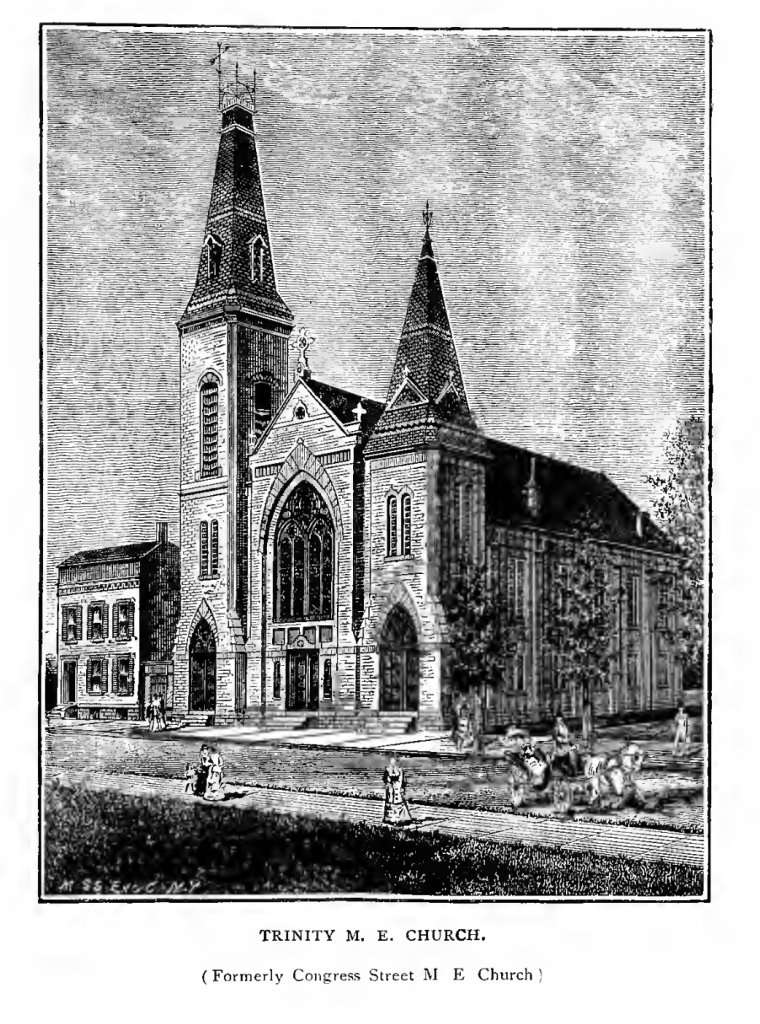
The building pictured at the top of the article shows the church after it was enlarged in 1880. The cornerstone was first laid on 13th Street, just north of its junction with Congress Street, in October 1848. The church was dedicated in 1849, and the following year, the society became an independent congregation with its own minister. It was enlarged, by 200 seats, in 1860, with enlargement to the Sunday School rooms in 1862. Hillman writes: “In 1880, the church was renovated and enlarged and attractively improved in appearance by the addition of corner towers and other architectural features, at a cost of $14,084.94. The building was rededicated December 28, 1880.” (Hillman. pp 110-111.

The structure burned, a decade after the congregation moved out, and was razed. A parking lot partially covers the site, today.

The etchings are from Hillman’s book, Methodism in Troy, 1888, which is available to read free online at various archives, including the Library of Congress. The photograph of the Congress Street Sunday School is from the booklet produced for the 75th Anniversary of Trinity Church, which is owned by Christ Church, United Methodist. A copy can be viewed at Troy Central Library. The photographs are the author’s.

The Methodist Episcopal Churches of Troy, NY: First German Methodist Episcopal Church & St Titus Methodist Mission

Extended notes on State Street Methodist Episcopal Church (now Christ Church United Methodist) and the buildings and congregations that came from it.

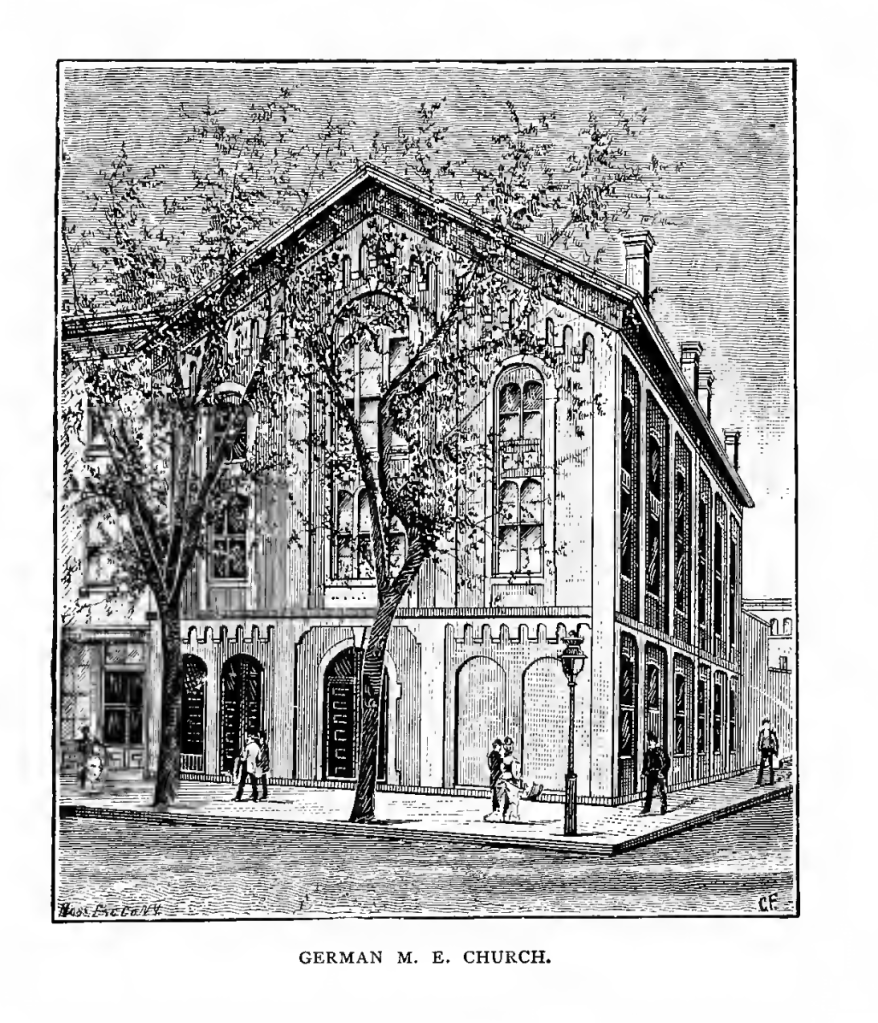
“Although Troy had from a very early date not a few German inhabitants, it was not until 1855 that an effort was made to form a religious society, composed exclusively of German people. At that time it was estimated that there were no less than 2500 Germans in the city. The first German minister, who undertook to form a German society of a religious denomination in Troy, was the Rev. Mr. Swartz, the pastor of the German Methodist Church in Albany, who in 1855 began to conduct religious services in a building on the northwest corner of First and Ferry streets. Some months later, the Rev. F. W. Dinger of the New York Conference continued these services in the True Wesleyan Methodist Episcopal Church, on the south side of Congress Street, at its intersection with Ferry Street. In that building, the First German Methodist Episcopal Church of Troy was organized, on July 25, 1857. The society was incorporated March 31, 1859 (…) Shortly afterward the society purchased two lots on the north-west corner of Union and State streets for $1,500. The buildings on the lots were destroyed in the great fire of May 10, 1862.” (The History of Methodism in Troy, Joseph Hillman, 1888. p. 114-6.)

Interestingly, maps show that was the very point where the fire stopped along State Street, was just half a block from the current Christ Church, making the German Church the last structure lost on that street. The society then rebuilt, on that same lot, creating the church as pictured above, with the front facing State Street. It  was dedicated on March 25, 1863.

This congregation, along with the 5th Avenue/ North-Second Street congregation merged with State Street Methodist Episcopal, in 1925, the three merged societies taking the official title of Fifth Avenue-State Street Methodist Episcopal Church. Many of the leading families of this congregation became leaders in the merged congregation, and their descendants were members until the end of the 20th century.

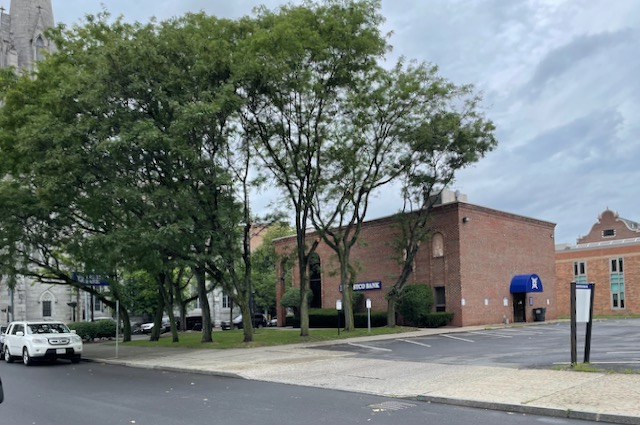
The original meeting house now lies under the car park behind the Central Library. As for the building above, Union Street no longer exists either side of State Street. It was the name for an alley which ran between Fifth and Sixth Avenue (alleys in Troy are named as streets) and this lot is now under the Trustco bank parking lot beside the Court building and Police Station. Maps show the building as one lot wide , but going back the whole two lots, as in the description above.

The spire of Christ Church United Methodist is at the left, the area immediately behind the sign at right is where Union St (alley) was. The black-topped parking lot was the site of the church. Out of site at the right are the municipal buildings and Police Station (corner State and Sixth.)

The spire of Christ Church United Methodist is at the left, the area immediately behind the sign, at right, is where Union St (alley) was. The black-topped parking lot was the site of the church.

The buildings on the east side of Fifth Avenue were removed during the 1960’s as part of an urban renewal program. I suspect this, too, was a victim of urban renewal, as the September 1950 copy “The Spire: Newsletter of Fifth Ave-State St Methodist Church,” lodged at the Troy Central Library, states the Liberty Presbyterian Church was at that time the occupant of the building above. It may have become unstable or in a fire between those two dates – so while that is unclear at time of writing, before that happened it became home to the …

St. Titus Italian Methodist Mission

So little is known of this congregation, that it has not appeared in Christ Church histories until this point. According to the collection of historical materials of Troy Conference, by Samuel Gardiner Ayres, archived at the Hart-Cluett Museum in Troy, St. Titus began as a mission to Italian families in 1913. However, he also states it began at that time in the Third Methodist Episcopal Church, which had been sold 15 years before that to the Ukrainian Orthodox congregation. I suspect this was an error, and the real location is 43 State Street – the German M.E. Church, where they remained after the latter congregation moved out.

The Adirondack Record- ElizabethTown Post newspaper for April 7th, 1932, carries an announcement by the Ausable Forks Methodist Church that: “The Reverend Lucius Martucci of St. Titus Italian Methodist Church, Troy, N.Y.” would give a talk on “The Melting Pot in America” in which he would talk of the pioneering missionary work of his mission among “the Italians of Troy.” The newspaper has another article about how the same church donated money each year to the St. Titus mission, stating it was the “only Church in the Troy Conference area, in which services are conducted in the Italian Language.” it gives the address of the church as 43 State Street, the same address as the building vacated in 1925 by the German Episcopal Church (above.) Interestingly, the author remembers several people named Martucci in the congregation, as well as the Rossi family, whose name is on a brass offering plate in Christ Church, United Methodist, to this today. It may have come along with the families when the congregation merged into State Street, at an unknown date, whether at its demolition, having shared the building with the Liberty Street Presbyterian Church, or before that, leaving the building empty for its new owner. I suspect someone will know…and if so, I will gladly update this mini history.

Line drawings and quotations are from “The History of Methodism in Troy” by Joseph Hillman, 1888, available as a PDF, free of charge, at a number of online archives, including the Library of Congress. Photographs are the author’s.

The Methodist Episcopal Churches of Troy, NY: Third Street Church.

Extended notes on the Methodist congregations associated with the State Street Methodist Episcopal Church (now Christ Church, United Methodist.)

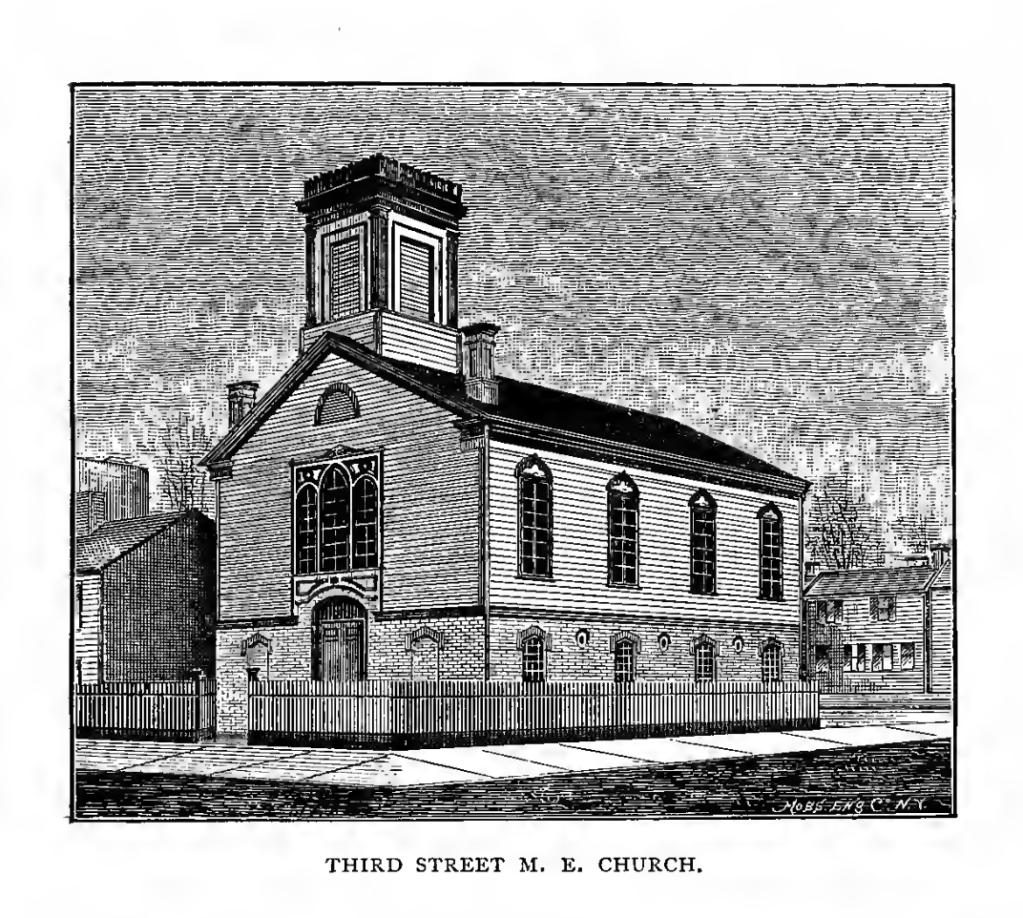
Third Street Methodist Episcopal Church, corner 3rd and Monroe Streets, South Troy.

In March 1844, trustees were elected for a separate congregation named “the Third Street Methodist Episcopal Society of the City of Troy” and a Sunday School was organized. The following year “a lot on the northeast corner of Third and Monroe Streets was purchased by the society to build a church. “  (Hillman, p.96) “The small society which had organized in 1843, began its erection in 1847(…) On Christmas day, that year, the building was dedicated.”  (Hillman p. 66)

“The origin of the Third Street Methodist Episcopal Church can be traced to a statement made by William Barrett, a class-leader of the State Street Church, at the leaders’ meeting held on May 2, 1842 (…) he suggested the suitableness of the house belonging to him in that part of the city for preaching.”  “ In1873, the church was enlarged by the construction of a lower story of brick, on which the wooden structure of the first edifice was placed.” (Hillman, 96-99)

Prayer meetings had been conducted in William Barrett’s house for a while, and when Daniel Hudson, an experienced Sunday School Superintendent, moved “from the northern part of the city,” a class of Methodists was formed. A “class” was the usual Methodist term for a neighborhood group of adults and families with children. The Trustees of the State Street congregation, seeing the success of the class, started to look for a building in earnest, meanwhile paying William Barrett for the use of his house for prayer meetings, preaching and a Sunday School. This saved South Troy participants from trudging the one mile each way to the State Street church, or not quite as far a walk for many – but up a steep hill – to Levings Chapel. 

Like other new congregations, the decision came at a time of dissension that pew rentals were being charged in the State Street building, usually reported by Hillman as temporary fees to pay for new buildings, but always mentioned with hints that the decision was not universally approved.  Certainly the cost to rent a pew could have dissuaded attendance by the workers of South Troy, many of whom worked in the steel mills and foundries of the area. In fact, Hillman tells us this would-be congregation decided not to accept State Street’s appeal for money for their building, but to create its own Board of Trustees and become a separate church. 

In October, 1844, the Sunday School reported having 15 teachers, in addition to two superintendents –  one for males and one for females – and a secretary-librarian, even though Hillman estimates membership of the society being around 35, with 75 students in the Sunday School. The first sermons were preached on the steps of the partially-built church, and the sanctuary was dedicated on Christmas Day, 1847.

After a time as a separate charge, the congregation reunited with State Street and operated under the name of Wesley Chapel. When attendance climbed again, peaking at 151, under the able leadership of its superintendent, Daniel Klock Jr., they once again took a minister and revived their Third Street name. The Sunday School had 288 members in 1888, and the school rooms were enlarged. Sadly, it was not to last. 

The congregation which had struggled, revived, and struggled and thrived for a few years, then struggled again, closing its doors at the end of the19th century, not so long after its best years.

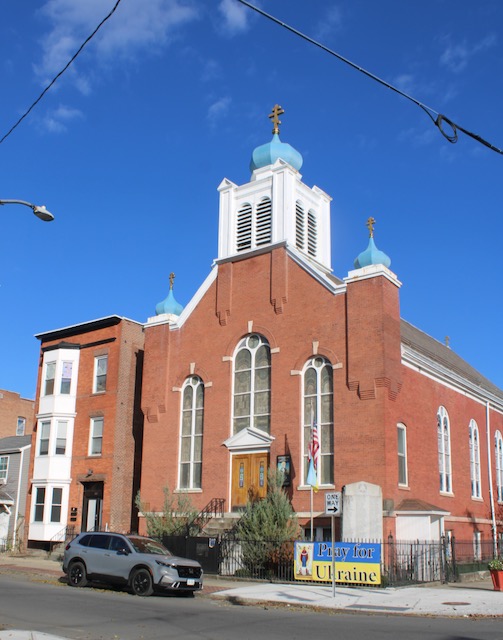
Saint Nicholas Ukrainian Orthodox Church, with a similar shaped, but brick, building now occupies the lot.

Line drawings and quotations are from “The History of Methodism in Troy” by Joseph Hillman, 1888, available as a PDF, free of charge, at a number of online archives, including the Library of Congress. Photographs are the author’s.