Stories from the lives of members of the State Street Methodist Episcopal Church
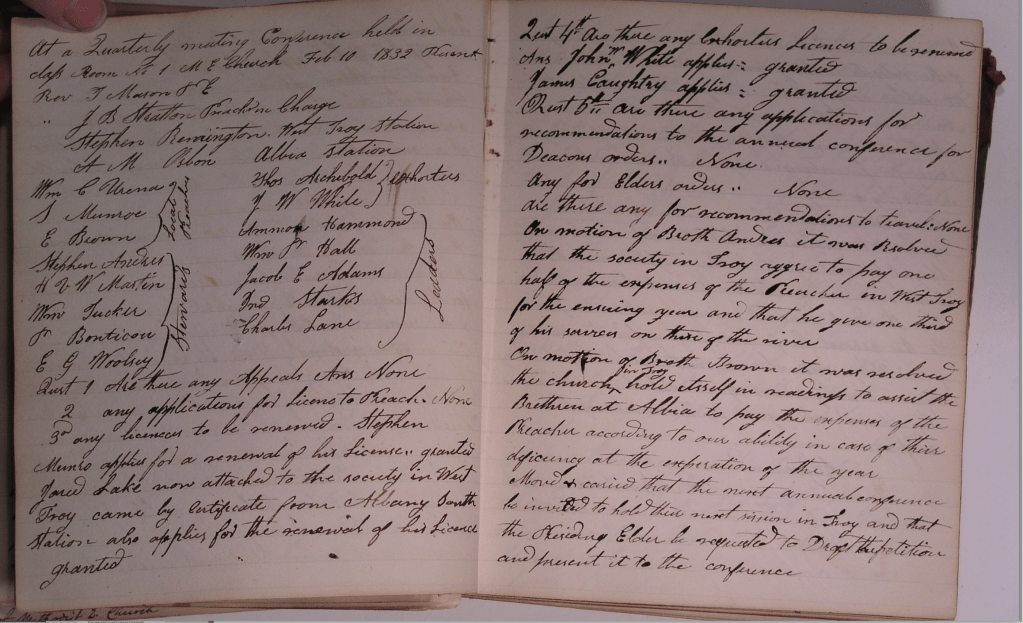
Minutes of the Quarterly Meeting of the State Street ME Church, Troy, NY February 10th, 1832, showing the approval of our subject as an exhorter (top right.)
What name links the State Street Methodists to the very beginnings of the Salvation Army? We should start with a little background: you may have heard that the Salvation Army was founded by William Booth in England, but did you know that before that Booth was a Methodist preacher? Indeed, at one point of his career Booth was preaching in the very same Gateshead Methodist pulpits as your author, as that is where I was living and preaching before moving to Troy…but I am not, of course, the link in question! The link I am writing about goes back to the mid 1800’s, and concerns a preacher, forgotten by most people, but about whom much has been written because of his preaching successes on both sides of the Atlantic. And it’s a story which begins with Troy’s State Street Methodists.
James Caughey’s name is no longer familiar to us, but in his day, his preaching and books were frequently mentioned in pulpits and newspapers, in America, Canada and in Britain, where he was popular with the masses – while being frequently unpopular with the developing hierarchy of the church. He was an old-fashioned revivalist, calling the people to repentance and a new way of life. The Southern Christian Advocate newspaper on Friday, July 23rd, 1852, called him “one of the remarkable men of our time. We suppose him to be the greatest revivalist now in Christendom.” and the Philadelphia Enquirer of April 4th, 1857, wrote: “This distinguished divine has been preaching at the Salem M.E. Church (…) with the most astonishing success.” But as the church moved away from noisy camp meetings and rallies, and moved toward a style more suited to middle class adherents, his methods began to sit uneasily with the leadership, first in England, and later in America, and his achievements were mostly forgotten.
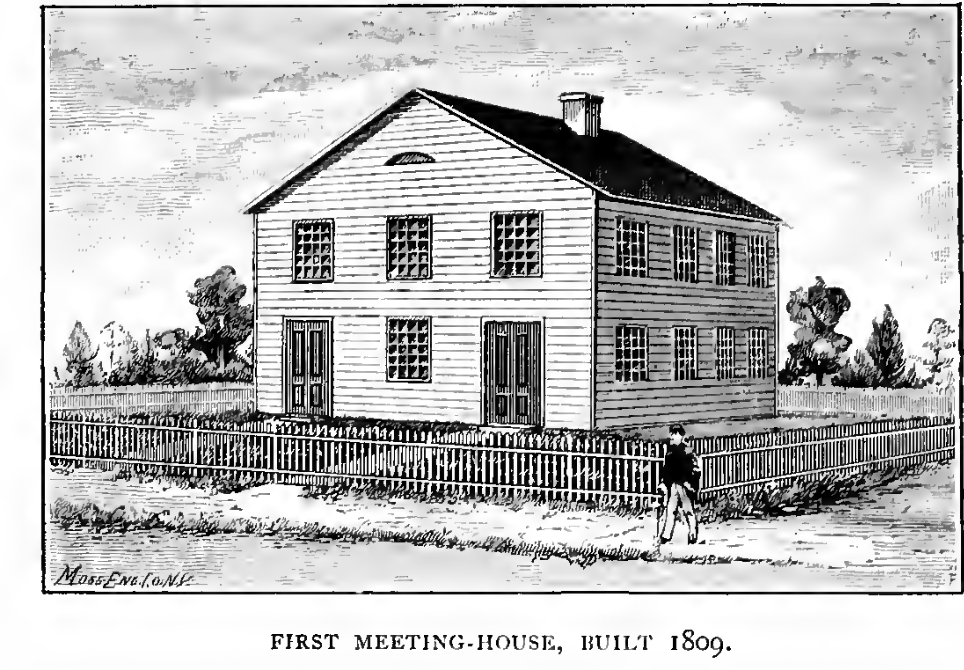
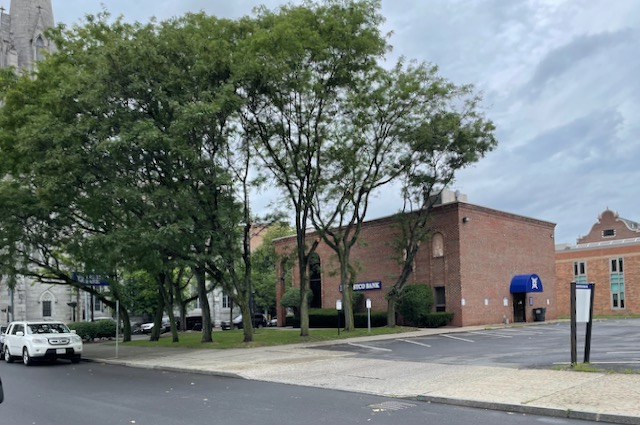
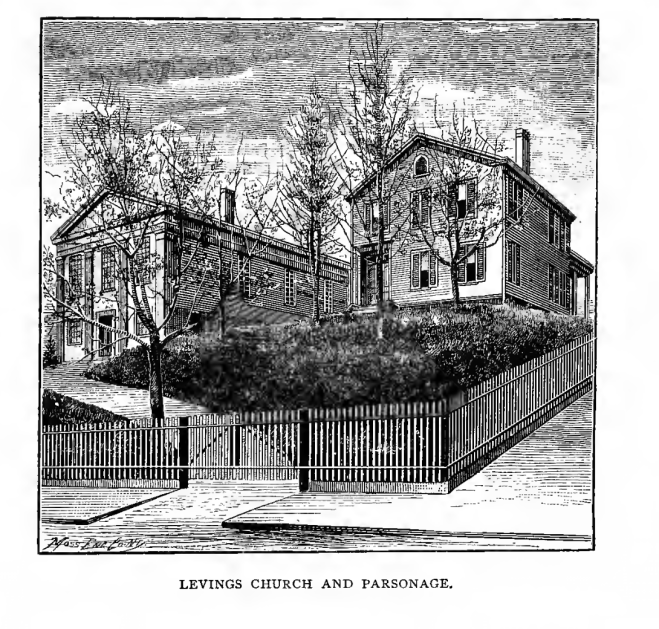
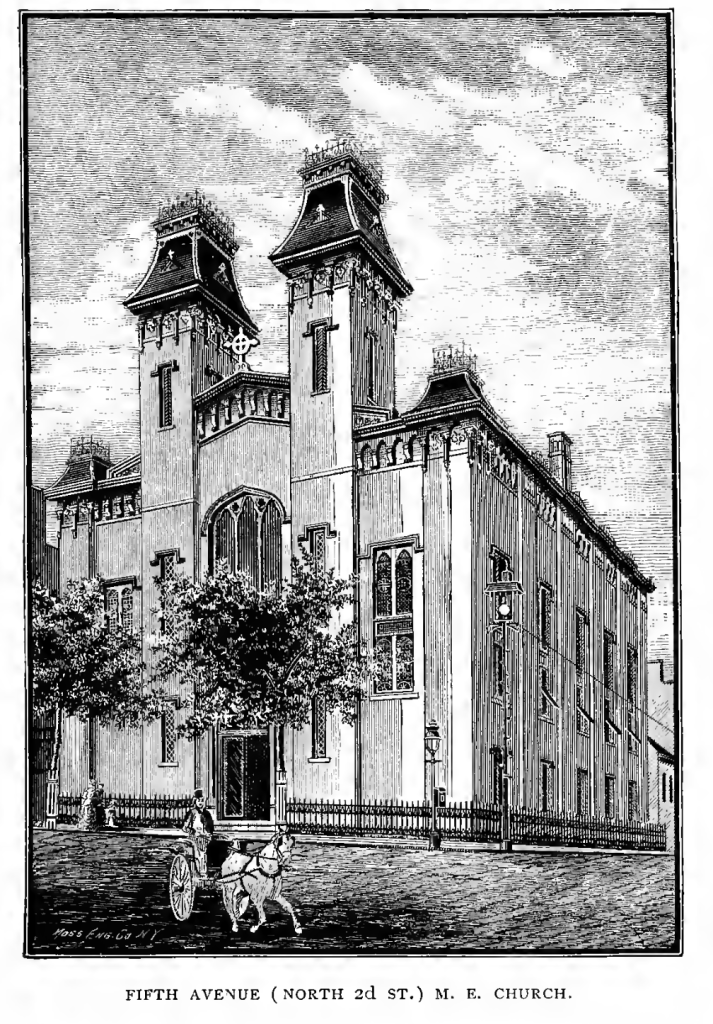
James Caughey was born on April 9, 1810, in northern Ireland. His parents were Scottish, and he was raised, not surprisingly, in the Presbyterian Church. While he was still a boy, the family moved to Troy. There had been a steady flow of Irish protestants to New York for two decades already, attracted by the explosion of industrial jobs to be found. By the time he was 15, Caughey was employed in a local flour mill, where he apparently came into contact with some of the early Methodists of the city. At this point State Street was the only Methodist society in Troy, and was in the process of building its second and larger brick sanctuary, at the front of the lot now occupied by the garden. There is no record which mill he worked in, but there were two families in the congregation with a long history in milling, and the existence of workplace Methodist practice is known to us from the history of Levings Chapel in South Troy, which was set up soon after this time, when a group of workers at the nail factory began to meet in a Methodist class, either before or after their shift. So he may have been encouraged to visit State Street M.E. by his co-workers or management.
For someone who left us so many of his words, Caughey was quite reluctant to offer details of this time in his life, and city directories, which only began in 1829, do not mention where the family was living. However, on several occasions in England, he mentions that he was associated with the Methodists for 3 or 4 years before he received a call to preach. Several biographies explain that change as coming from a revival in 1830 when he was still just 19 years old. The early members of State Street were very fond of holding regular revival meetings led by invited fiery preachers, at which they would record dozens of people joining the congregation at each event, as well as encouraging others to be more fully part of their baptist or presbyterian churches. In various sermons he spoke of attending many meetings and seeking assurance of his place in the family of God. At a camp meeting outside the city, he saw people who had that assurance and decided he would not rest until he found it. Caughey received what he had been craving – a sense of peace and that he was forgiven and at peace with God. It came with a duty to tell others:
“The doctrine of entire sanctification I did not understand ; … I sought the blessing earnestly by day and by night. I fasted, prayed, . and wept, and often entered into an agony of soul for the blessing. Months passed away without any other benefit than an increased spirituality of mind, accompanied by great tenderness of conscience. Sitting one day in a private room alone, reading Mr. Wesley’s Plain Account of Christian Perfection, a heavenly calm, with a consciousness of entire purity, over-spread my heart, and a light like day-dawn beamed upon my placid soul. I exclaimed, in sweet amaze, ” Why,-if this be Christian perfection, which Mr. Wesley describes, — if this be the true Scriptural view, — then I have it ; I do enjoy this very thing. The blood of Jesus Christ has cleansed me !
I held the blessing for some weeks with a trembling hand, and confessed with a faltering tongue, in the assembly of the saints, what God had wrought in my soul. The more frequently I spoke of this great blessing, confessing it, and urging others to press after it, the clearer my evidence became.” from Helps to Life of Faith, p.175
From that point on we can assume Caughey began to take his faith journey more seriously, seriously enough to request the position of exhorter at State Street M.E. Church in Troy. The image above shows his application being accepted. Becoming an exhorter in your home society was the first step in the direction of becoming a local preacher, and then an ordained minister. Exhorters operated only in their own congregation, and encouraged and led people in worship and prayer, between the visits of the traveling ordained clergy. Referring to old Conference records, Caughey’s biographers then record that he was sent by the congregation with a recommendation he receive Deacon’s orders in 1834, and that two years after that he was ordained as a Methodist elder (pastor) and sent to serve at Whitehall, NY . He was then 26 years old, but already in the intervening year, he had accomplished his first evangelical preaching tour in Canada.
On July 9th, 1839, at Whitehall, when he was struggling with the idea of whether it was time to settle down and get married, he had a vivid experience of being called to return to Canada, where he would then receive the financial means to travel to Ireland and England. Instead of choosing marriage and a settled life, he asked permission of the Conference to follow where he felt the Holy Spirit was sending him. He spent March – July 1841 in Montreal, and then sailed for England. His great success in the period between 1841 and 1847 led to him becoming known as the “King of Revivalist Preachers.” The Rhemalogy site quotes Caughey saying that he saw “20,000 profess faith in Christ and 10,000 profess sanctification,” adding that these were conservative numbers, created by carefully adding the names of those who professed faith, meeting after meeting, year after year.
Daniel Wise, who edited and editorialized some of Caughey’s letters and journals in the 19th century, presented the young preacher as a self-educated yet voracious reader but that his early career gave no indication of the huge impact he would later have in England. His Wikipedia page states that later in life “Caughey had an imposing figure and face, a forceful personality, a quick wit and great eloquence.” William Booth’s biographer, Harold Begbie said of Caughey: “He was a tall, thin, smooth-shaven, cadaverous person with dark hair. One who often saw him and well remembers him tells me that he wore a voluminous black cloak folded about him in a Byronic manner; his voice was subdued, he gave no sign of an excitable disposition, his preaching warmed slowly into heat and passion which communicated themselves with magnetic instantaneousness to his audiences.”
His presence in Britain caused enough controversy that after a few years, the leadership there encouraged him to return to the States. His preaching style had brought to a head a discussion between two factions within the British Methodist Church, and many of the leadership belonged to the group which was beginning to become less sensational, dramatic and outwardly “enthusiastic” in style – the complaint the established church had always leveled at John Wesley and his followers – and wanted the church to become more acceptable to the growing middle class. This would shortly begin to affect Methodism in America too. My co-researcher, Alice Rose, and i have both begun to suspect that a rift was growing among Troy’s Methodists by the second half of the 19th century, as the State Street church adopted a system of paid pew rentals, became less interested in revival meetings, and less invested in it evangelical endeavors – and even started using musical instruments in worship! (That is a story for another day.) Those who were unhappy with the direction moved into some of the other congregations State Street had birthed and continued earlier ways at least for a while longer.
So, after 6 years In England and a little time in Ireland, Caughey left Britain in 1847, and he returned to Burlington, Vt. making preaching tours in Canada annually for a time, as well as three more trips across the Atlantic and as an invited preacher up and down the East coast of America, from his base in Burlington, VT.
And the link with the Salvation Army? William Booth attributed his becoming a Methodist, and subsequently a Methodist minister, to the preaching of James Caughey. Booth was just 15 years old when he first heard Caughey. The Wikipedia page for William Booth says: “William styled his preaching after the revivalist American James Caughey, who had made frequent visits to England and preached at Broad Street Chapel, Nottingham, where Booth was a member.”
In his 1920 Life of William Booth, Harold Begbie writes about Caughey’s influence and includes a new paper article describing what it was like to attend one of Caughey’s meetings. The full text is available online (link below) but it begins: “But the greatest influence upon William Booth was exercised, beyond all question, by the American evangelist James Caughey, a minister of the Methodist Episcopal Church. This man attracted enormous crowds to Wesley Chapel, and brought about an undoubted revival of religion in the town. ”
Eventually, as the tension between the old-time revivalist preachers and the leadership grew, Booth left Methodism and formed his own organization based on the principles and understanding, and even the language, he had first heard from his mentor, James Caughey: the Salvation Army was born.
As for Caughey, ill-health had forced his retirement to Highland Park, NJ, where he became Pastor Emeritus of Highland Methodist Episcopal Church. In 1886, when William Booth visited America on a preaching tour, he came to visit and thank the man he saw as his mentor.
Caughey died at age 80 on 30th January 1891, and is buried in the Elmwood Cemetery in North Brunswick, NJ.
Caughey may not be celebrated in Methodism today, on either side of the Atlantic, but there are traditions who regard him as foundational to their understanding of the work of the Holy Spirit to this day. Among some Evangelical and Pentecostal traditions, Caughey is seen as an early proponent of what they now would call the baptism of, or rebirth in, the Holy Spirit. His influence is celebrated on various websites, and I have named some of those below
Caughey, however, proclaimed himself a traditional Methodist to the end, and disliked any link to schism, believing he was loyal to the words and ethos of its founder, John Wesley. He just saw himself as an old-time preacher in the mold of Wesley. We still have many of his sermons, as his revival meetings always had someone to record his words. He called people to convert to a new way of life, a new focus. He spoke to the workers who were starting to bring great wealth to those in charge, but he encouraged owners and workers to do the right thing. He told them no matter what the rigors of their daily life, God valued them, loved them and always had, and wanted to forgive them and prepare them for a new start. And because he was an old time Wesleyan preacher, he preached on sanctification. John Wesley would have been so proud – as he frequently complained in his final months, that although his preachers did really well talking about prevenient grace, and redeeming grace, they were neglecting the very Methodist notion of sanctifying grace. Caughey really made sanctifying grace, as Wesley first described it, the cornerstone of his work. For, when he was “reading Mr. Wesley’s Plain Account of Christian Perfection, a heavenly calm, with a consciousness of entire purity, over-spread my heart, and a light like day-dawn beamed upon my placid soul. I exclaimed, in sweet amaze, ” Why,-if this be Christian perfection, which Mr. Wesley describes, then I have it.”
And he wanted everyone else to experience it, too.
Janet Douglass, Troy NY. November 2025
And as a final curiosity of a personal nature to me… it was not only William Booth who graced those pulpits I also preached in… James Caughey also spoke in the Methodists chapels of Gateshead, and the style of worship of at least one would still seem familiar to the man who set their hearts on fire long ago! Small world….(JD)
Want to know more?
Search for “King of Revival Preachers” on the Rhemalogy website
Search for “Revival Heroes James Caughey” on the Revival Library site
Beautiful Feet, a website about revivalism in America: https://romans1015.com/tag/rev-james-caughey/page/8/
This description of Caughey includes part of Begbie’s description of what it was like to attend one of his revival meetings: https://ukwells.org/revivalists/james-caughey
Full description of a Caughey revival meeting: Harold Begbie Life of Booth vol 1 p. 9ff (1920.) https://archive.org/details/lifegeneralwill04begbgoog/page/n30/mode/2up
On the changes happening in Methodism during Caughey’s time in England: https://oxford-institute.org/wp-content/uploads/2018/11/2018-05-pedlar.pdf
Wikipedia page for William Booth: https://en.wikipedia.org/wiki/William_Booth
Wikipedia page for James Caughey: https://en.wikipedia.org/wiki/James_Caughey
There are numerous books based on Caughey’s sermons and journals, available free of charge on the internet. Many come in the form of questions and answers and the style conversational. All of the titles below are available free of charge on the internet, in the Google Book Archive or various educational libraries. Search for one by name and add Caughey, they come up easily. They include:
Glimpses of Life in Soul Saving:
Helps to a Life of Holiness and Usefulness, or Revival Miscellanies:
Revival Miscellanies: 11 Revival Sermons of James Caughey
Earnest Christianity
Showers of blessing from clouds of mercy: selected from the journal and other writings of the Rev. James Caughey
 janetintroy