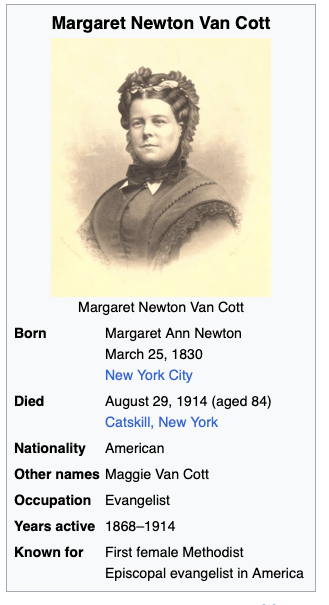
Maggie van Cott (1830-1914), seen here in a screen shot of her biography on Wikipedia.com, was the first woman in Troy Conference to be given a license to preach, and became famous throughout the North East as a leader of revivals, and even made tours out West. She received her license to preach in 1869, which was obviously controversial, and yet also very popular. In the book “The Harvest and the Reaper” written from her recollections, there are contemporary reviews of her preaching, and whilst some criticize her lack of training as an orator and theologian, (and talk about her “womanly logic” – meaning lack of it,) they all have to admit to her success at her goal of “bringing souls to Christ.”
In March and April,1876, Maggie van Cott visited the State Street, Troy, NY congregation, staying with the Hillman family. Both Maggie and the Troy Praying Band, under Hillman, had visited the Springfield, MA Methodists in the past to run revivals.
The Troy Daily Times reports the revival events, reporting that the church was full for some, and that the one – weekday – afternoon, when they reported a smaller crowd, it still numbered several hundred. The pastor’s wife, Mrs. Kimball, and Mrs Joseph Hillman held some women only events, in addition to those open to the general public.
Joseph Hillman records in his book, Methodism in Troy, both his home and that of the pastor, Rev. H.D.Kimball, were robbed during the revival at the church: “the writer took the most complacent view of the loss as was possible, and proposed that the hymn “Hallelujah, ‘tis done” should be sung.” (Hillman, p.73.) He then continues to speak of the revival being a “glorious success” and how it also gave the Presbyterian church some new members.* Several of the revivals, at State Street Methodist Episcopal do appear to have been led with some support from the local Baptists congregations.
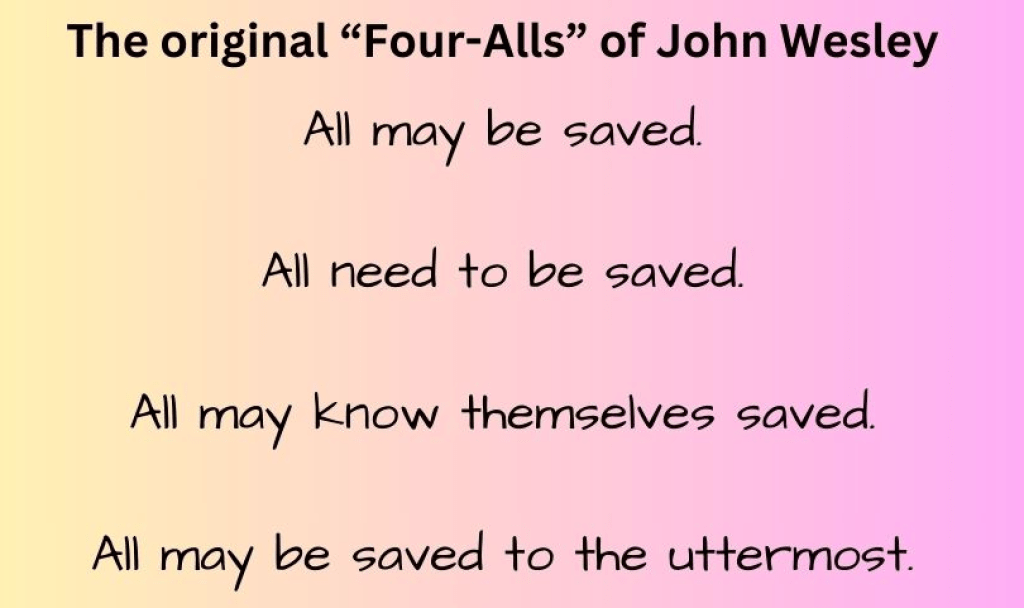
Revivals were not always seen positively in the Presbyterian denomination, as can be read at the link below, so it is interesting that the friendly relationships between denominations, praised more than half a century earlier by Frederick Garresttson when visiting Troy, seems to have continued to some extent. The objections by the Presbyterian denomination included the inordinate “enthusiasm” which so often was a criticism of Methodist worship, but also the preaching. The nature of revival preaching made it less likely to be on the theology of Calvin. Revivalists were often Methodists, and their founder, John Wesley, had written many treatises in direct opposition to Calvinism, contrasting it with his own theology of the Four Alls, a traditional summary of Methodism teaching which underpins British Methodism to this day:
She was born in New York City, but it is widely reported that, on the death of her husband, moved to Greene County, which she deemed a better base for her revival work, and died at Catskill. A Maggie Van Cott does appear on the list of city residents in the 1830s, which hints that maybe she moved first to Troy and, as her travels and fame grew, moved to Greene County.
By her 50th birthday she had supposedly traveled 143,417 miles, held 9,933 revival meetings, and given 4,294 sermons, but the total was far greater as continued her work until her eighties.
The New York Annual Conference of the Methodist Church created a bulletin insert for Women’s History Month in 2016, and it can be accessed at their site.
Online copy of her book: The Harvest and the Reaper can be read online, free of charge, at Google.com/books
Online copy of The Life and Labors of Mrs. Maggie Van Cott by John Onesimus Foster can be read free of charge, online, at Google.com/books
For more information on the Four Alls, one resource is the “What is Distinctive about methodism” page of the British Methodist Church.please visit the Methodist Church site at methodist.org.uk
The image at the top of the page comes from Wikipedia.com and is the title of their boigraphical sketch of the Mrs. Van Cott. The image of the “Four Alls” was created by the author.

 janetintroy