The Methodist Episcopal Church of Troy, NY: Levings Chapel/ Fourth Methodist Church/ Levings Church.

Extended notes on the Methodist congregations associated with the State Street Methodist Episcopal Church ( now Christ Church, United Methodist.)
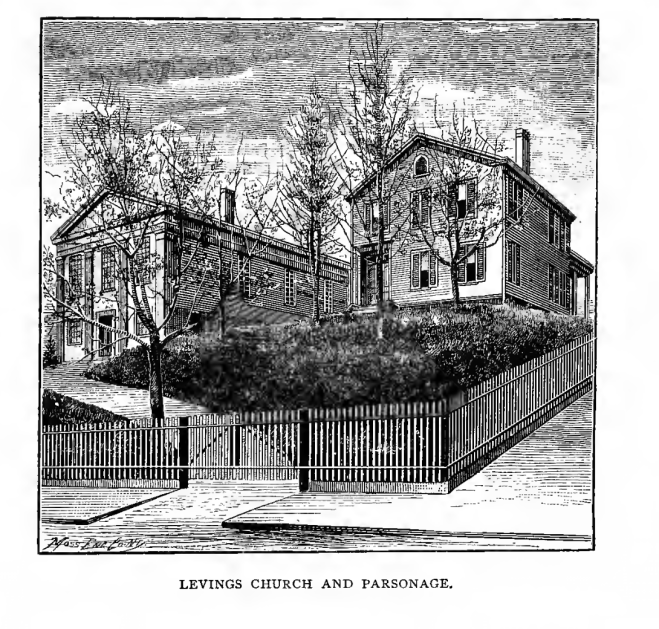
Fourth Methodist Church/ Levings Chapel, 63 Mill Street, South Troy, NY

In the mid 1830s, Methodists who were working in the nail factory on Mill Street, began to ask for a church to be erected closer to their place of work and homes. According to Hillman, they were holding worship services at the nail factory. On September 24, 1838, they met at the factory and designated themselves as the “Trustees of the Levings Chapel in the city of Troy,” also known as Fourth Methodist Church of Troy.

In 1850, they erected a sanctuary opposite the factory. Two years later, the Rev. Tobias Spicer, another early Methodist from the State Street church,  and who was appointed as pastor of the Levings Chapel society, spoke unflatteringly of his work there: “My labors this year were mostly in South Troy, where we had a feeble society, which had lately built a church. “ None the less, by the early 1860’s the church had a membership of 140, and in 1888, at the publication of Hillman’s book, the number had swelled to 212 members, by which time the church had been renamed “Leving’s Church” though the old name of Chapel was often used. 

The congregation continued until the 1960’s, when the decision was made to close it, rather than execute the much needed expensive repairs. The remaining members merged with the Green Island Methodist Church, now called Good Shepherd United Methodist Church, and anyone looking for genealogical materials from Levings Chapel could start there.

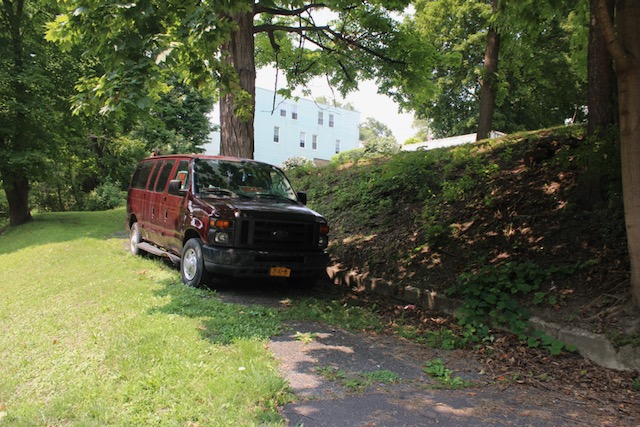
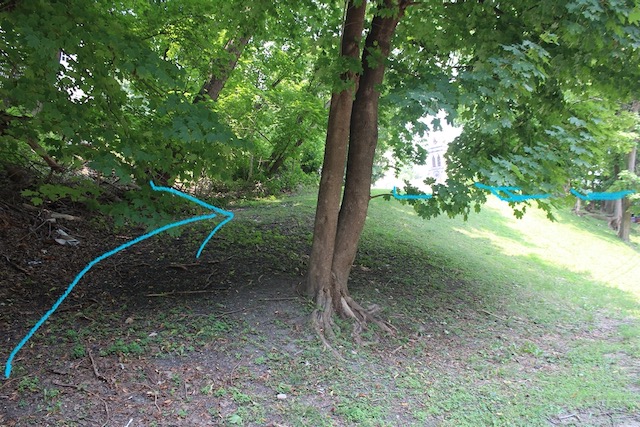
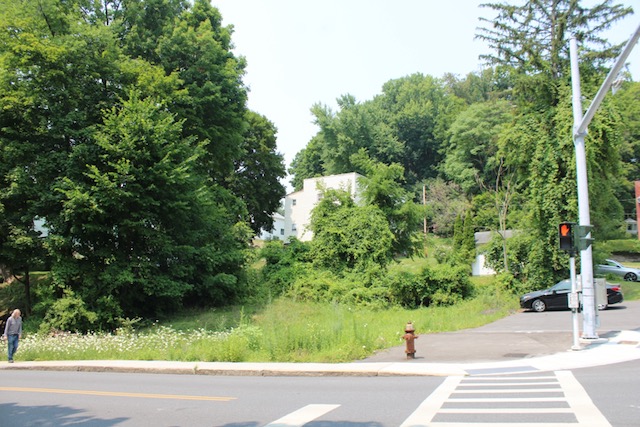
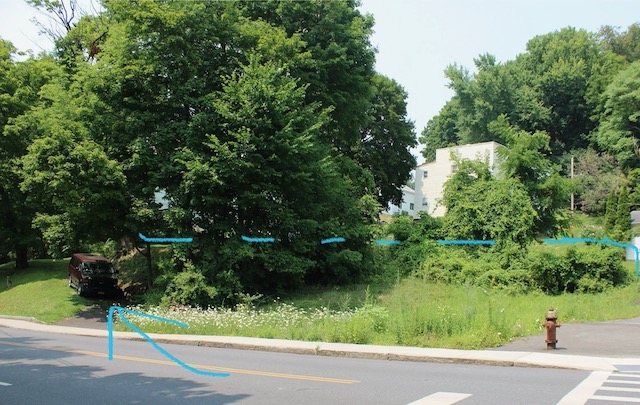
The last service was held on Palm Sunday, 1968, and the decision seemed prescient, given that during the following Winter the roof collapsed during a heavy snow storm and shortly afterward the church and manse were torn down. The lot for the two buildings remains empty, and stands on the corner of Mill and Erie Streets, and across Erie Street from the Woodside arts center, which was previously Woodside Presbyterian Church. The photographs below show the site, now obscured from the road by trees – the blue marks delineate the platform which remains and the two disused paths leading to it, one covered in gravel and the other metallized. The tower of the neighboring former Woodside Presbyterian Church can be seen beyond the trees. The platform can also be glimpsed behind current homes from the top of Erie Street.

The substantial buildings of the nail factory and Albany Steel Works, which lined the Wynantskill at the time, have also long-since disappeared. Today there is a walk around Burden Pond, down beside the Burden Falls and then on toward the Hudson River. If you look for them, there are still bricks and a few ruins of the old mills, in places. The location is famous for the giant Burden Water Wheel that used to stand there, purportedly the most powerful water wheel ever built. Several websites give those details, and also tell how an RPI student used his knowledge of this wheel, and his engineering skills, to build the first fairground pleasure wheel for the Chicago Columbian Exhibition in 1893. His name was George Washington Gale Ferris. For the first members of Levings Chapel however, it was simply one of the amazing pieces of new technology, which made them so productive and helped create Troy’s wealth.
As for the Rev. Noah Levings, this early convert to Methodism by the State Street faithful, while still an apprentice blacksmith, will need to have a brief history of his own at later date.

Line drawings and quotations are from “The History of Methodism in Troy” by Joseph Hillman, 1888, available as a PDF, free of charge, at a number of online archives, including the Library of Congress. Photographs are the author’s.
The Methodist Episcopal Churches of Troy, NY: East Side Church/ Pawling Avenue.

Extended notes on the Methodist congregations associated with the State Street Methodist Episcopal Church (now Christ Church, United Methodist.)

Pawling Avenue/ East Side Methodist Episcopal Church

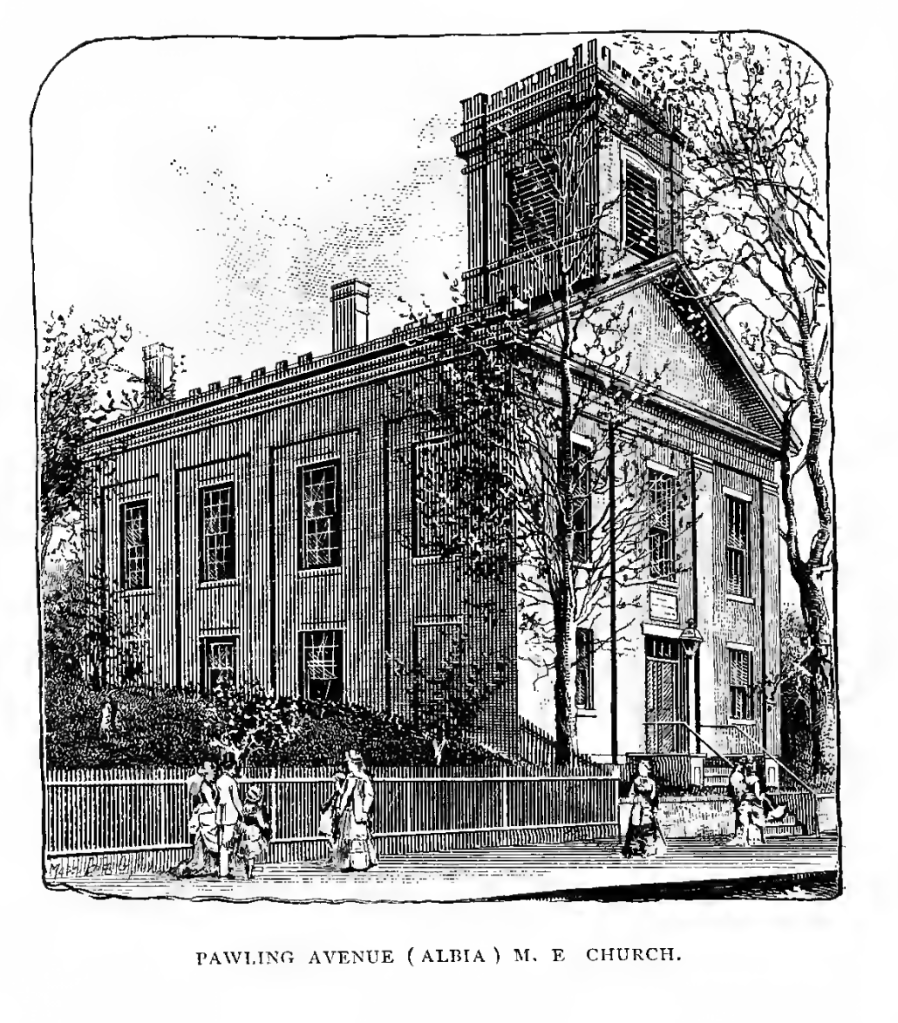
“The first Methodist meeting house at Albia, in the fifth ward of the city, was erected by the trustees of the State street society, for the purpose of providing its members with a convenient place for hearing preaching and for holding prayer -meetings, when they were precluded from attending religious services at the State Street Church.“ The trustees of State Street formed a committee to build a meeting house in Albia, on August 15, 1826. The first reported sermon was preached there in 1829 (Hillman. p 83.)

This Methodist “society” – congregation- was not only the the first satellite church of the State Street church, but of all of those churches, is the only one still in operation today, in a building within sight of the location of the original one. It was needed because the mill workers would have had a xxx mile work to downtown Troy, and then walking back up a steep valley side, not only taking a lot of time and effort, but on unpaved roadways and in all weather, it must have been a dangerous and difficult journey. It is remarkable that up to this point some actually had made it!

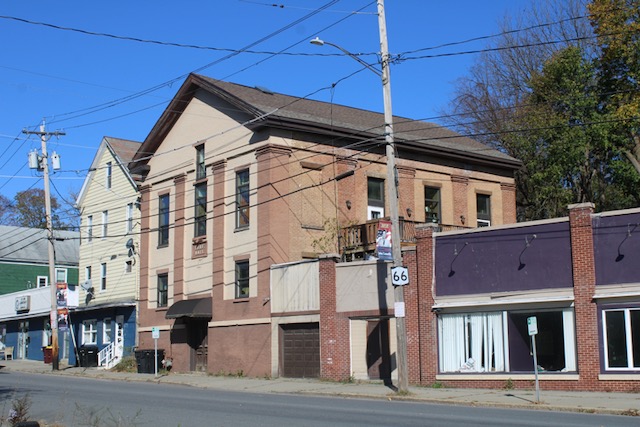
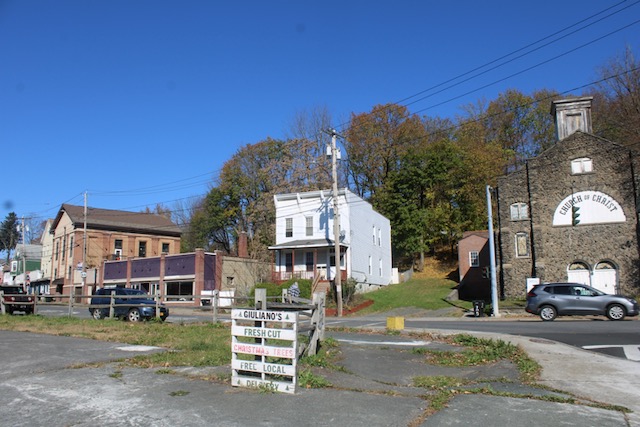
The original building was made of wood, and Hillman reported that the stone tablet above the door read that the church was erected in 1827, and rebuilt in 1858. Maps show it as being a little smaller than the still-standing original Presbyterian Church, now labeled as a Church of Christ, though not in use, just a hundred yards away at the junction of Pawling Avenue and Winter Street. The site of the East Side Methodist Church became home to the Oddfellows Society, and the structure still visible at the site does have the appearance of a chapel, but one made of brick, not wood. It now appears to be a home.

The site of the original East Side Methodist Episcopal Church on the east side of Pawling Avenue.

The view from the junction of Pauling Avenue and Winter Street, with the Wynantskill immediately behind the photographer. These banks were lined with mill buildings, and some remains are visible looking over the bridge as well as on adjacent properties.

The congregation adopted the official name of the “Pawling Avenue Methodist Episcopal Church” in 1868, and in 1888 Hillman reported a membership of 166 persons.

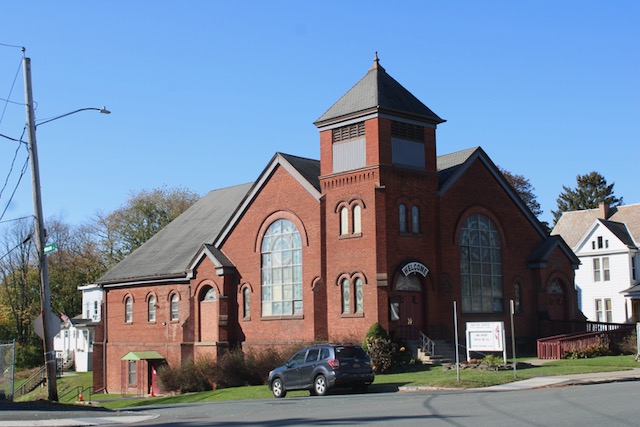
A few years after the publication of Hillman’s book, the current brick church, known locally as “The Welcome Church,” was constructed on the western side of the road, less than half a mile to the north. This congregation continues to welcome neighbors and friend to worship and community meals, and can be contacted on Facebook and the web. If your genealogical search leads you to this congregation, you should start by asking what records they have, as operational UMC churches usually hold their records.

Many of the imposing brick structures of the mills, including those first erected by Mahlon Taylor not long after his arrival in Troy in 1789, and their successors, were still standing beside the Wynantskill into the 21st Century.

Line drawings and quotations are from “The History of Methodism in Troy” by Joseph Hillman, 1888, available as a PDF, free of charge, at a number of online archives, including the Library of Congress. Photographs are the author’s.
The Methodist Episcopal Churches of Troy, NY: Third Street Church.

Extended notes on the Methodist congregations associated with the State Street Methodist Episcopal Church (now Christ Church, United Methodist.)

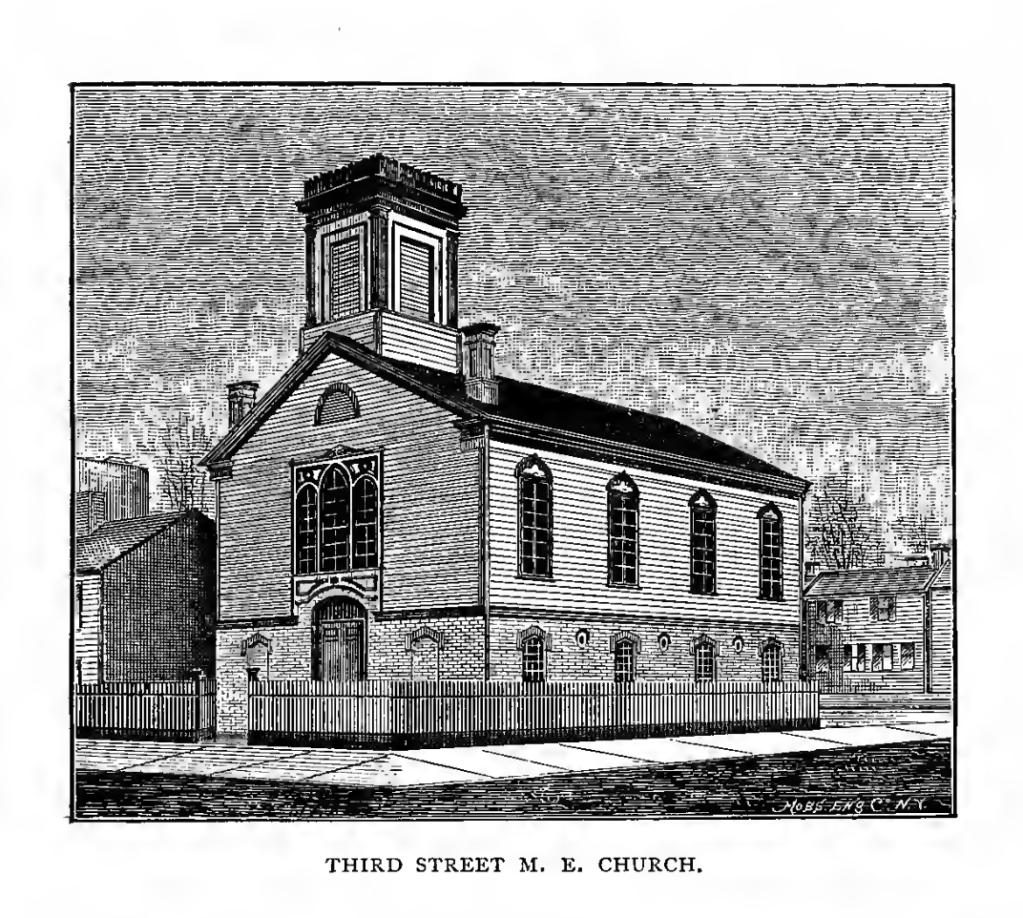
Third Street Methodist Episcopal Church, corner 3rd and Monroe Streets, South Troy.

In March 1844, trustees were elected for a separate congregation named “the Third Street Methodist Episcopal Society of the City of Troy” and a Sunday School was organized. The following year “a lot on the northeast corner of Third and Monroe Streets was purchased by the society to build a church. “  (Hillman, p.96) “The small society which had organized in 1843, began its erection in 1847(…) On Christmas day, that year, the building was dedicated.”  (Hillman p. 66)

“The origin of the Third Street Methodist Episcopal Church can be traced to a statement made by William Barrett, a class-leader of the State Street Church, at the leaders’ meeting held on May 2, 1842 (…) he suggested the suitableness of the house belonging to him in that part of the city for preaching.”  “ In1873, the church was enlarged by the construction of a lower story of brick, on which the wooden structure of the first edifice was placed.” (Hillman, 96-99)

Prayer meetings had been conducted in William Barrett’s house for a while, and when Daniel Hudson, an experienced Sunday School Superintendent, moved “from the northern part of the city,” a class of Methodists was formed. A “class” was the usual Methodist term for a neighborhood group of adults and families with children. The Trustees of the State Street congregation, seeing the success of the class, started to look for a building in earnest, meanwhile paying William Barrett for the use of his house for prayer meetings, preaching and a Sunday School. This saved South Troy participants from trudging the one mile each way to the State Street church, or not quite as far a walk for many – but up a steep hill – to Levings Chapel. 

Like other new congregations, the decision came at a time of dissension that pew rentals were being charged in the State Street building, usually reported by Hillman as temporary fees to pay for new buildings, but always mentioned with hints that the decision was not universally approved.  Certainly the cost to rent a pew could have dissuaded attendance by the workers of South Troy, many of whom worked in the steel mills and foundries of the area. In fact, Hillman tells us this would-be congregation decided not to accept State Street’s appeal for money for their building, but to create its own Board of Trustees and become a separate church. 

In October, 1844, the Sunday School reported having 15 teachers, in addition to two superintendents –  one for males and one for females – and a secretary-librarian, even though Hillman estimates membership of the society being around 35, with 75 students in the Sunday School. The first sermons were preached on the steps of the partially-built church, and the sanctuary was dedicated on Christmas Day, 1847.

After a time as a separate charge, the congregation reunited with State Street and operated under the name of Wesley Chapel. When attendance climbed again, peaking at 151, under the able leadership of its superintendent, Daniel Klock Jr., they once again took a minister and revived their Third Street name. The Sunday School had 288 members in 1888, and the school rooms were enlarged. Sadly, it was not to last. 

The congregation which had struggled, revived, and struggled and thrived for a few years, then struggled again, closing its doors at the end of the19th century, not so long after its best years.

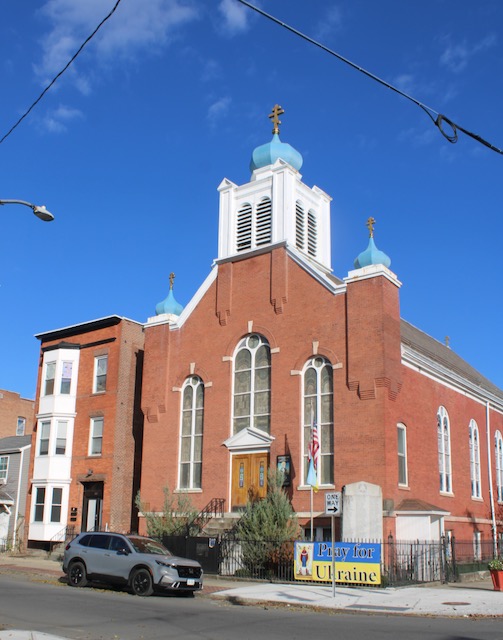
Saint Nicholas Ukrainian Orthodox Church, with a similar shaped, but brick, building now occupies the lot.

Line drawings and quotations are from “The History of Methodism in Troy” by Joseph Hillman, 1888, available as a PDF, free of charge, at a number of online archives, including the Library of Congress. Photographs are the author’s.