13 of the farmsteads in Pittstown, NY, have been approved for the National Register of Historic Places, including a farm which served as an early meeting place for the first Troy Methodists.
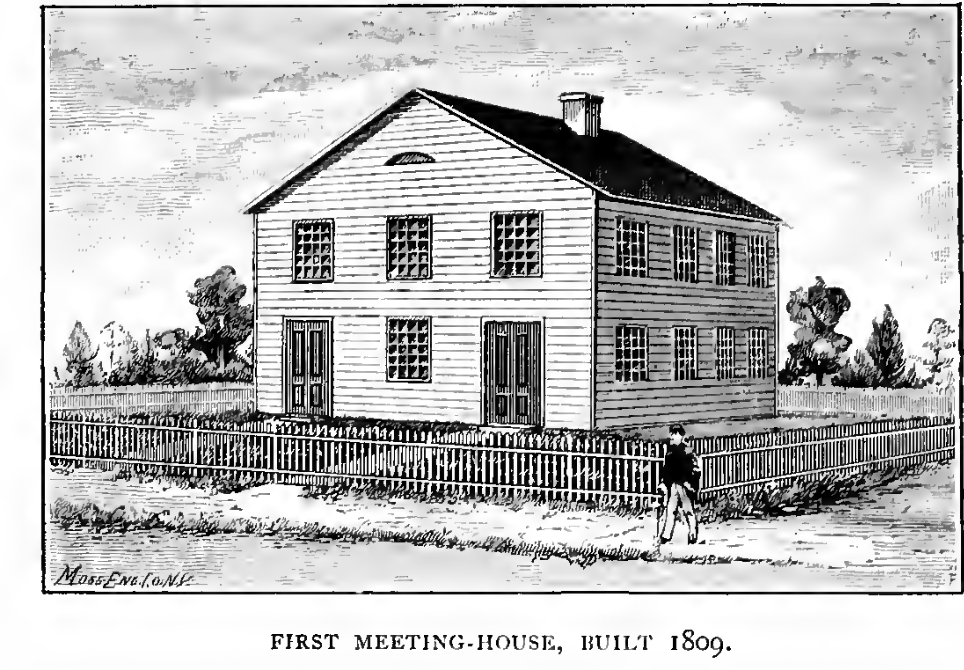
“Henry Cook was one of the wealthy farmers whose kind hearts were ready to sustain the meetings, and whose large barns in the early days of Methodism served on Sabbaths as churches. “In 1800 or 1801,” Miss Curtis says, “when I was a young girl, I remember hearing Benjamin Stephens preach in Mr. Cook’s barn.” (…) The inconveniences of holding meetings at the dwellings of the members and in the court-house were evidently detrimental to the strong growth of the society. “In the court-room,” as Phebe Curtis relates, ” some- times on summer evenings, it would be nearly nine o’clock before the congregation could be seated. This was not owing to the slackness of the brethren in making timely application for its use, but because the person who had the key, or the one who rang the bell, had no interest in our prosperity.” From “Methodism in Troy” by Joseph Hillman, self-published 1888. pp 22-3.
That two-sentence record of early Troy Methodists gathering in a barn, has led to some tantalizing clues about the importance of the Cook-Hayner-Halford Farmstead at Cooksboro Corners in Pittstown, for the growth of Methodism in the region.
Phebe Curtis, the young daughter of Caleb Curtis, and so from one of the earliest Methodist families in Troy, wrote a history of the congregation in the early 1800’s. The work is lost, but was frequently quoted by a number of local historians later in the century, including Hillman’s Methodism in Troy, which was the impetus for the research being undertaken by Alice Rose and I. Phebe wrote of the earliest Methodists and where they met, locations identified only by the owner’s name – which was adequate in a still tightly-knit village of a hundred or two residences, but frustrating to our research today, as we try to find out which of those early Trojans offered them a place to gather.
Journals of the time and histories from the following century described some of the difficulties of starting a Methodist society in the early days of both Methodism and the history of the United States, something we can read in the diaries of the early preachers, many of whom endured beatings. Historians of Troy also recount some of the resistance to the society buying land for a church building – resistance which other denominations did not encounter.
As part of my research into early meeting sites for the congregation, I began looking for a farmer called Henry Cook…searching West Troy, Albia, then moving out to Brunswick, Poestenkill and the Greenbushes: nothing. The search illustrates the difficulty we are having locating places and the people who became the first State Street Methodist society. Women, of course, often go by the names of their spouse; servants, particularly if African American, slave or free, by their first name; houses identified by the owner with no location. Finding any Henry Cook with a farm took months of peering at maps, reading census documents and the journals of early preachers.
Until the day – and I cannot think what prompted me to think it, but probably some Vanderheyden genealogical digging – I thought: ‘what if his name was not Cook – what if Cook is an anglicization of a Dutch name?’ In hours, I was on the trail: some of the Vandercook family seemed to have contracted their anglicized Dutch name, to Cook! Searching for the Vandercooks in censuses brought me to Pittstown, and also revealed that while the Vandercooks did not list many people of color on census forms, only one of the farmholders listed none at all…and that this farmer, Henry Vandercook, was often simply listed as Henry Cook. (Though also with the first name in its Dutch version: Hendrik, and the last name spelled differently: Henry/ Hendrik Van Der Cook or Henry Vander Cook or H.V. D.Cook or even with the last name Vanderkeock…but despite the variations, they all pointed to the same man.)
Had I found “our “ Henry Cook?
It was not a given that I would locate a Cook with a farm, where there were no slaves. The farm owner could have made an arrangement with the Methodist group, who paid to use his barn – but I had found a Cook with a farm, and therefore a barn, in a county which had considerable slave labor at the time, and this Cook had none. There was a chance I had found a follower of Wesley.
Further research showed that by 1795, Henry Cook was the leader (steward) of a Methodist class. Finding him in a leadership role that early confirmed he had known about Wesleyan teachings for a few years at least, predating the visit of Lorenzo Dow, a very famous preacher who came to Pittstown. And why Pittstown? Probably because at about the same distance as Troy was from Pittstown, but in the opposite direction, lay the farm formerly of Philip Embury, founder and builder of both the first and second Methodist structures in America , John St Chapel in New York City… and Ashgrove Chapel in Cambridge, NY.
I doubt that Henry Cook was a Methodist during the lifetime of Embury who died far too young, in 1775, or that he visited the farm of Embury’s fellow Irish Methodist cousin, Barbara Heck, the so-called Mother of Methodism. She had helped found and run the John Street society in New York as well as the one in Cambridge. Those founding Methodists moved to the north shore of the St Lawrence at the end of the Revolutionary War: this group of Palatine German Protestants found themselves unable to support the Revolution out of loyalty to the British crown, which had rescued them from persecution on the European continent. But many – like Cook himself- who fought for the liberty of America did nonetheless join the Methodist cause, despite its British origins, and they would have worshiped alongside other patriots as well as those who fought against them. For them the theology really mattered more.
It is hard to imagine today, just how much furor and opposition there was to Wesleyan teachings. Methodism today is just one of many Protestant groups, which seem much the same. But in the 18th and 19th century, it stood alone in opposition to the Calvinist ideas of Presbyterian, Baptist and Reformed theology. Where they talked of the “elect few” who could be right with God, Wesley’s followers declared all could be saved. And not only all could be saved, but they could feel it, know it. The 18th century Irish Methodists who did not flee to Canada, and the group they had attracted, stayed in Cambridge and continued to talk about the teachings of John Wesley. Meanwhile, 11 miles to the West of Pittstown, in Schaghticoke, Captain Groesbeck was inviting Methodist preachers to speak in his barn. The great Frederick Garrettson writes that he had a great reception there on September 24th, 1791, 4 years before we find Henry listed as the class leader. These farmers were spreading more than the seeds of wheat in their fields…they were seeding the church!
Janet Douglass, February 2025
At a distance of 16 miles from Troy, ‘Mr. Cook’s barn’ became a gathering for Methodists in the late eighteenth century. It is a piece of land which would eventually be the home of the Cooksboro Methodist Society, sharing this piece of Vandercook land with a cemetery and a schoolhouse. A barn with some distinctive early Dutch features remains visible on the land which is still a working farm. The address is #346 Cooksboro Road (CR 126), in Pittstown, NY,and the barn is near the junction with Plank Road. The church is no longer there, but its location is discernible. Henry is buried a little way down the road in the Old Cooksborough Cemetery, not the adjoining graveyard, but both are generally off limits for safety/accessibility reasons. You can see an image of his tombstone at this link: https://www.findagrave.com/memorial/10289425/henry-vandercook
John Wesley grew his theology to stand in opposition to the prevailing Calvinist thought of his day. Many of his letters and treatises deal with this issue. Almost as many show his interactions with the British Government on the need to prohibit the use of British ships in transporting Africans westwards, and stop Britons profiting from slavery. These sentiments, along with its British origins, meant early Methodism had cause to be unpopular with many. That it grew as large and as fast as it did, attests to the work of the early leaders, their character and their determination.
A different version of this essay, with another emphasis, appears in the February newsletter of the Pittstown Historical Society. whose wonderful archive about the Vandercooks confirmed I had found “our Henry” and helped me understand more about the farm and the neighborhood in his day.
 janetintroy