A curious link between Troy, NY State Street Methodists & the Birth of the Salvation Army

Stories from the lives of members of the State Street Methodist Episcopal Church
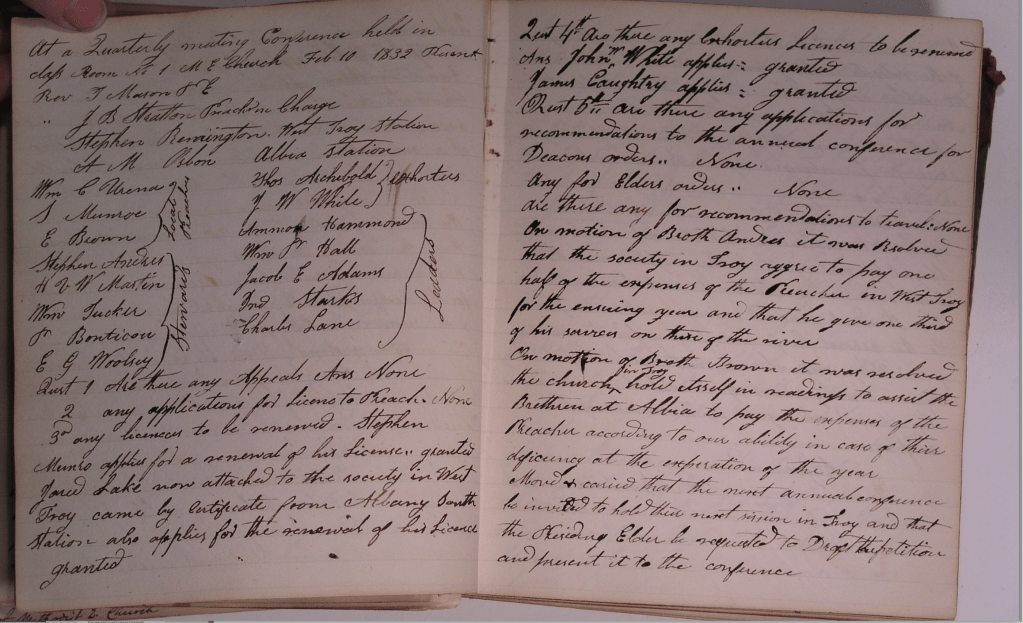
Minutes of the Quarterly Meeting of the State Street ME Church, Troy, NY February 10th, 1832, showing the approval of our subject as an exhorter (top right.)

What name links the State Street Methodists to the very beginnings of the Salvation Army? We should start with a little background: you may have heard that the Salvation Army was founded by William Booth in England, but did you know that before that Booth was a Methodist preacher? Indeed, at one point of his career Booth was preaching in the very same Gateshead Methodist pulpits as your author, as that is where I was living and preaching before moving to Troy…but I am not, of course, the link in question! The link I am writing about goes back to the mid 1800’s, and concerns a preacher, forgotten by most people, but about whom much has been written because of his preaching successes on both sides of the Atlantic. And it’s a story which begins with Troy’s State Street Methodists.

James Caughey’s name is no longer familiar to us, but in his day, his preaching and books were frequently mentioned in pulpits and newspapers, in America, Canada and in Britain, where he was popular with the masses – while being frequently unpopular with the developing hierarchy of the church. He was an old-fashioned revivalist, calling the people to repentance and a new way of life. The Southern Christian Advocate newspaper on Friday, July 23rd, 1852, called him “one of the remarkable men of our time. We suppose him to be the greatest revivalist now in Christendom.” and the Philadelphia Enquirer of April 4th, 1857, wrote: “This distinguished divine has been preaching at the Salem M.E. Church (…) with the most astonishing success.” But as the church moved away from noisy camp meetings and rallies, and moved toward a style more suited to middle class adherents, his methods began to sit uneasily with the leadership, first in England, and later in America, and his achievements were mostly forgotten.

James Caughey was born on April 9, 1810, in northern Ireland. His parents were Scottish, and he was raised, not surprisingly, in the Presbyterian Church. While he was still a boy, the family moved to Troy. There had been a steady flow of Irish protestants to New York for two decades already, attracted by the explosion of industrial jobs to be found. By the time he was 15, Caughey was employed in a local flour mill, where he apparently came into contact with some of the early Methodists of the city. At this point State Street was the only Methodist society in Troy, and was in the process of building its second and larger brick sanctuary, at the front of the lot now occupied by the garden. There is no record which mill he worked in, but there were two families in the congregation with a long history in milling, and the existence of workplace Methodist practice is known to us from the history of Levings Chapel in South Troy, which was set up soon after this time, when a group of workers at the nail factory began to meet in a Methodist class, either before or after their shift. So he may have been encouraged to visit State Street M.E. by his co-workers or management.

For someone who left us so many of his words, Caughey was quite reluctant to offer details of this time in his life, and city directories, which only began in 1829, do not mention where the family was living. However, on several occasions in England, he mentions that he was associated with the Methodists for 3 or 4 years before he received a call to preach. Several biographies explain that change as coming from a revival in 1830 when he was still just 19 years old. The early members of State Street were very fond of holding regular revival meetings led by invited fiery preachers, at which they would record dozens of people joining the congregation at each event, as well as encouraging others to be more fully part of their baptist or presbyterian churches. In various sermons he spoke of attending many meetings and seeking assurance of his place in the family of God. At a camp meeting outside the city, he saw people who had that assurance and decided he would not rest until he found it. Caughey received what he had been craving – a sense of peace and that he was forgiven and at peace with God. It came with a duty to tell others:

“The doctrine of entire sanctification I did not understand ; … I sought the blessing earnestly by day and by night. I fasted, prayed, . and wept, and often entered into an agony of soul for the blessing. Months passed away without any other benefit than an increased spirituality of mind, accompanied by great tenderness of conscience. Sitting one day in a private room alone, reading Mr. Wesley’s Plain Account of Christian Perfection, a heavenly calm, with a consciousness of entire purity, over-spread my heart, and a light like day-dawn beamed upon my placid soul. I exclaimed, in sweet amaze, ” Why,-if this be Christian perfection, which Mr. Wesley describes, — if this be the true Scriptural view, — then I have it ; I do enjoy this very thing. The blood of Jesus Christ has cleansed me !

I held the blessing for some weeks with a trembling hand, and confessed with a faltering tongue, in the assembly of the saints, what God had wrought in my soul. The more frequently I spoke of this great blessing, confessing it, and urging others to press after it, the clearer my evidence became.” from Helps to Life of Faith, p.175

From that point on we can assume Caughey began to take his faith journey more seriously, seriously enough to request the position of exhorter at State Street M.E. Church in Troy. The image above shows his application being accepted. Becoming an exhorter in your home society was the first step in the direction of becoming a local preacher, and then an ordained minister. Exhorters operated only in their own congregation, and encouraged and led people in worship and prayer, between the visits of the traveling ordained clergy. Referring to old Conference records, Caughey’s biographers then record that he was sent by the congregation with a recommendation he receive Deacon’s orders in 1834, and that two years after that he was ordained as a Methodist elder (pastor) and sent to serve at Whitehall, NY . He was then 26 years old, but already in the intervening year, he had accomplished his first evangelical preaching tour in Canada.

On July 9th, 1839, at Whitehall, when he was struggling with the idea of whether it was time to settle down and get married, he had a vivid experience of being called to return to Canada, where he would then receive the financial means to travel to Ireland and England. Instead of choosing marriage and a settled life, he asked permission of the Conference to follow where he felt the Holy Spirit was sending him. He spent March – July 1841 in Montreal, and then sailed for England. His great success in the period between 1841 and 1847 led to him becoming known as the “King of Revivalist Preachers.” The Rhemalogy site quotes Caughey saying that he saw “20,000 profess faith in Christ and 10,000 profess sanctification,” adding that these were conservative numbers, created by carefully adding the names of those who professed faith, meeting after meeting, year after year.

Daniel Wise, who edited and editorialized some of Caughey’s letters and journals in the 19th century, presented the young preacher as a self-educated yet voracious reader but that his early career gave no indication of the huge impact he would later have in England. His Wikipedia page states that later in life “Caughey had an imposing figure and face, a forceful personality, a quick wit and great eloquence.” William Booth’s biographer, Harold Begbie said of Caughey: “He was a tall, thin, smooth-shaven, cadaverous person with dark hair. One who often saw him and well remembers him tells me that he wore a voluminous black cloak folded about him in a Byronic manner; his voice was subdued, he gave no sign of an excitable disposition, his preaching warmed slowly into heat and passion which communicated themselves with magnetic instantaneousness to his audiences.”

His presence in Britain caused enough controversy that after a few years, the leadership there encouraged him to return to the States. His preaching style had brought to a head a discussion between two factions within the British Methodist Church, and many of the leadership belonged to the group which was beginning to become less sensational, dramatic and outwardly “enthusiastic” in style – the complaint the established church had always leveled at John Wesley and his followers – and wanted the church to become more acceptable to the growing middle class. This would shortly begin to affect Methodism in America too. My co-researcher, Alice Rose, and i have both begun to suspect that a rift was growing among Troy’s Methodists by the second half of the 19th century, as the State Street church adopted a system of paid pew rentals, became less interested in revival meetings, and less invested in it evangelical endeavors – and even started using musical instruments in worship! (That is a story for another day.) Those who were unhappy with the direction moved into some of the other congregations State Street had birthed and continued earlier ways at least for a while longer.

So, after 6 years In England and a little time in Ireland, Caughey left Britain in 1847, and he returned to Burlington, Vt. making preaching tours in Canada annually for a time, as well as three more trips across the Atlantic and as an invited preacher up and down the East coast of America, from his base in Burlington, VT.

And the link with the Salvation Army? William Booth attributed his becoming a Methodist, and subsequently a Methodist minister, to the preaching of James Caughey. Booth was just 15 years old when he first heard Caughey. The Wikipedia page for William Booth says: “William styled his preaching after the revivalist American James Caughey, who had made frequent visits to England and preached at Broad Street Chapel, Nottingham, where Booth was a member.”

In his 1920 Life of William Booth, Harold Begbie writes about Caughey’s influence and includes a new paper article describing what it was like to attend one of Caughey’s meetings. The full text is available online (link below) but it begins: “But the greatest influence upon William Booth was exercised, beyond all question, by the American evangelist James Caughey, a minister of the Methodist Episcopal Church. This man attracted enormous crowds to Wesley Chapel, and brought about an undoubted revival of religion in the town.

Eventually, as the tension between the old-time revivalist preachers and the leadership grew, Booth left Methodism and formed his own organization based on the principles and understanding, and even the language, he had first heard from his mentor, James Caughey: the Salvation Army was born.

As for Caughey, ill-health had forced his retirement to Highland Park, NJ, where he became Pastor Emeritus of Highland Methodist Episcopal Church. In 1886, when William Booth visited America on a preaching tour, he came to visit and thank the man he saw as his mentor.

Caughey died at age 80 on 30th January 1891, and is buried in the Elmwood Cemetery in North Brunswick, NJ.

Caughey may not be celebrated in Methodism today, on either side of the Atlantic, but there are traditions who regard him as foundational to their understanding of the work of the Holy Spirit to this day. Among some Evangelical and Pentecostal traditions, Caughey is seen as an early proponent of what they now would call the baptism of, or rebirth in, the Holy Spirit. His influence is celebrated on various websites, and I have named some of those below

Caughey, however, proclaimed himself a traditional Methodist to the end, and disliked any link to schism, believing he was loyal to the words and ethos of its founder, John Wesley. He just saw himself as an old-time preacher in the mold of Wesley. We still have many of his sermons, as his revival meetings always had someone to record his words. He called people to convert to a new way of life, a new focus. He spoke to the workers who were starting to bring great wealth to those in charge, but he encouraged owners and workers to do the right thing. He told them no matter what the rigors of their daily life, God valued them, loved them and always had, and wanted to forgive them and prepare them for a new start. And because he was an old time Wesleyan preacher, he preached on sanctification. John Wesley would have been so proud – as he frequently complained in his final months, that although his preachers did really well talking about prevenient grace, and redeeming grace, they were neglecting the very Methodist notion of sanctifying grace. Caughey really made sanctifying grace, as Wesley first described it, the cornerstone of his work. For, when he was “reading Mr. Wesley’s Plain Account of Christian Perfection, a heavenly calm, with a consciousness of entire purity, over-spread my heart, and a light like day-dawn beamed upon my placid soul. I exclaimed, in sweet amaze, ” Why,-if this be Christian perfection, which Mr. Wesley describes, then I have it.”

And he wanted everyone else to experience it, too.

Janet Douglass, Troy NY. November 2025

And as a final curiosity of a personal nature to me… it was not only William Booth who graced those pulpits I also preached in… James Caughey also spoke in the Methodists chapels of Gateshead, and the style of worship of at least one would still seem familiar to the man who set their hearts on fire long ago! Small world….(JD)

Want to know more?
Search for “King of Revival Preachers” on the Rhemalogy website
Search for “Revival Heroes James Caughey” on the Revival Library site
Beautiful Feet, a website about revivalism in America: https://romans1015.com/tag/rev-james-caughey/page/8/
This description of Caughey includes part of Begbie’s description of what it was like to attend one of his revival meetings: https://ukwells.org/revivalists/james-caughey
Full description of a Caughey revival meeting: Harold Begbie Life of Booth vol 1 p. 9ff (1920.) https://archive.org/details/lifegeneralwill04begbgoog/page/n30/mode/2up
On the changes happening in Methodism during Caughey’s time in England: https://oxford-institute.org/wp-content/uploads/2018/11/2018-05-pedlar.pdf
Wikipedia page for William Booth: https://en.wikipedia.org/wiki/William_Booth
Wikipedia page for James Caughey: https://en.wikipedia.org/wiki/James_Caughey

There are numerous books based on Caughey’s sermons and journals, available free of charge on the internet. Many come in the form of questions and answers and the style conversational. All of the titles below are available free of charge on the internet, in the Google Book Archive or various educational libraries. Search for one by name and add Caughey, they come up easily. They include:
Glimpses of Life in Soul Saving:
Helps to a Life of Holiness and Usefulness, or Revival Miscellanies:
Revival Miscellanies: 11 Revival Sermons of James Caughey
Earnest Christianity
Showers of blessing from clouds of mercy: selected from the journal and other writings of the Rev. James Caughey 
Reed Brockway Bontecou (1824 – 1907)

Stories from the lives of members of the State Street Methodist Episcopal Church

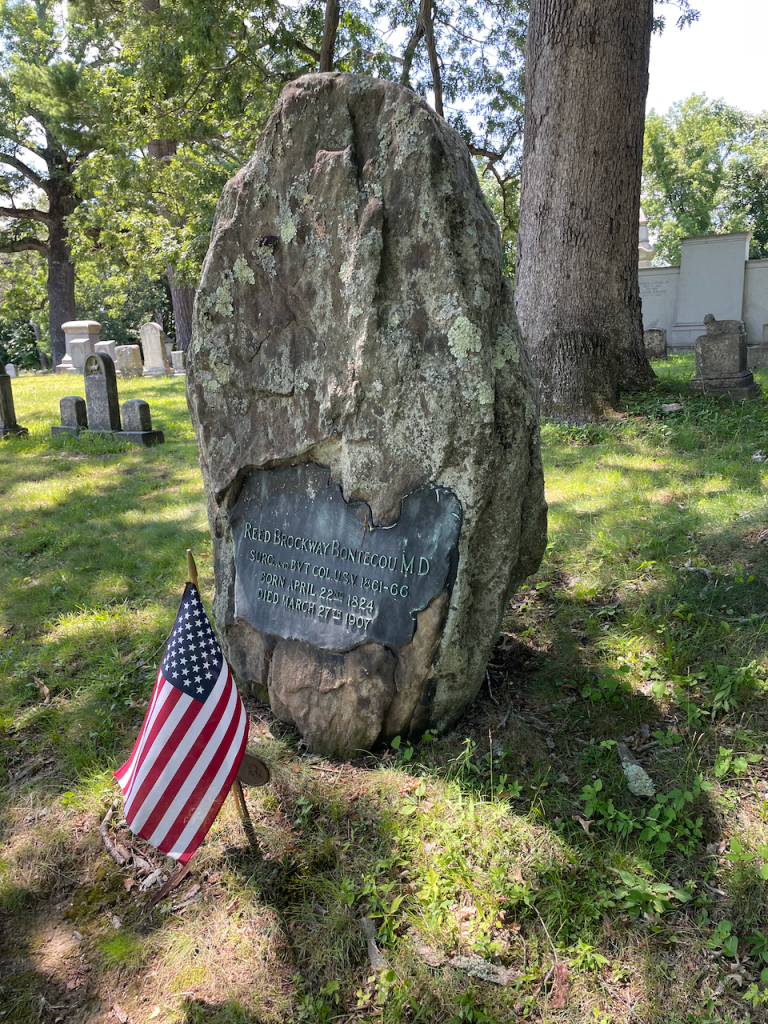
The gravestone of Reed Brockway Bontecou M.D. in Oakwood Cemetery, Troy, NY.

While the Cluett family, which played such an important part in the history of Christ Church, is now probably the best remembered name locally, on a national scale the most renowned person, by far, would be Dr. Reed Brockway Bontecou.

Dr. Bontecou’s name appears in medical journals dealing with surgery techniques and the beginnings of plastic surgery, in photographic journals detailing his photographs from the Civil War, and on Civil War and veteran sites, because of the pioneering nature of his surgical methods and how he recorded them in photos at such an early date of the craft. A few years ago, the Hart-Cluett Museum in Troy had a whole exhibit dedicated to Dr. Bontecou and displayed his medical bag.

In terms of the history of Christ Church, United Methodist in Troy, his lifetime spans all three of the buildings that have stood on State Street between the Williams Street alley and 5th Avenue, growing up in a devoted Methodist family. 

He was descended from Pierre Bontecou, a French Huguenot, who was linked to Dutch Protestants before him. Pierre arrived in New York City as a refugee from the regime of King Louis XIV in the late 1600’s, and the family originally worshipped in a French speaking Huguenot (protestant) church. One branch of the family ended up in New Haven, CT. They were industrious and successful, but like many in the area suffered financially and physically at the hands of the British during the struggle for independence. This brought one branch of the Bontecous to the “village of Lansingburgh”  in the late 1780s. Subsequently, Peter Bontecou, father of Dr. Reed Brockway Bontecou, was brought to Coeymans by his parents. But when still “a young lad” he removed to Troy to work as a clerk in a shoe store. He later became the proprietor.

Peter was a lifelong and ardent Methodist. Whether he heard about Methodism when he arrived in Troy, or had already made contact with the dedicated group already established in Albany County, we do not know. However, our records show he was a leader of State Street Methodist from its earliest days until his death in 1868. The family genealogist describes him as “cold and austere in manner, and strictly honest in all his dealings; a member of the Methodist Episcopal Church, and a great student of theological works.“

Reed was his first child. He had married Samantha Brockway in Troy in 1823. A year later he had a motherless infant son. Samantha’s death 2 weeks after giving birth was credited by some historians for Reed becoming a physician. 

Even as a child, Reed was studious, with a naturally curious, scientific mind. When a boy, he started a collection of sea shells and he noted the similarities and differences as he catalogued them. According to the History of Rensselaer Co., New York by Nathaniel Bartlett Sylvester, published in 1880, he attended the “High School Academy” then Rensselaer Polytechnic Institute and then graduated M. D. from the Castleton Medical College, VT. At the age of 22 years, between attending RPI and medical school, he went on a year-long voyage up the Amazon to study. He was married, on July 18, 1849, to Susan Northrup and they went on to have 5 children. 


In 1857, at the Troy Hospital, Bontecou “ligated the right subclavian artery for diffuse traumatic aneurysm of the axillary artery, the first successful case in America and one of the first three on record” https://en.wikipedia.org/wiki/Reed_Brockway_Bontecou

 In 1861, he left his physician’s practice to become the medical officer of the Second Volunteer Infantry of New York. Within 3 months he was running the Fortress Monroe military hospital and then was asked to lead Harewood Hospital in DC, which he left at its closure in 1866. By that time he had been brevetted lieutenant-colonel and colonel of volunteers for his faithful and meritorious services during the war. 

He returned to Troy and became the assistant surgeon at the Watervliet Arsenal, resident surgeon at Marshall’s Infirmary off Hill Street in South Troy, and had a private medical practice for four more decades. He is quoted in numerous coroner’s reports in Troy and area newspapers, was an official examiner for those seeking Civil War pensions, and held a number of prestigious positions in medical societies. He published reviews of his work and inventions, which included a special kit for soldiers to take with them into battles to self-treat a wound until help arrived, greatly increasing their chance of survival.

His name appears in the works of Arthur Weise who published several books on Troy in addition to Sylvester’s history of Rensselaer County. The Hart Cluett Museum had a display about his life and work, a few years ago, and displayed his medical bag.

According to the site dedicated to medical collections: “Bontecou’s peers respected ‘his unselfish character, his strict devotion to the truth, his extreme modesty and his unswerving fidelity to his students, colleagues and friends,’ noted one physician. Another doctor called him, ‘the Napoleon of Surgeons.’ “ That site hosts a long article, with illustrations, and catalogs his medical achievements. It is entitled: “Dr. Reed Bontecou’s Pocket Surgical Wallet, Bloodstained from the First Recorded Battlefield Amputation in the Civil War, on a Soldier of the 5th New York (Duryee Zouaves) And the Coins Driven into a Soldier’s Groin by a Bullet!”

The “Faces of the Civil War” blog has an entry entitled “The Napoleon of Surgeons” about Bontecou. http://facesofthecivilwar.blogspot.com/2013/05/the-napoleon-of-surgeons.html

In addition to the medical sites, he is remembered on historical photography sites for his pioneering use of the art as a documentary tool during the Civil War. This site has the most extensive descriptions of those achievements:

One of the largest online collections of his photographs can be found at: 

https://www.robertandersongallery.com/gallery/reed-bontecou/

The site says: “Reed Bontecou was responsible for pioneering, and taking, the largest number of photographs of wounded soldiers during the Civil War and was the single largest contributor of photographs and specimens to the Army Medical Museum and medical publications of the time. His close up images of surgery, anesthesia, and patients posing with their pathological specimens were unique to his time.”

Just a few of the many sites which speak of Dr. Bontecou, for all his great qualities, do recount a lapse of judgment and somewhat of a fall from grace, in a situation that caused his wife Susan Northrup Bontecou to file for divorce.  Details are few. One site (the Faces of the Civil War blog,) quotes a New York Times report that Susan’s accusation was “criminal intimacy”- the term used for an affair with a married person – and gives two names for the woman involved. All other references state simply that they divorced because of his affair with a young woman. For now we will leave it at this: in the strict society of his day, and doubtless among his colleagues and social group, this brief affair must have been quite a scandal, and stirred up much gossip once divorce proceedings began, but I have found few references to it.* What we do know is that, despite the embarrassment and notoriety, Dr. Bontecou did not leave the city in disgrace and his career does not seem to have been radically changed by the events. He continued to be a member – and head of – various esteemed organizations and to work with the military, at Marshall Infirmary and in private practice in Troy. The divorce was finalized in 1883. He never remarried.

Bontecou died in 1907. He is buried in Oakwood Cemetery, Troy.

(The photograph was taken by the author on 4th July, 2025. The headstone is very unusual, and I have not seen another in the century which is uncarved rock.)

Other interesting articles:

https://spotsylvaniacw.blogspot.com/2013/07/podcast-battlefield-photography-of-dr.html

https://www.hartcluett.org/rensselaer-county-blog/dreadful-accident?rq=bontecou

https://www.seekingmyroots.com/members/files/G000711.pdf

Bontecou genealogy, which starts with the amazing maritime adventures of a famous Dutch family member. 

The FindaGrave website includes additional details of his Civil War Service I have not seen elsewhere and photos of the doctor, in uniform and on horseback. 

https://www.findagrave.com/memorial/7050830/reed-brockway-bontecou

*Ron Coddington’s blog: Faces of the Civil War  says: “Susan Northrup (1828-1911) and Bontecou married in 1849. She alleged criminal intimacy between her husband and Emma Josephine Murray, also known as Emma Brockway. According to the 1870 U.S. Census, she is the daughter of Reed Brockway. There may be a genealogical connection between this branch of the Brockway family and that of Bontecou’s mother, Samantha Brockway Bontecou (1803-1824). New York Times, November 28, 1883.”  As I started to research the matter, errors in family trees made the strands of the tale hard to untangle for this essay: I may go back to researching who this Emma was, as the only Emma in the family was never known as “Emma Josephine Murray” – even a little research has thrown up other inconsistencies with even that brief account and no interest in the story in local newspapers so far – Janet

The Methodist Episcopal Churches of Troy, NY: First German Methodist Episcopal Church & St Titus Methodist Mission

Extended notes on State Street Methodist Episcopal Church (now Christ Church United Methodist) and the buildings and congregations that came from it.

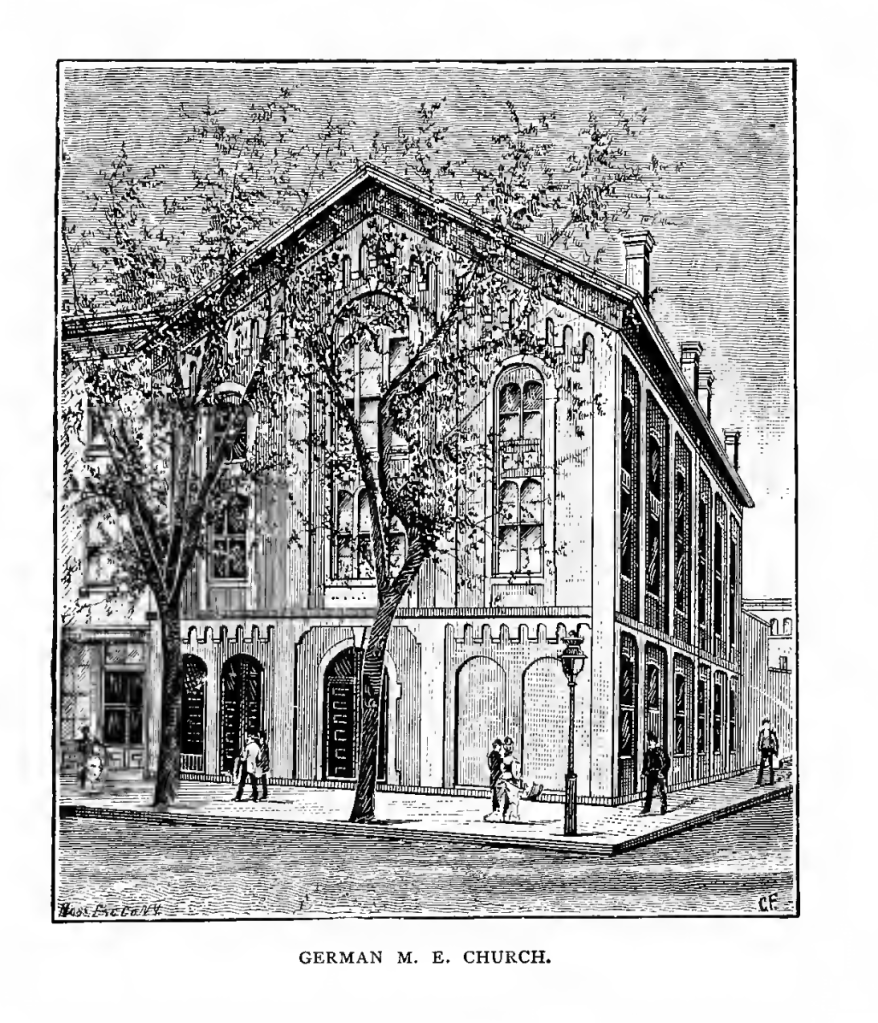
“Although Troy had from a very early date not a few German inhabitants, it was not until 1855 that an effort was made to form a religious society, composed exclusively of German people. At that time it was estimated that there were no less than 2500 Germans in the city. The first German minister, who undertook to form a German society of a religious denomination in Troy, was the Rev. Mr. Swartz, the pastor of the German Methodist Church in Albany, who in 1855 began to conduct religious services in a building on the northwest corner of First and Ferry streets. Some months later, the Rev. F. W. Dinger of the New York Conference continued these services in the True Wesleyan Methodist Episcopal Church, on the south side of Congress Street, at its intersection with Ferry Street. In that building, the First German Methodist Episcopal Church of Troy was organized, on July 25, 1857. The society was incorporated March 31, 1859 (…) Shortly afterward the society purchased two lots on the north-west corner of Union and State streets for $1,500. The buildings on the lots were destroyed in the great fire of May 10, 1862.” (The History of Methodism in Troy, Joseph Hillman, 1888. p. 114-6.)

Interestingly, maps show that was the very point where the fire stopped along State Street, was just half a block from the current Christ Church, making the German Church the last structure lost on that street. The society then rebuilt, on that same lot, creating the church as pictured above, with the front facing State Street. It  was dedicated on March 25, 1863.

This congregation, along with the 5th Avenue/ North-Second Street congregation merged with State Street Methodist Episcopal, in 1925, the three merged societies taking the official title of Fifth Avenue-State Street Methodist Episcopal Church. Many of the leading families of this congregation became leaders in the merged congregation, and their descendants were members until the end of the 20th century.

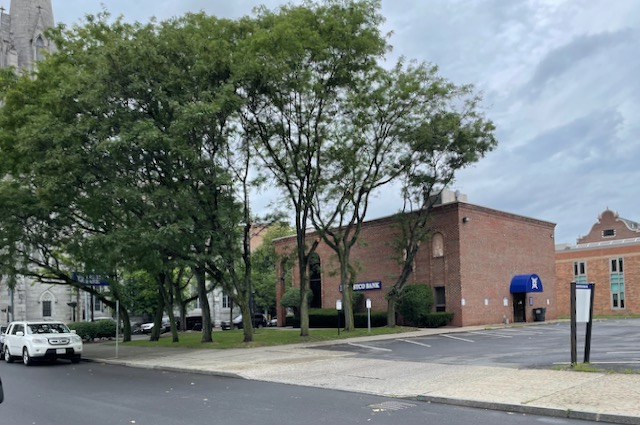
The original meeting house now lies under the car park behind the Central Library. As for the building above, Union Street no longer exists either side of State Street. It was the name for an alley which ran between Fifth and Sixth Avenue (alleys in Troy are named as streets) and this lot is now under the Trustco bank parking lot beside the Court building and Police Station. Maps show the building as one lot wide , but going back the whole two lots, as in the description above.

The spire of Christ Church United Methodist is at the left, the area immediately behind the sign at right is where Union St (alley) was. The black-topped parking lot was the site of the church. Out of site at the right are the municipal buildings and Police Station (corner State and Sixth.)

The spire of Christ Church United Methodist is at the left, the area immediately behind the sign, at right, is where Union St (alley) was. The black-topped parking lot was the site of the church.

The buildings on the east side of Fifth Avenue were removed during the 1960’s as part of an urban renewal program. I suspect this, too, was a victim of urban renewal, as the September 1950 copy “The Spire: Newsletter of Fifth Ave-State St Methodist Church,” lodged at the Troy Central Library, states the Liberty Presbyterian Church was at that time the occupant of the building above. It may have become unstable or in a fire between those two dates – so while that is unclear at time of writing, before that happened it became home to the …

St. Titus Italian Methodist Mission

So little is known of this congregation, that it has not appeared in Christ Church histories until this point. According to the collection of historical materials of Troy Conference, by Samuel Gardiner Ayres, archived at the Hart-Cluett Museum in Troy, St. Titus began as a mission to Italian families in 1913. However, he also states it began at that time in the Third Methodist Episcopal Church, which had been sold 15 years before that to the Ukrainian Orthodox congregation. I suspect this was an error, and the real location is 43 State Street – the German M.E. Church, where they remained after the latter congregation moved out.

The Adirondack Record- ElizabethTown Post newspaper for April 7th, 1932, carries an announcement by the Ausable Forks Methodist Church that: “The Reverend Lucius Martucci of St. Titus Italian Methodist Church, Troy, N.Y.” would give a talk on “The Melting Pot in America” in which he would talk of the pioneering missionary work of his mission among “the Italians of Troy.” The newspaper has another article about how the same church donated money each year to the St. Titus mission, stating it was the “only Church in the Troy Conference area, in which services are conducted in the Italian Language.” it gives the address of the church as 43 State Street, the same address as the building vacated in 1925 by the German Episcopal Church (above.) Interestingly, the author remembers several people named Martucci in the congregation, as well as the Rossi family, whose name is on a brass offering plate in Christ Church, United Methodist, to this today. It may have come along with the families when the congregation merged into State Street, at an unknown date, whether at its demolition, having shared the building with the Liberty Street Presbyterian Church, or before that, leaving the building empty for its new owner. I suspect someone will know…and if so, I will gladly update this mini history.

Line drawings and quotations are from “The History of Methodism in Troy” by Joseph Hillman, 1888, available as a PDF, free of charge, at a number of online archives, including the Library of Congress. Photographs are the author’s.

The Methodist Episcopal Church of Troy, NY: Levings Chapel/ Fourth Methodist Church/ Levings Church.

Extended notes on the Methodist congregations associated with the State Street Methodist Episcopal Church ( now Christ Church, United Methodist.)

Fourth Methodist Church/ Levings Chapel, 63 Mill Street, South Troy, NY

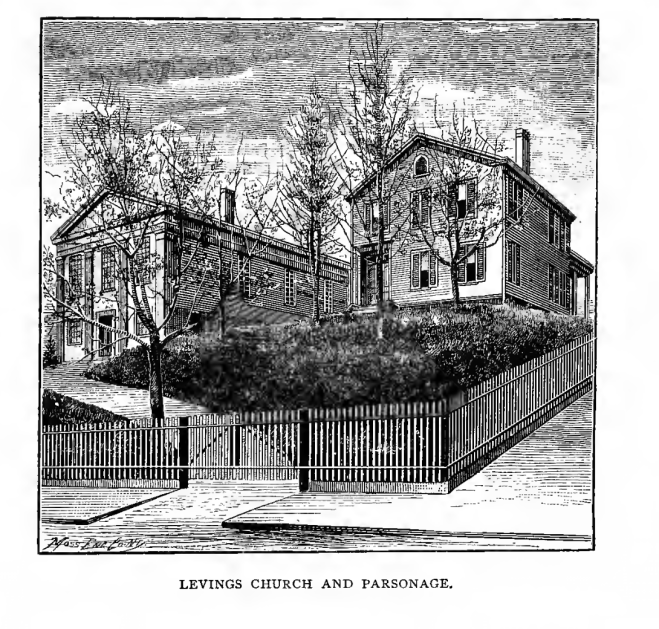
In the mid 1830s, Methodists who were working in the nail factory on Mill Street, began to ask for a church to be erected closer to their place of work and homes. According to Hillman, they were holding worship services at the nail factory. On September 24, 1838, they met at the factory and designated themselves as the “Trustees of the Levings Chapel in the city of Troy,” also known as Fourth Methodist Church of Troy.

In 1850, they erected a sanctuary opposite the factory. Two years later, the Rev. Tobias Spicer, another early Methodist from the State Street church,  and who was appointed as pastor of the Levings Chapel society, spoke unflatteringly of his work there: “My labors this year were mostly in South Troy, where we had a feeble society, which had lately built a church. “ None the less, by the early 1860’s the church had a membership of 140, and in 1888, at the publication of Hillman’s book, the number had swelled to 212 members, by which time the church had been renamed “Leving’s Church” though the old name of Chapel was often used. 

The congregation continued until the 1960’s, when the decision was made to close it, rather than execute the much needed expensive repairs. The remaining members merged with the Green Island Methodist Church, now called Good Shepherd United Methodist Church, and anyone looking for genealogical materials from Levings Chapel could start there.

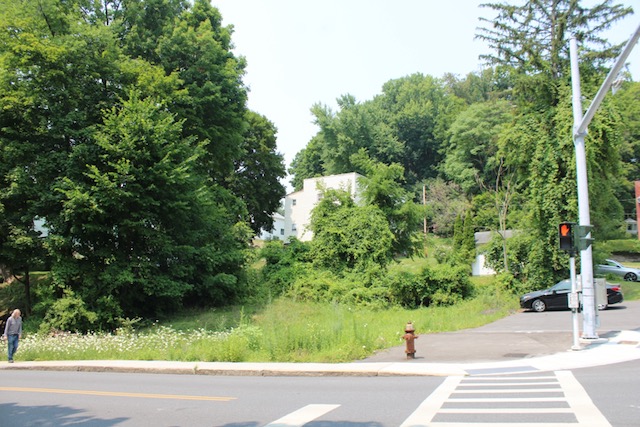
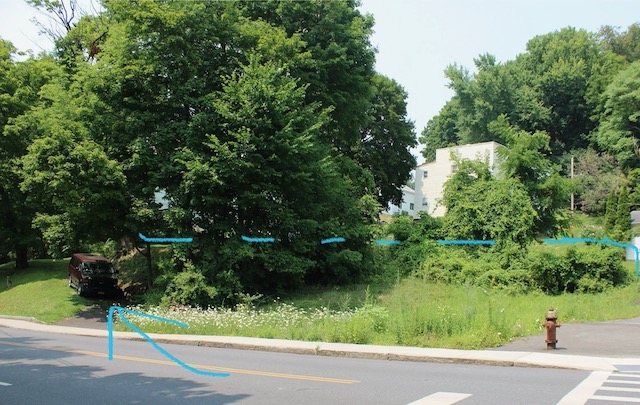
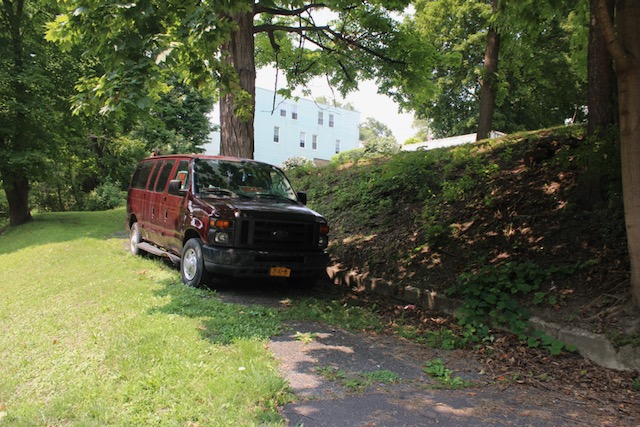
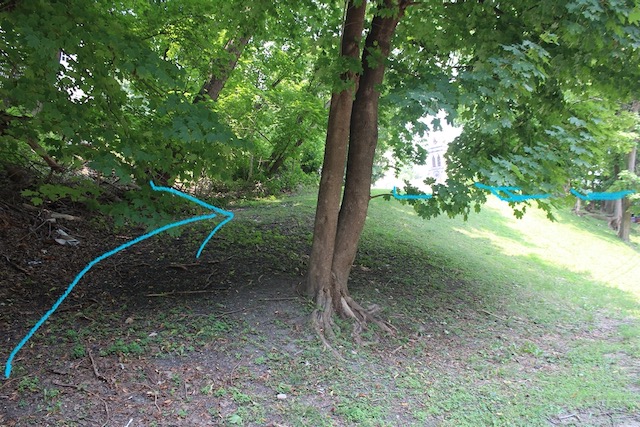
The last service was held on Palm Sunday, 1968, and the decision seemed prescient, given that during the following Winter the roof collapsed during a heavy snow storm and shortly afterward the church and manse were torn down. The lot for the two buildings remains empty, and stands on the corner of Mill and Erie Streets, and across Erie Street from the Woodside arts center, which was previously Woodside Presbyterian Church. The photographs below show the site, now obscured from the road by trees – the blue marks delineate the platform which remains and the two disused paths leading to it, one covered in gravel and the other metallized. The tower of the neighboring former Woodside Presbyterian Church can be seen beyond the trees. The platform can also be glimpsed behind current homes from the top of Erie Street.

The substantial buildings of the nail factory and Albany Steel Works, which lined the Wynantskill at the time, have also long-since disappeared. Today there is a walk around Burden Pond, down beside the Burden Falls and then on toward the Hudson River. If you look for them, there are still bricks and a few ruins of the old mills, in places. The location is famous for the giant Burden Water Wheel that used to stand there, purportedly the most powerful water wheel ever built. Several websites give those details, and also tell how an RPI student used his knowledge of this wheel, and his engineering skills, to build the first fairground pleasure wheel for the Chicago Columbian Exhibition in 1893. His name was George Washington Gale Ferris. For the first members of Levings Chapel however, it was simply one of the amazing pieces of new technology, which made them so productive and helped create Troy’s wealth.

As for the Rev. Noah Levings, this early convert to Methodism by the State Street faithful, while still an apprentice blacksmith, will need to have a brief history of his own at later date.

Line drawings and quotations are from “The History of Methodism in Troy” by Joseph Hillman, 1888, available as a PDF, free of charge, at a number of online archives, including the Library of Congress. Photographs are the author’s.

The Methodist Episcopal Churches of Troy, NY: Fifth Avenue/ North Second Street

Extended notes on the Methodist congregations associated with the State Street Methodist Episcopal Church (now Christ Church, United Methodist.)

“The expediency of taking advantage of the growth of the city northward of Grand Division Street, and of having a church in which the seats were free, caused the State Street society to give consideration to the project of providing a place of worship in the north part of Troy. On May 23, 1831, the Quarterly Conference appointed a committee ‘to provide a place for preaching somewhere in the bounds of the fourth ward.’ On August 8, that year, the committee reported ‘that the only place to be had ‘ was ‘the dwelling-house’ of Stephen Monroe. A committee of five persons was then appointed ‘to provide a place or places for meetings in the first and fourth wards of the city (…) Considering that the lot on the northeast corner of North Second and Jacob streets would be an eligible site for a church.” (Hillman, pp 87-8)

On the evening August 13, 1831, the trustees of the State Street society “resolved that a subscription should be circulated throughout the City of Troy and elsewhere for the purpose of building a Methodist Episcopal Church in the fourth ward of the city ‘with free seats.” showing that the idea of having paid seating in the “mother church” on State Street had become an issue for some of the congregation.

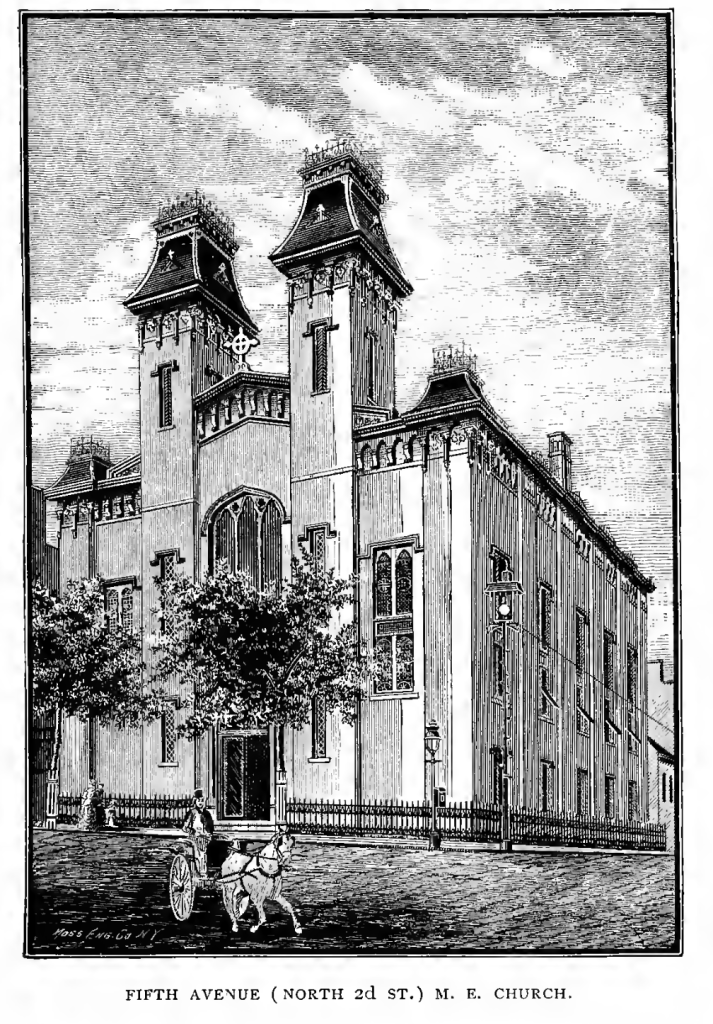
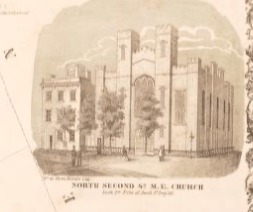
This building was a brick structure and included a basement. As soon as it was built the Sunday School which had been organized nearby, in the school-room of Miss Annie Manwarring, was moved there and prayer meetings began. “On Sunday afternoon, August 30, 1835, Bishop Elijah Hedding dedicated the church.“ (Hillman 87-88.) The congregation having grown in number, this church building was replaced with a grander structure, which was originally slightly less grand than the drawing found in Hillman’s book. The original aspect of the church can be seen in this 1869 map by William Barton which can be seen online at the New York Public Library website. The private house next door in that drawing, appears have become the parsonage.

The congregation chose to re-merge with the State Street congregation in the 1920’s, at the same time as the German Episcopal Methodist church. The merger of these three churches occurred in 1925, and is recalled by an unknown member of State Street Methodist Episcopal, upon the 125th anniversary of the church in 1939:“Time passed on with greater or less success to Methodism in Troy, until the year 1925 when the mother church grew lonesome for her children and it was decided to unite the congregations of State Street, Fifth Avenue and the German Church under one head whose name should be the Fifth Avenue-State Street Methodist Episcopal Church.”

(quoted by Rev. Dr. James Fenimore in his 1998 paper: “Christ Church, United Methodist – a Church on the Edge of an Apocalypse” from a letter to the church entitled “To the Pastor and People of State St. Methodist Episcopal Church.” This paper is available online.)

The building and its parsonage became the property of St. Peter’s Armenian Apostolic Church in 1927. That congregation left the building when they constructed their new church in Watervliet, in 1971. An African American congregation then worshiped in the church, until it became suddenly and dangerously unstable, and was razed by the City of Troy in the 1999. The parsonage was demolished a little later.

In 2024, the lot which was occupied by the church and parsonage, is used for parking. It is located between Federal and Jacob Streets on Fifth Avenue, in the area now known as Columbus Square.

Line drawings and quotations are from “The History of Methodism in Troy” by Joseph Hillman, 1888, available as a PDF, free of charge, at a number of online archives, including the Library of Congress. Photographs are the author’s.