A story about the remarkable early Methodists of Troy, NY and especially those associated with the State Street Methodist Episcopal Church and its branches.
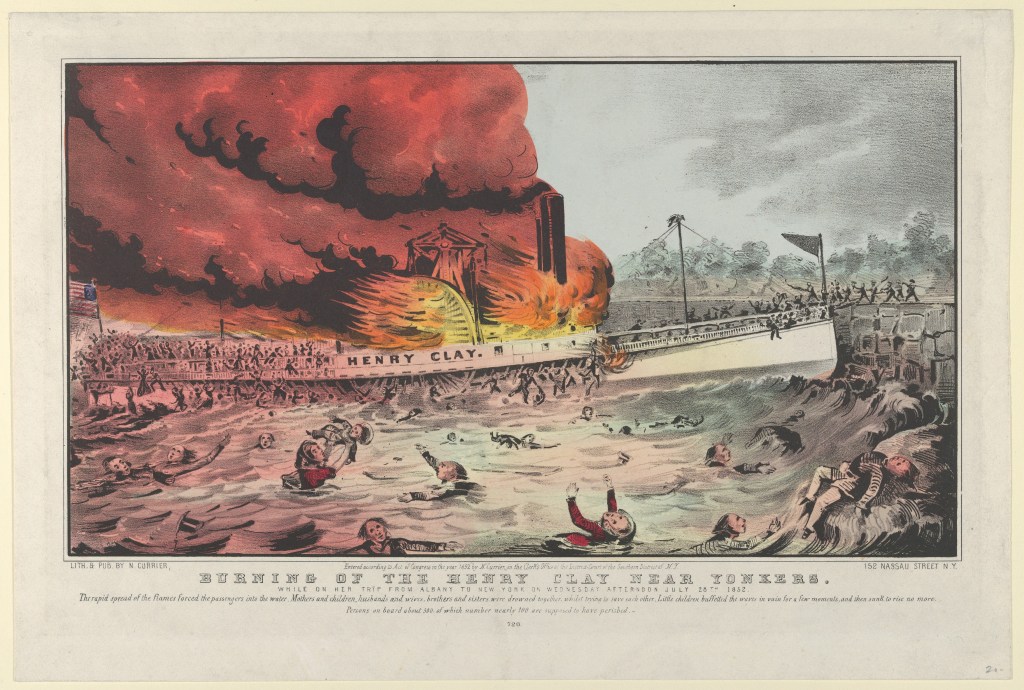
Burning of the Henry Clay Near Yonkers–While on Her Trip From Albany to New York on Wednesday Afternoon July 28th, 1852.–The rapid spread of the flames forced the passengers into the water. Mothers and children, husbands and wives, brothers and sisters were drowned together, whilst trying to save each other. Little children buffetted the waves in vain for a few moments, and then sunk to rise no more. Persons on board about 500 of which number nearly 100 are supposed to have perished., 1852
American,
Hand-colored lithograph; Image: 7 9/16 × 13 1/2 in. (19.2 × 34.3 cm) Sheet: 10 1/16 × 14 15/16 in. (25.5 × 38 cm)
The Metropolitan Museum of Art, New York, Bequest of Adele S. Colgate, 1962 (63.550.101)
http://www.metmuseum.org/Collections/search-the-collections/662253 (Public domain.)
“One of the most touching incidents illustrative of the sanctifying power of God’s grace and the Christian fortitude of a pious woman, I may here relate as a tribute to the memory of a much- loved relative and an estimable member of the State Street and Congress Street societies, Miss Elizabeth Hillman, familiarly called Aunt Betsey Hillman, who was well-known to all its people as an earnest Christian and a zealous worker in the Lord’s vineyard. During revivals she frequently gave evidence of her joyous exaltation of soul with loud shouts of praise and hallelujahs. On
Tuesday evening, July 27, 1852, while present at a prayer-meeting held at the residence of Noah Clapp, a member of the State Street Church, she led in prayer. One of the special favors which she solicited of the Great Ruler and Disposer of events was that when her work was done on earth she might be called quickly to heaven, for she dreaded the pains of a prolonged illness.
On the following morning she took passage on the boat Henry Gay (sic), plying between Albany and New York. On the way the boat began racing with another steamboat, the Armenia, on the opposition line. The excited passengers became greatly alarmed for their safety. A young woman from Albany was much frightened and Miss Hillman, in her endeavors to calm her apprehensions, spoke to her about the salvation of her soul. Discovering that she had not yet accepted Christ as her Saviour, and was wholly unprepared to die, Aunt Betsy urged her to give her heart to God. This she promised to do, if she should be permitted to get off the boat alive. Shortly afterward the boat was discovered to be on fire, and was steered toward the shore. In attempting to save their lives about fifty of the passengers were burned or drowned. The young woman and Miss Hillman, in seeking a way of escape, were compelled to decide which one of the two should perish on board the burning boat. Aunt Betsy at once urged her dismayed and sorely-distressed companion to leave her, saying: “I am prepared to die, and you are not.” The young woman fortunately escaped and afterward obtained that peace of soul, of which she
delighted to speak when tearfully telling of the noble unselfishness of the Christian woman who went to Heaven in a bright mantle of flame. Her age was fifty -seven(sic.)” (Methodism in Troy, Joseph Hillman, 1888, pp79-80. She was actually 67. )
Joseph, the author of the seminal work on the history of our congregation, was the nephew of the woman in the story. He writes that the The Hillman* family, Isaac and his second wife, Nancy Hillman joined the church in 1827, as the second church structure, the “brick church,” was being built. Isaac had come under the influence of the renowned Methodist preacher, Lorenzo Dow, when the family still lived in Vermont, and became a fully confessing member of the Methodist Church in 1809, at the age of 12. In reality, as a family of German Palentines finding refuge in Ireland, his whole community was already allied with the Methodists before many migrated to America, many settling in the area of the New York-Vermont border. While Isaac and his wife immediately appear in the official membership records of the church, the first time Elizabeth HIllman is mentioned, in the surviving records, is in 1835, though she may have joined earlier. City Directories show that this extended family lived in adjoining lots on Congress Street, with Elizabeth and their brother David first appearing in the Troy City Directory in the 1837-8 edition, which says that she is “boarding” at 190 Congress Street Extended, with the rest of the family, including David. Another brother, John Hillman, a physician, appears in the Troy listing for only one edition.
In Ireland, the family had kept their German name of Bergmann, but used various versions of the last name until the contingent who moved to Troy translated it, quite literally, into English as Hill-man. Elizabeth was born on July 1st, 1784, the fourth of 8 children born to John (see below for versions of his last name) and Mary – also recorded as Maritia and Calreana – Miller. A book tracing the family line of her brother Isaac down to current survivors (“A Few More Left: The Story of Isaac Hillman” by Henry Z. Jones ,Jr.) reveals that there was something of a scandalous break up between her parents, with her mother being disowned by her husband at least twice, and even by her own father who, at his death, divided her one-sixth share of his wealth between John and Mary’s 8 children, leaving none to his errant daughter.
Her childhood went through other troubled times. In 1785, the parents and their four oldest children – including Elizabeth – were asked to “depart the town immediately” (Bennington, VT Official records) and again in 1808 when the family were “warned out” of Shaftsbury – something that happened when a family was in danger of becoming a financial burden on a community. At the age of 24, you would expect Elizabeth to no longer be living with them, most typically already married, but a notification in the Vermont Gazette, in 1791, could explain why she might be needed with her father: her mother had left the family home. She later returned for a while, during which time their youngest child, Isaac, was born, but left again in 1799. It is tempting to play amateur psychologist on the subject of why Elizabeth never married! Did Mary Miller reconcile with her children after their father had died? Enough, at least they buried her in the Mount Ida Cemetery inTroy, but I could find no evidence that she was living with any of them before that.
As for Elizabeth, “Aunt Betsey”, what we do know is that she was baptized as Elisabetha Barrackman, later Hillman, and is recorded in the Gilead Lutheran Church books of Center Brunswick, NY. which is intriguing, but there is family history linking the family to that area, including her mother’s family being in Brunswick. At the time of her birth, the family was living in Shaftsbury, VT and attending the Fourth Church, which later became the Shaftsbury Baptist congregation. Baptism In Center Brunswick would suggest this did not happen when she was a baby. Other siblings spent time with Isaac at various points of his life, in Middleburgh and then Lansingburgh, which is when Elizabeth reappears in records in1824. This was where Jerusha Sweet Hillman, Isaac’s first wife died, shortly after their second child was born – did she move in to help care for the children until he remarried? Either way Elizabeth was then to remain close to Isaac for the rest of her life.
During her life, Elizabeth conducted various property transactions, and at her death still owned a house in Lansingburgh, as well as being the owner of land on Congress Street, though she had previously sold some of the lots. There is no mention of any work she was undertaking in the city directories, but may have helped Isaac in his on-site business endeavors. She seems to have been left with sufficient money by earlier family members – her maternal grandfather is the one we know about – in order to buy land. It was enough for her to be generous, too: Elizabeth is listed as one of three major benefactors of the Congress St, later Trinity, Methodist Episcopal Church on 13th Street. The cost of building the church was $6,199.84 , but half the cost was donated by just three people: Elizabeth, Isaac and Alvin Williams. It faced the entrance to Prospect Park, and burned after the congregation had merged with the State Street church in 1965. (I have an essay about the church on this site.)
It is easy to presume she was a dour, unmarried, and hyper-religious presence, but her appellation of “Aunt Betsey” by church members and the fondness felt by her nieces and nephews belie that idea. Joseph Hillman calls her a “much loved relative.” She was certainly fiscally astute, especially in comparison to Isaac, who was far more prone to taking risks, making and losing and remaking his fortune on several occasions, though he was not to blame for them all!
Elizabeth’s life is a reminder of the danger** of the only feasible way for people in Troy and environs to travel to New York City, which they did, in surprisingly large numbers: by boat. It was a cut-throat business. Numerous companies rushed from port to port trying to get ahead of a rival boat to get all the passengers. Elizabeth’s final voyage, indeed, was not the only time she was involved with a ferry boat disaster on the Hudson.
A report in The Daily Whig newspaper in April, 1845, has Elizabeth Hillman of Troy, who was rescued from the The Swallow when a sudden snow squall caused the boat to strike a rock near Athens, NY, and within 5 minutes the boat was at the bottom of the river. A long list of passengers were rescued, but a few drowned, including Elizabeth Spencer, a “young convert” according to Joseph Hillman, who had only 8 days earlier united with the State Street congregation. (Methodism inTroy, p.63) Was she traveling with Elizabeth? We do not know, but how could that event not have influenced Elizabeth’s decision the next time she faces tragedy on the Hudson?
The New Yorker magazine in 1938 published a dramatic description of the fatal trip which claimed Elizabeth’s life (see link below.) The burning of the Henry Clay was the catalyst for a state law finally banning the racing of commercial ferry boats down the Hudson. It was too late for 50-80 souls (reports vary) including Elizabeth, though her brother Jacob, who was also traveling, did survive, and brought her body back to Troy.
Her death was officially given as drowning, although the telling of the story by her nephew makes it sound like she burned. A photo of her body in Jones’ book, taken after her recovery from the water, shows some dark marks, like soot, but is basically intact: she must have jumped or fallen from the boat, as others did, and drowned.
After her funeral, held at the Congress St Methodist Episcopal Church, Elizabeth was buried in the Mount Ida Cemetery, where her mother, brother David, and sister-in- law, Nancy, had all been buried before her. The memorial on her gravestone is quoted in the 1923 book, “Inscriptions of Graves from Mt. Ida Cemetery, Pawling Ave, Troy N.Y.” recorded by the Daughters of the American Revolution: “Elizabeth Hillman, one of the sufferers by the burning of the Steamboat Henry Clay, on the passage from Albany, N.Y. July 28, 1852. Aged 67 years.”
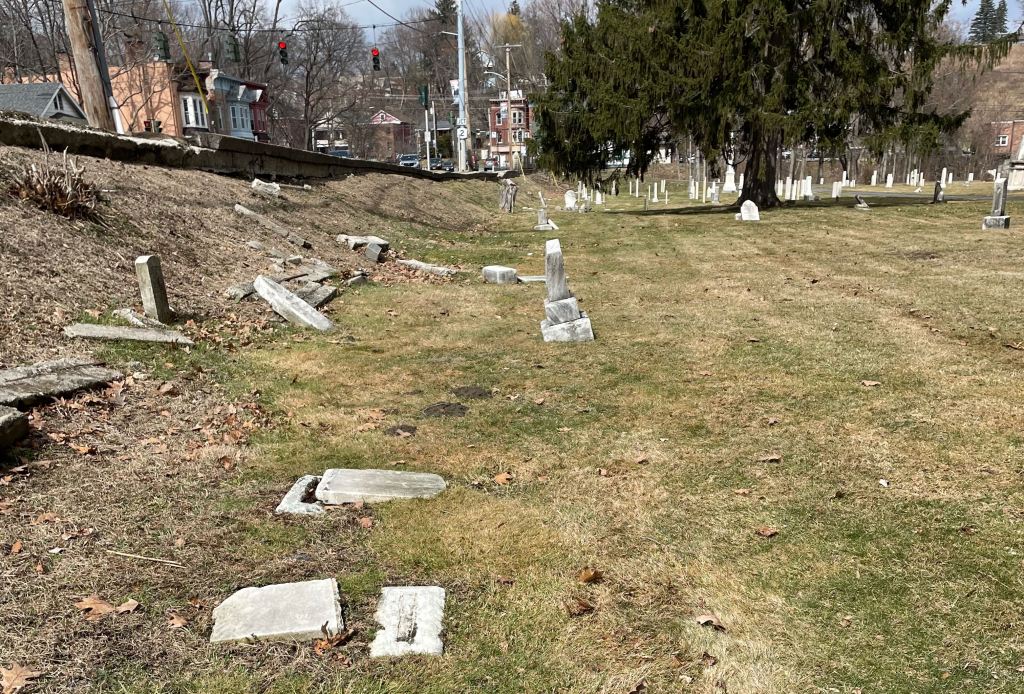
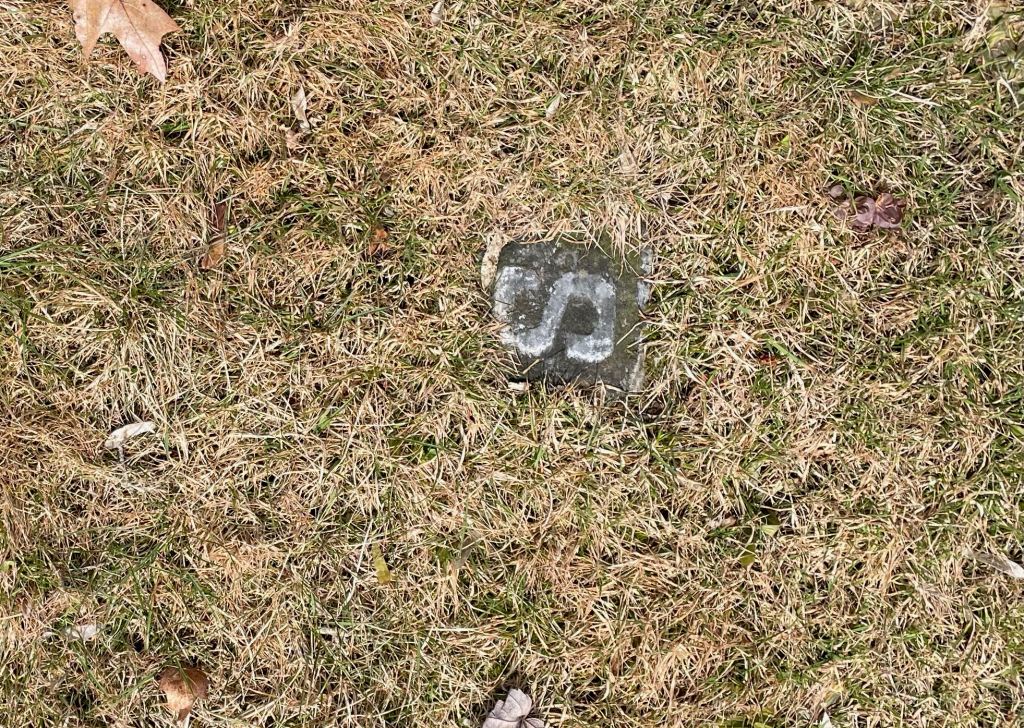
With no photos on the Find-a-Grave site of these four Hillman graves, I presumed the sites had been lost, and an hour’s walk around the site on a recent cold, wintery day, proved what a small percentage of the hundreds of graves are visible. Many stones have fallen, even in the past one hundred years since the DAR, with difficulty, recorded the inscriptions. Stones are broken, fallen on their face, have been completely covered by grass, have fallen down the hill and onto the walk beside the Poestenkill or become victim to subsidence at the edge of the road. Those that stand are frequently so worn by wind and rain as to be illegible. Volunteers continue to work on the site to restore and preserve the stones of hundreds of early residents of Troy, including many from the State Street congregation. So, it remains with us to remember this courageous and faithful woman, who, with her family, became such an important part of the State Street, and Congress Street, congregations. In the third quarter of the 19th century, Troy was an overwhelmingly Methodist city – hard to imagine, I know! – and Elizabeth and her family surely played a large part in that, through their financial support, but also through their dedicated demonstration of a faithful Methodist way of living.
Janet Douglass, Troy, NY, March 2026.
*Her father’s last name and some of the older children’s, was variously recorded as Birkman, Barckman(n), Barkman(n), Barkemann, Barrackmann, Barrickman, and Banackman but Isaac and the family, including Elizabeth, her brothers David and Jacob, and mother Mary, seem to have chosen the literal translation from the German – Hillman – at the time they move to Lansingburgh and Troy.
**In a sad postscript, this was not the last family tragedy caused by a racing steamboat. Her nephew, Isaac’s son born to his third wife after they moved to California, died when a racing ferry boat caused numerous passengers to be drowned, and nearly cost the boy’s mother life, too. Indeed Isaac himself had earlier been at risk of dying in a weather-related disaster at sea.. Isaac Hillman is such an interesting character he easily deserves an essay of his own: stay tuned!
An online copy of the DAR record of inscriptions at Mt. Ida Cemetery, Troy, NY.
Dramatic description of the race and the ship’s burning, when 50-80 of the 500 passengers died, the boat finally crashing near Yonkers.
https://www.newyorker.com/magazine/1938/07/23/the-fatal-hudson-river-steamboat-race
Also see the Wikipedia page for the boat and the disaster (Henry Clay 1851 steamboat)
The Swallow ferry boat disaster is described here:
The quoted biography of Isaac Hillman and his descendants is:
“A Few More Left: The Story of Isaac Hillman” by Henry Z. Jones ,Jr pub. Penobscot Press, 2005.
The County land records office in Troy, is the source for land transactions deeds for the family. The Central Library’s Troy Room holds all City Directories, since they began in 1829.

 janetintroy