Extended notes on State Street Methodist Episcopal Church (now Christ Church United Methodist) and the buildings and congregations that came from it.
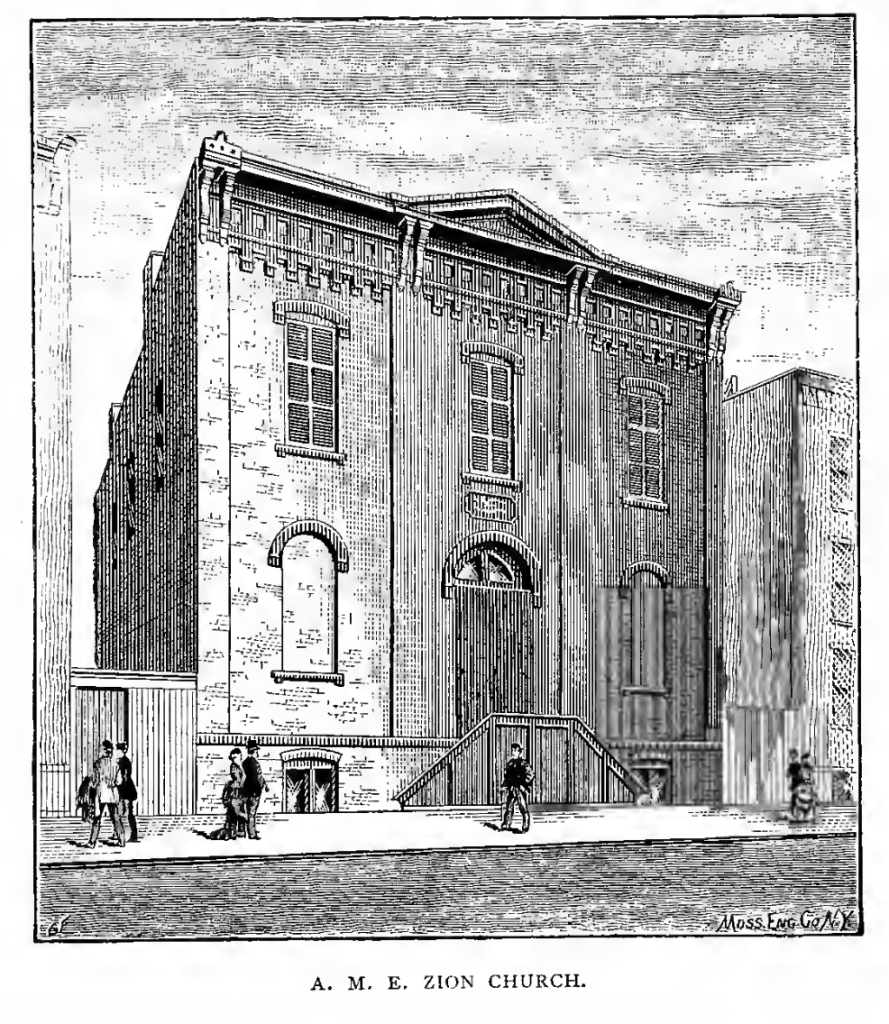
Of all the societies that came out of the State Street Methodist Episcopal congregation, this is the one that has had the most locations, all but the current one, having disappeared in the 190+ years since its formation.
Joseph Hillman in his History of Methodism Troy from 1888, which includes the engraving of their third location as seen above, writes:
“The origin of the African Zion Methodist Episcopal Church, is traceable to a class connected with the State Street Church, called “the colored class,” which was led in 1830, by John Dungy, an intelligent and pious man of African descent, who in 1831 became the pastor of the small congregation of colored people, which that year was known as the African Methodist Church of Troy. In 1832 the society took the name of the Wesleyan Methodist Episcopal Zion Church of Troy. A small wooden dwelling, on Fifth Street, north of Liberty Street, was fitted for a house of worship for the congregation. In 1841, the society purchased a lot and building on Fifth Street, and altered the structure into a church. On February 23, 1842, William Meads, Jacob Brown, Lewis Butler, Littleton Becket, and Lewis Jones were elected trustees of the Wesleyan Methodist Zion Church of the city of Troy. The property was sold about the year 1863. In the spring of 1864, George Bristol purchased for the congregation, the property on the east side of Seventh Street, between State Street and Broadway, the title of which was afterward conveyed to Joseph Hillman, Reuben Peckham, and Adam C. Fellows as trustees. On the resignation of A. C. Fellows, H. Clay Bascom, was elected his successor, and he in turn was succeeded by Henry C. Curtis. On the death of Reuben Peckham, Edward O.House was appointed to fill his place. On the brown stone tablet in the front wall of the brick building, in which the congregation worships, is inscribed : A. M. E. Zion Church, organized, A. D., 1832, erected A. D., 1865. The present membership is 79.” (Hillman. pp 118-20
I have included the entirety of that text, because it illustrates the issues that surface in writing about this congregation: we do not know in what spirit the separation of the State Street society, along lines of race and color, took place. The history gives us tantalizing, but contradictory, information. And when the author was invited to give a historical address in the current Fifth Avenue AME Zion, at one of their historical celebrations, the pastor did so explaining the congregation had few records – other than a founding date a few years earlier than the one mentioned by Hillman.
But the real puzzle for us today, stems from the photograph of the trustees of the congregation as preserved in Hillman’s book: the trustees include two men from the State Street leadership. Was their presence paternalistic? Was their presence altruistic, wanting to advertise the continued friendship of the two congregations, at a time when America was recovering from civil war, but hurtling into its ugly era of Jim Crow laws? Or somewhere between those options: they considered themselves as simply protecting their investment, both financial and emotional, with the African American society? Unless we get a lot of new information we can only guess.
Before we add just a little more information to that discussion, let’s talk about the origins of the congregation, and its various locations.
After looking at the various early maps, and not finding the first two churches named anywhere, all I can conclude from Hillman and other texts, is that the first location: “the small wooden dwelling on Fifth Street and north of Liberty” was a small wooden house typical of the neighborhood at the time – a worker’s home, which later made way for the breweries and factories that would be built there. The congregation had, in any case moved to their next location, also on Fifth Street, according to Hillman. They moved there in 1842. There may yet be records of the location for the sale of that second church, around 1863, as this was a time of massive rebuilding after the Great Fire of 1862. That fire engulfed a huge area, stopping half a block short of the State Street M.E. Church, but engulfing the site of the German M.E. Church, and a Presbyterian Church less than a block away. The biggest clue to location, however, is that in 1834, Troy’s very first church building, a Presbyterian church which stood on Congress Street in what is now Sage Park, was physically moved to Liberty Street, and began to be used as a day school for children of color, with evening classes for their elders. This in turn led to the building becoming the Liberty Street Presbyterian Church – a famous African American congregation. It would make sense that these locations were not too far apart. A number of buildings still standing could be imagined as being modified for a church, as there are a few wooden ones to this day, as well as what could be early brick buildings on the street. Most of that block became industrial buildings around this time: the purchase of the property around 1863 could have been to raze it to build a factory or a brewery, or could still be there, obscured by later renovations
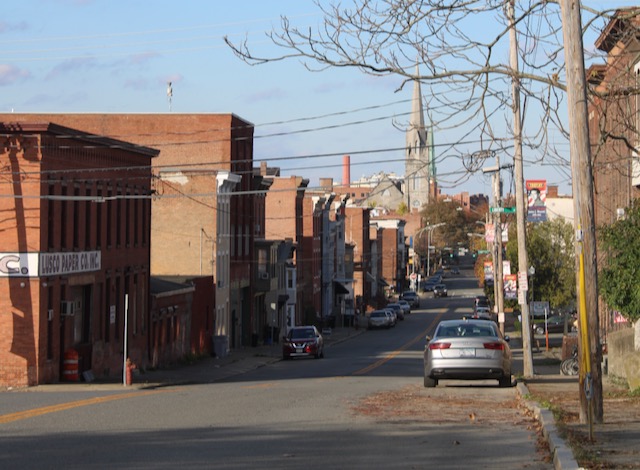
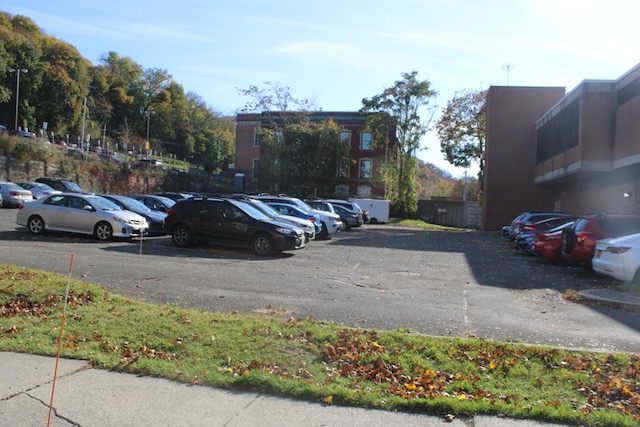
Their third church was the brick edifice, in the engraving at the top of the article.It was on the east side of what was Seventh Avenue, between State Street and Broadway, an area just north of the current County Buildings (formerly a school). The 1885 Sanford map, which can be viewed online at the Library of Congress, shows it in the center of that street, at a location very similar to one which had previously been used by the Ladies’ Home Mission, which Weise tells us was burned in the Great Fire of 1862. The whole area was rebuilt after that massive devastation, which destroyed homes, businesses, churches, the RPI building of that time, and the train station.
The Hart Cluett website has a page on Black Religious Societies with some information, which differs from my research, especially on the location of Troy High School and this church at the time – but thought that it was razed for the High School. Today, the site is under a parking lot, behind mid twentieth century offices.
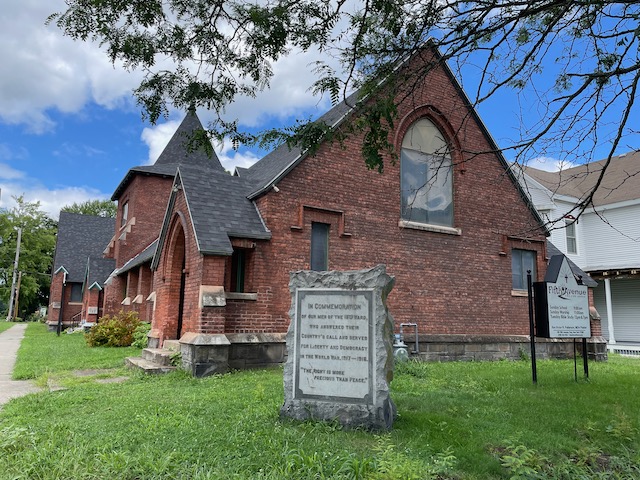
From there, the AME Zion congregation moved to the former Ninth Presbyterian Church, in North Central Troy. It stood on a now empty lot at the NW corner of 5th Avenue and Jay Street, having burned down in 1969. The next – and current – home of the Fifth Avenue A.M.E. Zion Church of Troy, is in what had been St. Savior’s Lutheran Church, (formerly a Unitarian Church), which had closed in 1968. The vibrant and socially active A.M.E.Zion congregation has served the local community from this building, at the corner of Fifth Avenue and 103rd Street, for over 50 years.
It is so appropriate that the history of this congregation has mostly centered on Fifth Street (now Avenue.) Fifth Street was one of the boundaries of the two fields where Jacob D. Vanderheyden, allowed the annual 6-day Pinkster or Pingster festival – meaning Whit Sunday or Pentecost in Dutch. Sylvester, in his book “The History of the City of Troy”(1880) quotes Henry Rousseau, who recalled: “In my early days there were many slaves in the state of New York. “Pingster” was the slave’s great holiday. The slaves of the four counties – Columbia, Albany, Schenectady, and Rensselaer – united in its celebration.”
As for the split between their congregation and the downtown Methodist congregation, historians of African Americans church history write that, by the 1820’s, all Protestant denominations were starting the process of splitting into separate white and black denominations. The State Street congregation seems to have done so later than many, but its timing, not longer after building a new brick sanctuary with a gallery level, does make me ponder if the church also introduced segregated seating at the end of the 1820’s, as that was one of the reasons other non-Methodist congregations had split a few years earlier. However, with the introduction of pew fees in the lower sanctuary space, to pay off the debt on the construction, I suspect there was plenty of reason for discontent. All we know, is, that the trend that had begun a few years earlier, spread to State Street.
I can imagine there was sadness when it happened, especially for the oldest members. Race – or class-based racism – may have been a matter of conversation for some Trojans, but was not seen as a subject of contention within the congregation. Hillman reports: “From the organization of the society not a few colored people were members of the church.” The inclusion of Africans in the congregation from the earliest days is corroborated by the “young daughter” of Caleb Curtis, an early founder of the society. She felt the need to defend the congregation from outsiders criticizing it, and at least some of those attacks were based on the racial identity of the members, as she felt the need to give a list of the notable person of the then village who attended, concluding:“I have thus been particular because it was asserted at a love-feast that the first society was composed of the lower order of person, and, at the same time, it was said that the time was when there was no place to hold prayer- meetings except in the basement of a house occupied by a black family. it is true that the prayer-meetings were held there sometimes. Ritta (the negro woman) was considered pious and had considerable gift in prayer. Her room was ample and decent. The person who made the statement must have been misinformed” (Phebe Curtis, quoted by Hillman, pp 13-4) Of course she knew the group actually chose to meet in Ritta’s room – her short history of the congregation, so often quoted by other authors in the following century, was based on the meetings often held in her father’s home, but also in other homes; at the very least the Curtis home was always available.
It is not surprising that African Americans, whether enslaved or free, were attracted to this young denomination: slave-owners were simply not allowed to be members of the society, following the work of the founder of Methodism. John Wesley had long campaigned for a law preventing the owning of slaves in Britain, while fighting a moral battle with those who profited from shipping slaves from Africa to the New World, many of whom lived in Bristol, where he spent much time.
As for John Dungy, “A class exclusively formed of persons of African descent was led, in 1830-31, by John Dungy, an intelligent and pious colored man.” (Hillman, pp 55) He includes him in the list of leaders of the State Street M.E. church in 1830-1 (p.176) and in the list of Methodist ministers, he is listed as the pastor of the African M. E church for 1831, 1832, 1833 and 1834 (Hillman, p. 288) after which the ministers no longer appear in his book. “The History of Troy and Lansingburgh” by A. J. Weise (1886), as well as the website of the current A.M.E. Zion congregation, lists the first minister appointed by their conference to the Zion M.E. Church of Troy, in 1834, as being Rev. R. Noyes. The only other reference found for John Dungy was a listing in the Troy City Directories for 1830, where he is listed as living at 4 Franklin St, occupation: shoemaker, and then for the years, 1831,1832,1833 and 1834 as the Rev. John Dungy, Pastor of the African Church, still living at the same address. His name is italicized which indicates him being a free person of color. He appears neither in the first city directory of 1829, nor in the 1835 one.
Nothing is known of the relationship between the white and black congregations after Hillman wrote his book in 1888, but it was doubtless far from ideal. However, during the author’s time with Christ Church, there were three occasions where the AME Zion congregation hosted its multi-district annual conference at the State Street location, where they filled the sanctuary and balcony with energetic singing, enthusiastic preaching, loud hallelujahs. It was a sight to behold, and an experience we were glad to participate in – not to mention the great smells coming from the busy kitchen and Fellowship Hall! It seemed a fitting time to welcome them back on site – and of course, the usual, mostly white, Christ Church congregation rejoiced to have their turn at being seated in the balcony…
The source book for most of the quotations is Joseph Hillman’s 1888 book ‘Methodism in Troy” which can be read online free of charge at a number of websites, including the Library of Congress. It includes the photograph of the 1887-8 Trustees of American Zion Church, with their names. Original Troy City Directories can be viewed at the Troy Central Library, and in facsimile at the Hart-Cluett Museum. Photographs are by the author.
 janetintroy