The 19th Century Struggle for Musical Instruments in Worship

The use of musical instruments in the church, it should be known, was not approved by its early members and no little opposition was shown to the gradual innovations that were made to support the congregational and choir singing with such instruments as the bass viol and organ. At one time, the singers in the church attempted to introduce the use of a bass viol and obtained a player to bring one to the church for a rehearsal. Seeing the objectionable instrument in the gallery, while on his way to class-meeting, Isaac Hillman took his pocket-knife and cut the strings of the viol, thereby defeating, the purpose of the ambitious choristers. Although he had used so summary a method to sustain the authority of the society, he nevertheless indemnified the viol-player for the loss of the strings of his instrument.(Methodism in Troy by Joseph Hillman, son of Isaac, p. 60)

Accompanied music in churches today seems so very ordinary, it is hard to consider what outrage the introduction of musical instruments into worship could possibly have caused, though there are Christians denominations to this day which forbid their use. In fact, many of us are  very familiar with the very opposite of that: friends and family members for whom the absence of a fabulous organist, extensive voice or hand bell choir, or a great band, is reason to avoid a church altogether. 

Our early records reflect the progression happening in many Protestant churches of the day: from unaccompanied congregational singing and chanting  – solos were also impermissible –  to the arrival of an organ. Indeed, we even have the wording of the original letter detailing why a group of leaders tried to prevent it.

So what was the problem? After all, the Psalms, in the Christian Old Testament, mention singing and dancing accompanied by musical instruments. The issue centers on the fact that in the brief comments in the Book of Acts, and in the Letters, about the early gatherings of those who followed “the Way” of Jesus, mention no instruments by name. When the people driving the Protestant Reformation started to look closely at the Biblical texts, intending to return worship to what they felt had been its original form, they found no instruments mentioned and began to call accompanied singing a “heresy” and so they outlawed it.

The records of the State Street Methodist Church reveal the hesitancy of moving away from this received Protestant wisdom. The congregation had been hiring a succession of men to teach multi part singing in the “classes” as well as to general congregation, from at least the late 1820s. In the early 1830s, the choir requested they be allowed to rehearse, at least occasionally, and for a one month trial period, with a bass viol: a very tentative step, indeed. They understood there would be objections, as detailed above. Nonetheless, the choir prevailed,  and the bass viol appears to have become somewhat acceptable in Sunday services within a decade. The idea of installing an organ, however, would  be a far larger step, partly it seems, because siting an organ seemed such an irrevocable step, and maybe even an offensive one to the very structure of God’s house.*

Christian Heritage Edinburgh has this brief history of the organ in worship:

“In AD 670 Pope Vitalian introduced the first organ in church history at the cathedral in Rome, but organs were not widely played in churches until the eighteenth century. In fact often they were met with great suspicion and even anger. The organ gradually made its way into general usage in the Catholic Church by the thirteenth century but some of the Reformers, particularly John Calvin (1509-1564), considered it an instrument of the world and the devil.” 

Even so, by the mid 1700’s organs were being installed in congregations in New England, especially in Episcopal and Congregational churches, and pressure gradually mounted in all denominations to include musical instruments, with a large and complicated organ as a prized status symbol.

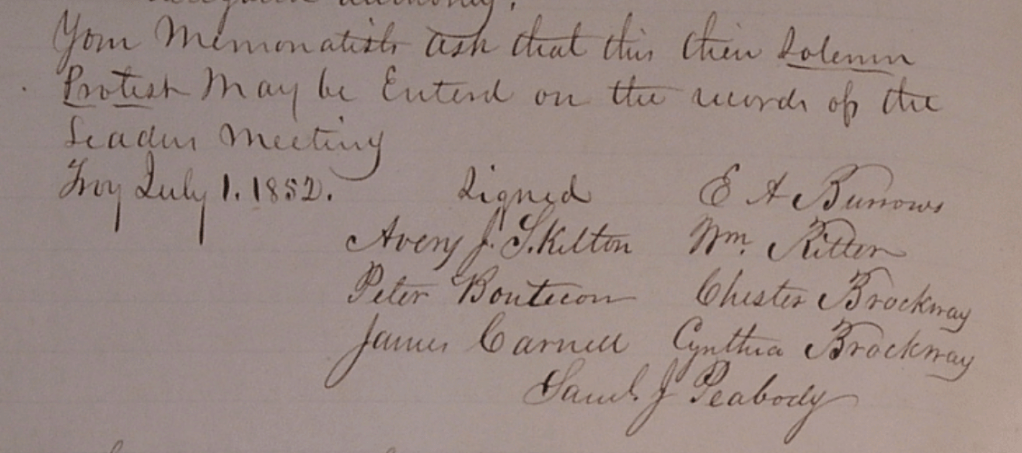
In the State Street Methodist society, those who fought hardest to prevent the acquisition of an organ called themselves the Memorialists. They were led by Dr. Avery J. Skilton, and when their cause appeared unsuccessful, they requested that the Leaders print their letter of objections, in full, in the minutes of their meeting held on August 22nd,1852. It begins: 

” To the Leaders and Stewards Meeting regularly assembled Brethren. 

A Church is an assemblage of pious persons associated together for the purpose of worshiping God, and of mutually aiding each other by advice, encouragement and exhortation to a Godly life and conversation, and to the exercise of holy disposition,” After several hundred words it concludes with a summary of the complaints of the Memorialists, who believed the leaders had made an “absurd” choice because firstly, the use of musical instruments is “unsanctioned by the Gospel”; an “imposition on their feelings” of people who joined the Church before this addition; an “injustice in a trespass upon the rights of property” of the members have paid their annual pew rental (threatening legal actions of trespass no less!); “an attempt to force the Church of God into accordance with man’s political preferences” (a comment on a presumed perceived imbalance between the objectors and those saying nothing, versus the leadership); “A withholding of the right of private judgment and conscience” – because there had not been a general ballot; and finally, they declared that the Leaders’ Meeting had “transcended its powers” and“violated the rights of members without the shadow of delegated authority” – a complaint that there had not been a vote for everyone, but neither were the leaders elected by the congregation as their representatives. The letter was signed by Dr Avery J. Skilton, Peter Bontecou, James Carnell, E. A. Burrows, William Ritter, Chester Brockway, Cynthia Brockway and S(Samuel? Sarah? Saul?) J. Peabody. 

By early 1853, the organ was installed and the topic only reappeared in the minutes when requests were made in following months to first “dispense with the organ voluntarys”(sic) and later, the organ interludes, showing that while the organ was deemed helpful in hymn singing, not everyone was comfortable with it being used in a performative way – or maybe this was a nod to those who had objected all along. The disagreement had been intense and passionate, yet those who protested the installation of the first organ did not leave the congregation when they failed. If limiting the use of the organ for a while was a small accommodation to its detractors, who had not simply moved on when they lost the discussion, this author can find it nothing other than heartening.

Janet Douglass, Troy, NY. February 2026.

*The organ discussion takes place in the Leaders’ Minute Book which records meetings from1849. It begins with the February 1852 meeting: “On motion of Bro. Matthews, it was resolved that the chorister be permitted to introduce an instrument called the melodion into the choir of the church on trial for one month.” Permission was continued for another month in March, but there was a motion “to rescind use” in April, but the decision was delayed after much discussion. A second April meeting and another long discussion ended with the resolution “in view of the feeling of the church on the subject of instrumental music in divine worship the purchase of an organ for the above purpose is inadvisible.”   At the meeting on July 2, 1852, “Dr. Skilton presented a paper…purporting to be a protest against the erection of an organ in this church, which he desired to read.” on the subject, and the following month his paper was recorded in the official minutes, as above. 

The first organist of the church was Mr. Conant who had first been hired as the Singing Master or Chorister, both terms are used, in November 1849. He was discontinued some months later, rehired in December 1850 and in February of 1852 he made the request to introduce a melodion. After Mr Conant left his position, the society tried to hire a Mr. Clucas but this led to strife with the leadership of St Paul’s who also believed they had hired him. There is no evidence he ever took the position with the Methodists, but Mr William Cluett did,  and the long and generous history of the Cluett family and this group of Methodists, began.


Quotation on the history of the organ is from www.christianheritageedinburgh.org.uk

For a contemporary take on the” heresy” of musical instruments in worship, read https://www.swrb.com/newslett/actualnls/InstrHer.htm
A Dream of Pigeons

An early story of the State Street Methodists, as recorded by Joseph Hillman

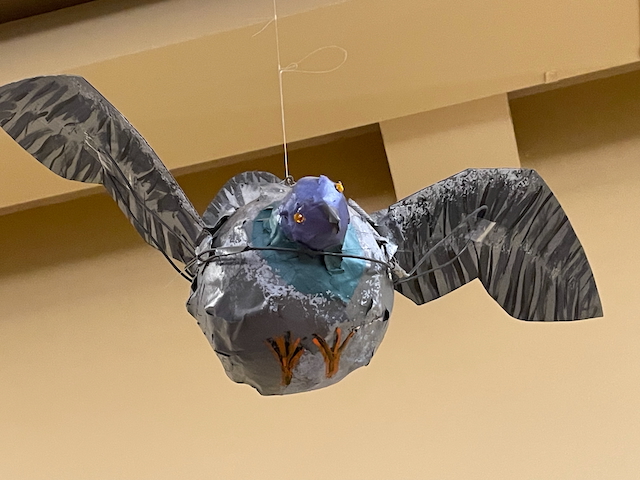
Isaac Hillman’s 1888 book,“Methodism in Troy,” is our main reference to the earliest days of the Methodist congregation on State Street in Troy, NY. We spent a whole year celebrating our 200th anniversary in 2007-8, including re-enacting some of those tales. We began with 3D wire and paper pigeons flapping their wings as they flew down wires from the balcony, over the heads of the congregation, landing at the communion rail at the start of worship one morning: an invention of resident engineer and installation creator, Alice Rose. They were decorated by members of the Sunday School and volunteers from the congregation, and 4 remain hanging in Fellowship Hall as a reminder of the dramatic event.

But why pigeons? In particular, why did we start with pigeons? It is because of a story told by Hillman. Here are his words:

”The congregation began to seek a suitable site for a meeting house. On the uninclosed ground then known as the Common, lying east of the line of Fourth Street, an eligible plot was found, which was designated on the map of the village as lots 743 and 744. They were originally part of the farm of Jacob D. Van der Heyden, which had been surveyed and laid out into building lots in 1807. As he had generously given to the Presbyterians and Baptists the ground on which they had built their meeting-houses, it was thought that if he were respectfully solicited he might be induced to convey lots to the society as a gift. When he was approached it was found• that he was not only unwilling to part with the property but personally opposed to the project of the society, asserting that the Methodists had no need of a meeting-house. Dr. John Loudon, a popular physician, who had begun his practice in the village in 1793, became greatly interested in the welfare of the society of which in 1810 he became a member, and he undertook to intercede with his brother-in-law to convey, for a small consideration, the lots to the trustees of the church. It is related that the business so much engaged his thoughts that one night he dreamed that he saw a large flock of pigeons fly over the village and settle down on the proposed site of the meeting-house. This dream he interpreted to presage the future prosperity of the church. After some further overtures, Jacob D. Vander Heyden consented to sell the ground for $500, demanding, however, the payment of an interest annually of $35 until the property was possessed by the purchasers. The conveyance was made on Christmas day, December 25, 1808.” (pp23-24 Methodism in Troy, Hillman, self-published 1888.)

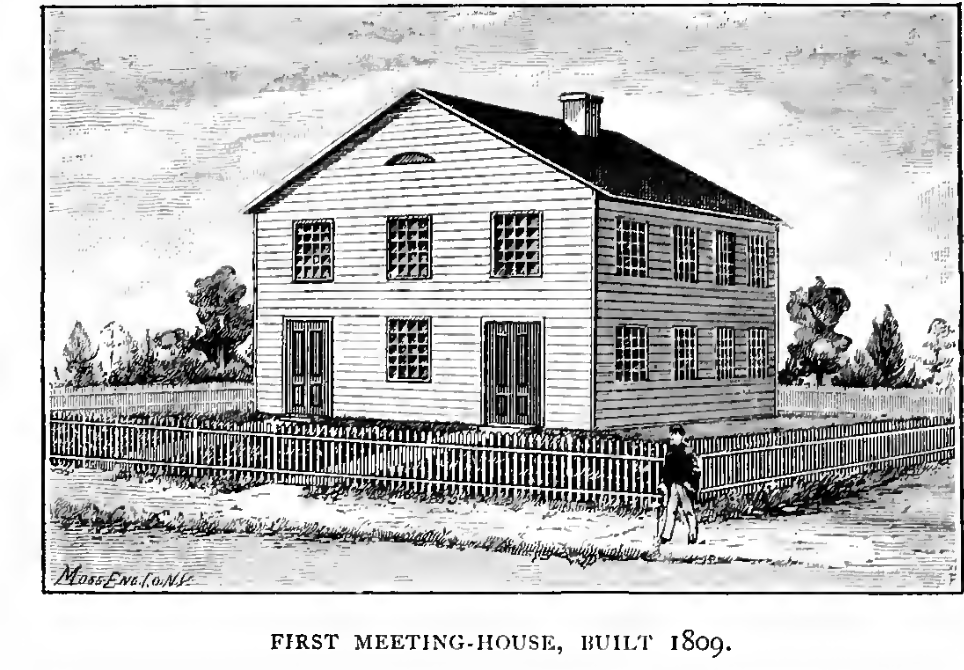
The  first two buildings were on that same piece of land, on the eastern edge of the Williams Street alley between Fourth and Fifth, facing State Street, where the parish house and garden are today. Early illustrations show that the first small white clapperboard building was on otherwise empty ground. The land had been Jacob D. Vanderheyden’s farm. This was the land which Vanderheyden had made available for the African American community, enslaved and free, to hold their annual week-long PInkerfest celebration. As the influence of the original Dutch farming families – with their numerous enslaved workers – waned, the land reverted to common land which Hillman describes as “not very inviting” as it was mostly dense weeds, briars and very little grass. Hillman further writes that a nearby stream would frequently overflow and leave “a strip of water on the east side of the church where children, in winter, found good sliding on the ice covering it.” (Hillman, p 27)

Housing at the time was still limited to First, Second and Third Streets with most commercial buildings on the banks of the Hudson, on River Street and increasingly along Congress Street: the land was, at the time, truly on the edge of the village.

The years of the 19th century would prove Loudon’s dream interpretation to be valid. The State Street site was the scene of many religious revivals, and birthed Sunday Schools and new Methodist churches in the area, as well as inspiring many to become pastors.

The trustees of the congregation solicited funds to build the “Troy University”, a towering ideal which sadly graduated only one full 4 year class, as original benefactors decided to promote other academic institutions. The building, with its four tall spires, dominated the Troy skyline for more than a century. It stood on the hill at the end of State Street, in full view of the congregation as they came to worship. When the university closed for lack of funding, it  was purchased by the rapidly growing Roman Catholic faithful, and eventually sold to RPI. The last part of the original 1840’s structure was torn down 120 years later to build the current RPI library. 

On the edge of Round Lake, a  Methodist campground, set up by Hillman and his colleagues, in 1868, attracted 20,000 people annually to hear the preachers. It became a Chautauqua-style educational meeting, before becoming the settled village we see today, with houses built on the original church tent plots. Attendees gathered to hear well-known preachers and to sing hymns. The magnificent 1847 organ, which was placed in the tabernacle in 1888, is regarded as a treasure of the organ world, and the public can attend organ recitals every Summer.  Methodist Farm on Crooked Lake, which is still operational as a Methodist summer camp, was bought and set up by local Methodists in the 1920’s, including the financial support of the State Street Methodists. 

This all started with a dream about pigeons. As in the time of Jesus, early settlers of this nation  put great store in dreams as a way for God to inspire them. A dream could sway even a staunch opponent like Vanderheyden to have his mind changed – at a price! 

In the late 1860’s a plan was formed to build the current church, and the adjoining plot – now nowhere near an overwhelming stream – was purchased to make the site the size it is today.

As for Troy’s actual pigeon flock – some of whom survive despite the attentions of bald eagles and a variety of  hawks – they can be seen at the end of the next block from the church at Barker (“Pigeon”) Park, along the Riverfront and in Monument Square, where some kind soul throws out food for them each morning.

The life of Dr. Loudon,  the Round Lake campground, Methodist Farm on Crooked Lake, and Troy University will all have their own essays  – as will the subject of antagonism toward early Methodists, as witnessed in the difficulty with which the congregation secured the land it still holds to this day.

Janet Douglass, August 2025.

Reed Brockway Bontecou (1824 – 1907)

Stories from the lives of members of the State Street Methodist Episcopal Church

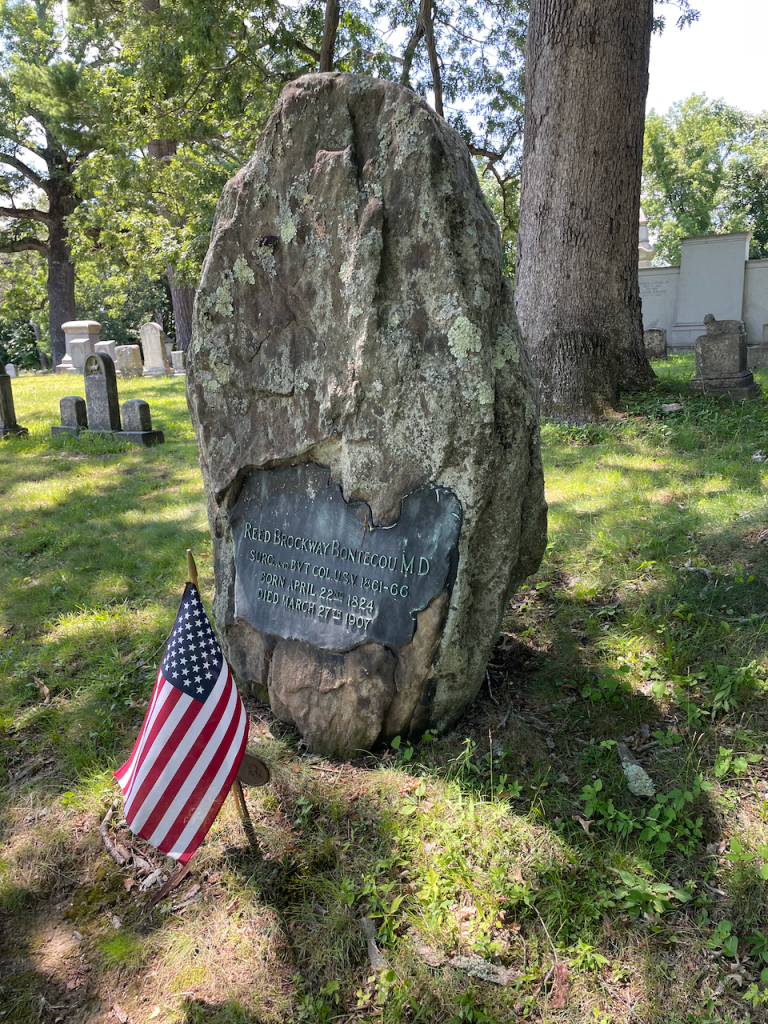
The gravestone of Reed Brockway Bontecou M.D. in Oakwood Cemetery, Troy, NY.

While the Cluett family, which played such an important part in the history of Christ Church, is now probably the best remembered name locally, on a national scale the most renowned person, by far, would be Dr. Reed Brockway Bontecou.

Dr. Bontecou’s name appears in medical journals dealing with surgery techniques and the beginnings of plastic surgery, in photographic journals detailing his photographs from the Civil War, and on Civil War and veteran sites, because of the pioneering nature of his surgical methods and how he recorded them in photos at such an early date of the craft. A few years ago, the Hart-Cluett Museum in Troy had a whole exhibit dedicated to Dr. Bontecou and displayed his medical bag.

In terms of the history of Christ Church, United Methodist in Troy, his lifetime spans all three of the buildings that have stood on State Street between the Williams Street alley and 5th Avenue, growing up in a devoted Methodist family. 

He was descended from Pierre Bontecou, a French Huguenot, who was linked to Dutch Protestants before him. Pierre arrived in New York City as a refugee from the regime of King Louis XIV in the late 1600’s, and the family originally worshipped in a French speaking Huguenot (protestant) church. One branch of the family ended up in New Haven, CT. They were industrious and successful, but like many in the area suffered financially and physically at the hands of the British during the struggle for independence. This brought one branch of the Bontecous to the “village of Lansingburgh”  in the late 1780s. Subsequently, Peter Bontecou, father of Dr. Reed Brockway Bontecou, was brought to Coeymans by his parents. But when still “a young lad” he removed to Troy to work as a clerk in a shoe store. He later became the proprietor.

Peter was a lifelong and ardent Methodist. Whether he heard about Methodism when he arrived in Troy, or had already made contact with the dedicated group already established in Albany County, we do not know. However, our records show he was a leader of State Street Methodist from its earliest days until his death in 1868. The family genealogist describes him as “cold and austere in manner, and strictly honest in all his dealings; a member of the Methodist Episcopal Church, and a great student of theological works.“

Reed was his first child. He had married Samantha Brockway in Troy in 1823. A year later he had a motherless infant son. Samantha’s death 2 weeks after giving birth was credited by some historians for Reed becoming a physician. 

Even as a child, Reed was studious, with a naturally curious, scientific mind. When a boy, he started a collection of sea shells and he noted the similarities and differences as he catalogued them. According to the History of Rensselaer Co., New York by Nathaniel Bartlett Sylvester, published in 1880, he attended the “High School Academy” then Rensselaer Polytechnic Institute and then graduated M. D. from the Castleton Medical College, VT. At the age of 22 years, between attending RPI and medical school, he went on a year-long voyage up the Amazon to study. He was married, on July 18, 1849, to Susan Northrup and they went on to have 5 children. 


In 1857, at the Troy Hospital, Bontecou “ligated the right subclavian artery for diffuse traumatic aneurysm of the axillary artery, the first successful case in America and one of the first three on record” https://en.wikipedia.org/wiki/Reed_Brockway_Bontecou

 In 1861, he left his physician’s practice to become the medical officer of the Second Volunteer Infantry of New York. Within 3 months he was running the Fortress Monroe military hospital and then was asked to lead Harewood Hospital in DC, which he left at its closure in 1866. By that time he had been brevetted lieutenant-colonel and colonel of volunteers for his faithful and meritorious services during the war. 

He returned to Troy and became the assistant surgeon at the Watervliet Arsenal, resident surgeon at Marshall’s Infirmary off Hill Street in South Troy, and had a private medical practice for four more decades. He is quoted in numerous coroner’s reports in Troy and area newspapers, was an official examiner for those seeking Civil War pensions, and held a number of prestigious positions in medical societies. He published reviews of his work and inventions, which included a special kit for soldiers to take with them into battles to self-treat a wound until help arrived, greatly increasing their chance of survival.

His name appears in the works of Arthur Weise who published several books on Troy in addition to Sylvester’s history of Rensselaer County. The Hart Cluett Museum had a display about his life and work, a few years ago, and displayed his medical bag.

According to the site dedicated to medical collections: “Bontecou’s peers respected ‘his unselfish character, his strict devotion to the truth, his extreme modesty and his unswerving fidelity to his students, colleagues and friends,’ noted one physician. Another doctor called him, ‘the Napoleon of Surgeons.’ “ That site hosts a long article, with illustrations, and catalogs his medical achievements. It is entitled: “Dr. Reed Bontecou’s Pocket Surgical Wallet, Bloodstained from the First Recorded Battlefield Amputation in the Civil War, on a Soldier of the 5th New York (Duryee Zouaves) And the Coins Driven into a Soldier’s Groin by a Bullet!”

The “Faces of the Civil War” blog has an entry entitled “The Napoleon of Surgeons” about Bontecou. http://facesofthecivilwar.blogspot.com/2013/05/the-napoleon-of-surgeons.html

In addition to the medical sites, he is remembered on historical photography sites for his pioneering use of the art as a documentary tool during the Civil War. This site has the most extensive descriptions of those achievements:

One of the largest online collections of his photographs can be found at: 

https://www.robertandersongallery.com/gallery/reed-bontecou/

The site says: “Reed Bontecou was responsible for pioneering, and taking, the largest number of photographs of wounded soldiers during the Civil War and was the single largest contributor of photographs and specimens to the Army Medical Museum and medical publications of the time. His close up images of surgery, anesthesia, and patients posing with their pathological specimens were unique to his time.”

Just a few of the many sites which speak of Dr. Bontecou, for all his great qualities, do recount a lapse of judgment and somewhat of a fall from grace, in a situation that caused his wife Susan Northrup Bontecou to file for divorce.  Details are few. One site (the Faces of the Civil War blog,) quotes a New York Times report that Susan’s accusation was “criminal intimacy”- the term used for an affair with a married person – and gives two names for the woman involved. All other references state simply that they divorced because of his affair with a young woman. For now we will leave it at this: in the strict society of his day, and doubtless among his colleagues and social group, this brief affair must have been quite a scandal, and stirred up much gossip once divorce proceedings began, but I have found few references to it.* What we do know is that, despite the embarrassment and notoriety, Dr. Bontecou did not leave the city in disgrace and his career does not seem to have been radically changed by the events. He continued to be a member – and head of – various esteemed organizations and to work with the military, at Marshall Infirmary and in private practice in Troy. The divorce was finalized in 1883. He never remarried.

Bontecou died in 1907. He is buried in Oakwood Cemetery, Troy.

(The photograph was taken by the author on 4th July, 2025. The headstone is very unusual, and I have not seen another in the century which is uncarved rock.)

Other interesting articles:

https://spotsylvaniacw.blogspot.com/2013/07/podcast-battlefield-photography-of-dr.html

https://www.hartcluett.org/rensselaer-county-blog/dreadful-accident?rq=bontecou

https://www.seekingmyroots.com/members/files/G000711.pdf

Bontecou genealogy, which starts with the amazing maritime adventures of a famous Dutch family member. 

The FindaGrave website includes additional details of his Civil War Service I have not seen elsewhere and photos of the doctor, in uniform and on horseback. 

https://www.findagrave.com/memorial/7050830/reed-brockway-bontecou

*Ron Coddington’s blog: Faces of the Civil War  says: “Susan Northrup (1828-1911) and Bontecou married in 1849. She alleged criminal intimacy between her husband and Emma Josephine Murray, also known as Emma Brockway. According to the 1870 U.S. Census, she is the daughter of Reed Brockway. There may be a genealogical connection between this branch of the Brockway family and that of Bontecou’s mother, Samantha Brockway Bontecou (1803-1824). New York Times, November 28, 1883.”  As I started to research the matter, errors in family trees made the strands of the tale hard to untangle for this essay: I may go back to researching who this Emma was, as the only Emma in the family was never known as “Emma Josephine Murray” – even a little research has thrown up other inconsistencies with even that brief account and no interest in the story in local newspapers so far – Janet

A Congregation where Innovation Runs Deep

Logo for Soul Cafe 1999-2005

In 1999, the pastoral team of Christ Church, United Methodist, Troy, NY, was led by the Rev. James Fenimore, whose first degree had been in Computer Science. Jim arrived at the church, not quite 30 years old, and aware of the possibilities of the new digital world for a downtown city congregation in a city with one of the leading technological institutes of higher education in the country. 

Christ Church became the first local congregation with a church website; the first Troy congregation to record services to CD and copy them for home distribution, then the first to offer DVDs and more…but I am getting ahead of my story.

In 1999, the website was up and running, CDs were, indeed, being produced, but Jim had had an idea based on his reading and conversations with other pastors he met at Drew Theology School, his alma mater…maybe what the church, what the city needed, was a different kind of church event: an evening “service” that did not seem like a church service at all. This would be nothing like a regular service: a dimmed coffeehouse setting, with good coffee and tea & snacks, free of course, live local musicians who could stop by on their way to the local busy bar music scene – paid a decent fee – and a big screen so we could show videos. The local “conference” of Methodist churches had just made it possible to buy into a licensing scheme to screen clips of current movies. Jim set about explaining the idea and winning the budget approval for the expense, which we thought would be near-impossible, but was, in fact, quickly approved, faster than we had dared hope.

We began to plan – and I have to say, there was real excitement about the idea. The upstairs fellowship hall would get round cafe style tables and candles, and a large back-projection screen would be placed on the stage, the projector hanging behind it out of view. Microphones for the musicians would be placed on the main floor of the room at the front, along with a couple of stools for the pastors, and the event run via a computer and sound system at the back of the room. The round tables were placed between those two areas. 

The “service” would have no hymns, no prayers, no spoken appeal for donations. It would begin with a brief introduction to a theme – a guiding metaphor – for the evening, followed by the musicians, at times a Christian rock band or singer, but mostly any local talent who wanted to perform, whether a college a capella group, a blues guitarist or band, a classical musician or even an opera singer. The music would last 20-25 minutes of a 40 – 45 minute gathering. “Soul Cafe” was meant to gather those for whom sitting face forward and being told what to say, sing, think and do, just did not work. The title came – with permission! – from one of Jim’s professors: Leonard Sweet had a magazine for preachers of that name, and it was so perfect for us, we asked to use it.

And the main event of Soul Cafe was always the movie clip. 

We would find a film sequence, often from a movie that was recently released, often days before so people had not had time to see it; where a more usual service would take a Bible passage and relate it to the world, Soul Cafe clips were picked to ask a question of the church. They represented a comment from the society about the society. So what did that society, have to tell us? The reflections would be no more than 5-6 minutes as the “service” ended, and the gathered group were always left with a question posed by the movie.

Well, I think the congregation, not just the leadership, felt we were being pretty “out there” to do this…

As the planning for “Soul Cafe”began,  the church was also starting to use Ebay as a way to sell donated items which had value, though not maybe to those visiting our fundraising events. The leadership team, also being interested in the history of the congregation, would also check Ebay in case State Street Methodist Episcopal items were for sale. Never the best at keeping records, we had found very few historical things in closets, though they included a blueprint from the early 1920’s lining a drawer. Interestingly, it showed that someone at that time was an innovative thinker: one of the plans even showed a ten pin bowling alley being constructed right under the aisles of the sanctuary!

It was a quick glance at Ebay while I was away in the UK that turned up some 80 year-old  bulletins of the church. I emailed the Senior Pastor, he put in a bid, and by the time I returned to Troy, the bulletins were waiting for me.

Imagine our surprise – and delight – to see maybe we were not as innovative as we thought! 

80 years before, in the days of silent movies, the Church had had movies at the evening service, an innovation of the Rev. Mark Kelley DD – probably the man who had the idea of the bowling alley under the church. 

We have only a few bulletins from 1921 and 1922, and many movie titles suggest they came from a religious source: a movie meant to inform about missionary work, or a Sunday School illustration (weren’t they on top of the latest developments!), but some of them seemed to be more about places in the world. I have traced a couple to an archive of educational films: Sights of Suva, Fiji* shown on Feb 19 1922; and Apple Blossom Time in Normandy** shown on May 8 1921.

As yet, I have not found any viewable copies, but wouldn’t it be fun to reenact one of those evening services, complete with their silent movie reel?

In 2005, the very week that the then largest, 50 inch, LED monitors came to market, the church installed two at the front of the sanctuary, along with 2 smaller ones further back, remotely operated digital cameras, a first-rate computer control booth and the latest recording and sound equipment. And so it was that the ability to screen movie clips came to morning worship and Soul Cafe ceased. The expense was considerable, and would have been unimaginable without what had happened in Soul Cafe, but it represented an openness of the congregation to embrace the new. With the new equipment, the congregation could now record CDs of worship, or weddings, or concerts, showing different angles and views. The Senior Pastor, Jim, was working on his Ph.D. on the impact of the digital revolution on church services around the country; the congregation was involved in planning, participating and running our media-rich and metaphor-based worship services. Another new era had begun – but  we now knew we were in a congregation which had valued the spirit of innovation and experimentation for a lot longer than we could have expected, when we started on our digital journey.

Janet Douglass, Troy, NY, March 2025.

Motion Pictures for Instruction 1926 by A.P.Hollis M.S. pub. The Century Co. New York 1926. Available as a Google book at: https://docs.google.com/document/d/1V3gCdNeICZOQdWuz5fckOWVWTcbxrEkaPDjaxNDqMLg/edit?tab=t.0

*reel 2 of 5 :  Fiji Islands by Burton Holmes Lectures,  Chicago; a rental film listed in Hollis p.348

** listed by Hollis, in the Blue-Ribbon List of Films for Cities p.213

The Rev. Dr. James Fenimore’s Ph.D. was awarded by RPI in Troy, and his dissertation “High-Tech worship: Media Technologies and Christian Liturgical Practice” is available on his website: www.JamesFenimore.com. His DMin. thesis: “How a Congregation’s Identity is Affected by the Introduction of Technology-Based Worship”  is also available on his website. He has 2 other theses available: “A church on the Edge of an Apocalypse,” a take on the history of Christ Church, is available online at: https://christchurchtroy.org/wp-content/uploads/2021/06/earlyhistory.pdf. Jim first featured the congregation – before he was appointed as the Pastor – in his thesis From meeting house to house of God : the Gothic revival in the American Methodist tradition of Troy Annual Conference (1870-1879), which is available from Drew University.

Jim’s academic work on digital worship included the benefits and pitfalls of using other people’s images as visual representations. The significance can be easily grasped if you have ever seen a so-called Bible-based commercial film, where white skinned, blonde-haired, blue-eyed males prevail scene after scene  (except maybe for Judas Iscariot…did you notice that?!) Movies can be enormously helpful – but graphical imagery can subtly mislead – or open us to the moviemakers’ biases or poor scholarship! Finding clips we wanted to present was always no quick task but could lead to valuable conversations about whose ideas prevail in society, and how to be a critical viewer of the imagery around us. 

The Methodist Episcopal Churches of Troy, NY: First German Methodist Episcopal Church & St Titus Methodist Mission

Extended notes on State Street Methodist Episcopal Church (now Christ Church United Methodist) and the buildings and congregations that came from it.

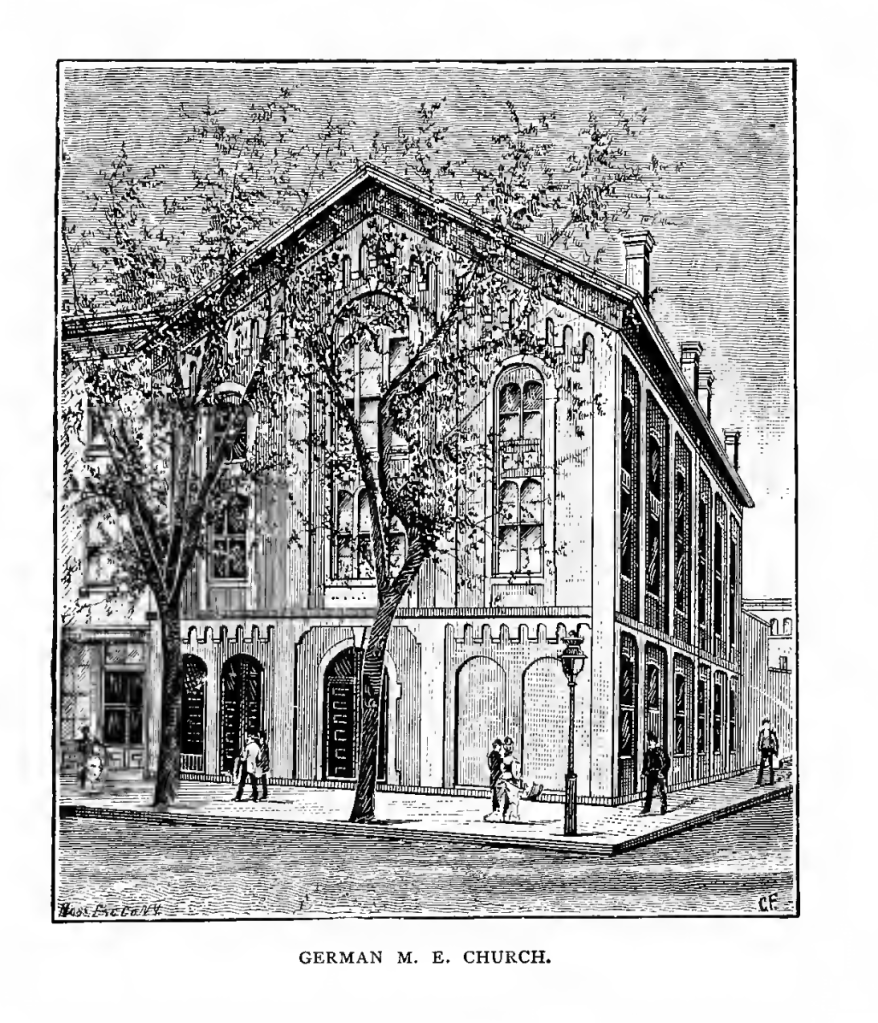
“Although Troy had from a very early date not a few German inhabitants, it was not until 1855 that an effort was made to form a religious society, composed exclusively of German people. At that time it was estimated that there were no less than 2500 Germans in the city. The first German minister, who undertook to form a German society of a religious denomination in Troy, was the Rev. Mr. Swartz, the pastor of the German Methodist Church in Albany, who in 1855 began to conduct religious services in a building on the northwest corner of First and Ferry streets. Some months later, the Rev. F. W. Dinger of the New York Conference continued these services in the True Wesleyan Methodist Episcopal Church, on the south side of Congress Street, at its intersection with Ferry Street. In that building, the First German Methodist Episcopal Church of Troy was organized, on July 25, 1857. The society was incorporated March 31, 1859 (…) Shortly afterward the society purchased two lots on the north-west corner of Union and State streets for $1,500. The buildings on the lots were destroyed in the great fire of May 10, 1862.” (The History of Methodism in Troy, Joseph Hillman, 1888. p. 114-6.)

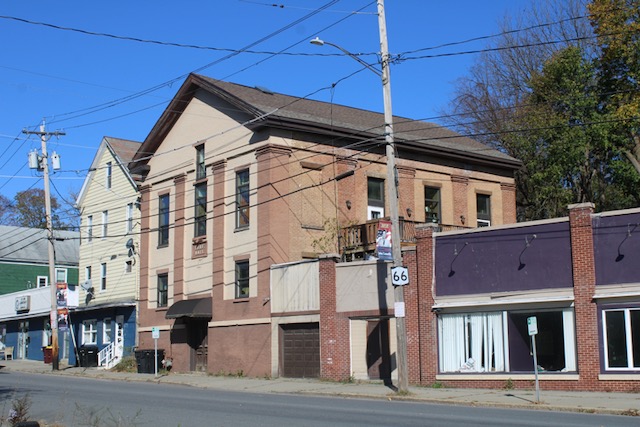
Interestingly, maps show that was the very point where the fire stopped along State Street, was just half a block from the current Christ Church, making the German Church the last structure lost on that street. The society then rebuilt, on that same lot, creating the church as pictured above, with the front facing State Street. It  was dedicated on March 25, 1863.

This congregation, along with the 5th Avenue/ North-Second Street congregation merged with State Street Methodist Episcopal, in 1925, the three merged societies taking the official title of Fifth Avenue-State Street Methodist Episcopal Church. Many of the leading families of this congregation became leaders in the merged congregation, and their descendants were members until the end of the 20th century.

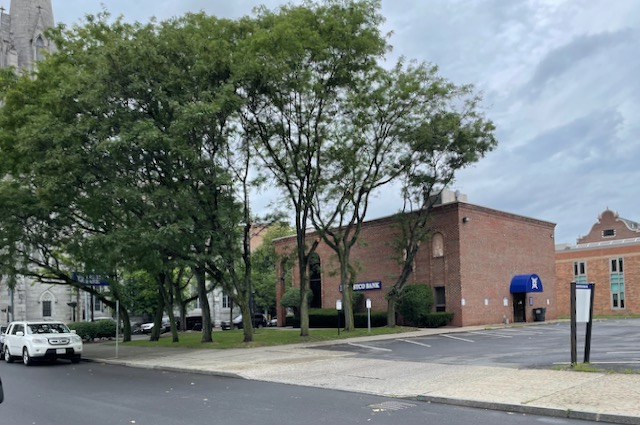
The original meeting house now lies under the car park behind the Central Library. As for the building above, Union Street no longer exists either side of State Street. It was the name for an alley which ran between Fifth and Sixth Avenue (alleys in Troy are named as streets) and this lot is now under the Trustco bank parking lot beside the Court building and Police Station. Maps show the building as one lot wide , but going back the whole two lots, as in the description above.

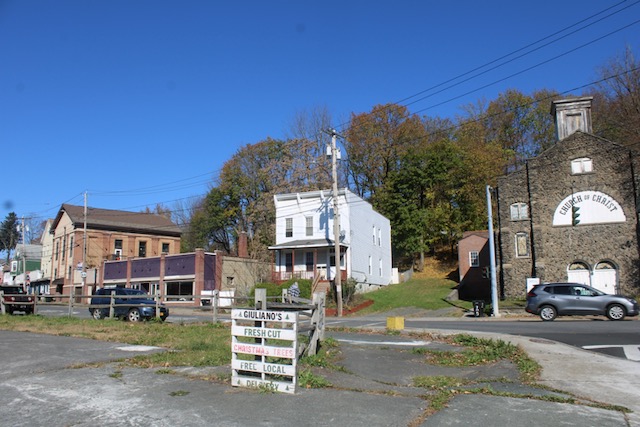
The spire of Christ Church United Methodist is at the left, the area immediately behind the sign at right is where Union St (alley) was. The black-topped parking lot was the site of the church. Out of site at the right are the municipal buildings and Police Station (corner State and Sixth.)

The spire of Christ Church United Methodist is at the left, the area immediately behind the sign, at right, is where Union St (alley) was. The black-topped parking lot was the site of the church.

The buildings on the east side of Fifth Avenue were removed during the 1960’s as part of an urban renewal program. I suspect this, too, was a victim of urban renewal, as the September 1950 copy “The Spire: Newsletter of Fifth Ave-State St Methodist Church,” lodged at the Troy Central Library, states the Liberty Presbyterian Church was at that time the occupant of the building above. It may have become unstable or in a fire between those two dates – so while that is unclear at time of writing, before that happened it became home to the …

St. Titus Italian Methodist Mission

So little is known of this congregation, that it has not appeared in Christ Church histories until this point. According to the collection of historical materials of Troy Conference, by Samuel Gardiner Ayres, archived at the Hart-Cluett Museum in Troy, St. Titus began as a mission to Italian families in 1913. However, he also states it began at that time in the Third Methodist Episcopal Church, which had been sold 15 years before that to the Ukrainian Orthodox congregation. I suspect this was an error, and the real location is 43 State Street – the German M.E. Church, where they remained after the latter congregation moved out.

The Adirondack Record- ElizabethTown Post newspaper for April 7th, 1932, carries an announcement by the Ausable Forks Methodist Church that: “The Reverend Lucius Martucci of St. Titus Italian Methodist Church, Troy, N.Y.” would give a talk on “The Melting Pot in America” in which he would talk of the pioneering missionary work of his mission among “the Italians of Troy.” The newspaper has another article about how the same church donated money each year to the St. Titus mission, stating it was the “only Church in the Troy Conference area, in which services are conducted in the Italian Language.” it gives the address of the church as 43 State Street, the same address as the building vacated in 1925 by the German Episcopal Church (above.) Interestingly, the author remembers several people named Martucci in the congregation, as well as the Rossi family, whose name is on a brass offering plate in Christ Church, United Methodist, to this today. It may have come along with the families when the congregation merged into State Street, at an unknown date, whether at its demolition, having shared the building with the Liberty Street Presbyterian Church, or before that, leaving the building empty for its new owner. I suspect someone will know…and if so, I will gladly update this mini history.

Line drawings and quotations are from “The History of Methodism in Troy” by Joseph Hillman, 1888, available as a PDF, free of charge, at a number of online archives, including the Library of Congress. Photographs are the author’s.

Searching for the First Methodists in a City Not Yet Created.

An engraving of the first of the 3 Methodist sanctuaries to be built on State Street, between Williams Street (alley) and Fifth Avenue, in Troy NY.

Searching the earliest records for a settlement that was only recently declared a village, and a decade before becoming an early northeastern city, turns out to be no simple matter.

Troy, New York had not long since chosen its name, when the people we are seeking arrived in search of a new life. Fellow congregation member, Alice Rose, and I have many questions we would like answered. However, even at these early stages of our research, we are learning a lot about the people who so determinedly created, and grew, a Methodist society in this new place. This is part of the story of State Street Methodist Episcopal Church. 230 years after the first followers of John Wesley showed up on State Street, we still worship there – at Christ Church, United Methodist.

How many hundreds of times did this story play out as the United States developed, in the decade or two after the Revolutionary War? How many thousands of stories could we tell about the earliest settlers of these villages, towns and cities, if we only had the journals and records of those women, men and children, itinerant preachers and circuit riders, who grew our denomination and without whom, we might not be Methodists today?

So what do we know? Well, we know these were adventurous people.

Most of the earliest Methodist members of the State Street society came from  New England, and specifically from Connecticut. They arrived to find an unpaved, barely inhabited site, where farmers brought their corn to be weighed, and then shipped down the Hudson to New York City. Native Americans still hunted, fished and gathered the ample food supply growing along the flood plain of the Hudson River. Only three homesteads were located on the land that would become Troy: the three buildings designating the division of land between the 3 Vanderheyden patroons. The New Englanders who made the journey into what looked like nowhere, created a village, then city, from the farm lands of the Vandeheydens. That city became one of the third or fourth richest in the US in the following one hundred years, showing the first settlers to be not only adventurous, but resourceful and enterprising – and extremely hard-working. 

As adventurous people, it is not so surprising that we found many so hard to locate because they simply continued their adventures – their sought-for better lifestyle – by moving on. Others were hard to find in the records because they were female, or African American, who, whether freed or enslaved, simply did not count enough to be counted and recorded. A few of the newcomers had already accrued some money. A lot more became wealthy in the city, inspired by the ingenuity of their fellow citizens. Many were the necessary tradespeople, providing the necessary needs of the population, shoes and coats and wheels and houses, earning a respectable and steady income from their craft. Others arrived, with only rural skills, seeking new trades, and often took their new skills even further west as new areas opened up. 

The William McBurney family is one such case.

Joseph Hillman tells us that one of the earliest residents seeking a Methodist church was an Irishman, William McBurney (McBerney.) His descendants did some of the work to trace William, which I was able to confirm in my own research, but there was good reason I could not locate much about him in Troy. 

William left County Down, Ireland, arriving in New York City in May, 1804, on the brigantine Sally (not the infamous slave ship of Rhode Island – that one had been wrecked  a few years earlier in Barbados.) He came with his wife Alice, and 3 children: the “muster roll” quoted on geni.com states all children were under 5. William was 35, and Alice was 32. They were farmers, and most likely from the area around  the small town of Dromore, some 21 miles from the port of Newry, which is cited as the port the ship left from. Newry and Donaghadee, 32 miles from Dromore,  were  popular ports for Irish ships bound for the United States in the 18th and 19th centuries. 

The 2 leading preachers of Methodism had both visited that area in the preceding decades: Rev. John Wesley, the founder of Methodism followed his then chief substitute, Rev. George Whitefield, and preached in Lisburn, Co. Down in 1756. He returned every two years until his death in 1791. Methodism remains very strong in Lisburn to this day, and its main church is billed as the “mother church” of the younger Dromore Methodist congregation, just 10 miles away. It seems very possible that Willliam saw Wesley himself – at the very least, he surely must have known people who did.

Once in the US, the McBurneys wasted no time in moving to Troy. In our major historical source for our church – Methodism in Troy by Joseph Hillman, published in 1888, we read that “in 1806, William McBurney joined the class” of Caleb Curtis, one of our earliest members. When John Wright enquired about a Methodist society in the village a “colored woman informed Mrs. Wright that she knew an Irishman, named William McBurney, who was a Methodist. While in search of his house, John Wright heard a number of persons singing together a familiar Methodist hymn, and without attempting to repress his joyful feelings, he abruptly opened the door of the dwelling in which the voices were united in praise, and identifying the small company of men and women as Methodists, he gladly exclaimed, ‘Now I have found you!’ ”

In the list of official members of the Church in 1821-2, William McBurney is mentioned as one of the 12 “Leaders.” However, by the time we come to the first Troy City Directory, in 1829, which listed businesses and residences, only one McBurney- James- a “laborer,” is mentioned. 

The family speculates, with good reason, that the family, left Troy, in the early 1820’s and followed the Erie Canal west, as did so many others. William is next found in the censuses as being in Ira, Cayuga County, home of a well-known local potter of the same name.  The family located a reference, in one of William Ketchum’s books on New York State Potters, to a William McBurney, making and selling stoneware in Troy in 1820. They wonder if the well-known Cayuga potter, therefore, is “their“ William. Certainly, the newly-arrived William purchased land in Ira in 1825, and other members of the family, having disappeared from Troy records, seem to be in Ira and nearby Jordan, which is just to the south, on the Erie Canal. Indeed, a James McBurney is recorded as being in Jordan, right after the name disappears from the Troy City Directories.

This all reminds me that Troy’s fame as “The Collar City,” so much tied to the Cluett heritage, happened, in part, because Mrs. Cluett became sick on the Cluetts’ own journey to Western New York, and they simply stayed, after her recuperation in the city.  Interestingly, the Cluetts were also leading Methodists and a big part of the State Street congregation for many decades. It is a story for another day, but like many other families, once they became wealthier, most of the family left Methodism – to become Episcopalian! At least, before leaving, they put the spire onto the tower – and probably left us a rare and magnificent Steinway piano…all for another day…

Today, many people who find themselves in the Methodist congregation on State Street, are also passing through the city. Visitors, looking for a Methodist congregation downtown, frequently stop in. Hundreds of students from Rensselaer Polytechnic Institute and Russell Sage College have worshiped with us over the last 230 years, before graduating and moving on. The position of the church downtown, with the closest residences now being apartments, has also created a more transient community, held together by loyal and determined long-term members, and the legacy of the first Methodists – like William McBurney – who settled in what would become the City of Troy and practiced their Methodist faith on State Street..

Janet Douglass

A sad postscript, to this story is that of a very early Methodist preacher in the area William came from – a John M’Burney who may be related, but we cannot know. John M’Burney was beaten and killed for being a Methodist. The brutal attack is detailed in ‘The Centenary of Methodism”(p.160ff) published in Dublin in 1839 , and details how, even as his assailants beat him, he forgave them. The book can be read free of charge on Google books. The website of the Irish Methodist Church lists John as a preacher from 1772 to around 1779.

Joseph Hillman’s book, Methodism in Troy, can be read free of charge at number of online archives. The book has been our starting point. However, one of the resources Hillman used, and which we would love to locate, is a publication by the “young daughter” of Caleb Curtis, mentioned above. Phebe Curtis’ “Rise of Methodism” has been much quoted through the years, but we have not found a copy. If you happen to know of such we would be grateful to know where we can access it.

The above illustration is an engraving taken from Hillman’s book showing the first of the 3 Methodist sanctuaries that have stood on the piece of land on State Street, between William Street (alley) and Fifth Avenue, in Troy, NY.

The Methodist Episcopal Church of Troy, NY: Levings Chapel/ Fourth Methodist Church/ Levings Church.

Extended notes on the Methodist congregations associated with the State Street Methodist Episcopal Church ( now Christ Church, United Methodist.)

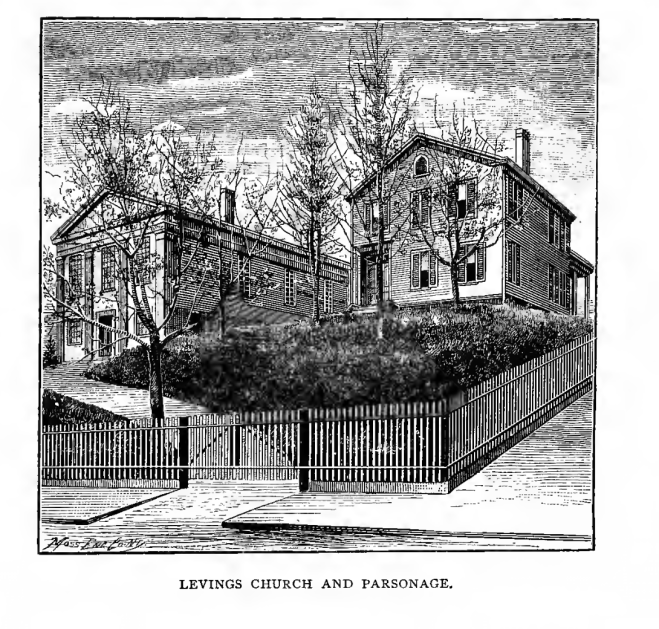
Fourth Methodist Church/ Levings Chapel, 63 Mill Street, South Troy, NY

In the mid 1830s, Methodists who were working in the nail factory on Mill Street, began to ask for a church to be erected closer to their place of work and homes. According to Hillman, they were holding worship services at the nail factory. On September 24, 1838, they met at the factory and designated themselves as the “Trustees of the Levings Chapel in the city of Troy,” also known as Fourth Methodist Church of Troy.

In 1850, they erected a sanctuary opposite the factory. Two years later, the Rev. Tobias Spicer, another early Methodist from the State Street church,  and who was appointed as pastor of the Levings Chapel society, spoke unflatteringly of his work there: “My labors this year were mostly in South Troy, where we had a feeble society, which had lately built a church. “ None the less, by the early 1860’s the church had a membership of 140, and in 1888, at the publication of Hillman’s book, the number had swelled to 212 members, by which time the church had been renamed “Leving’s Church” though the old name of Chapel was often used. 

The congregation continued until the 1960’s, when the decision was made to close it, rather than execute the much needed expensive repairs. The remaining members merged with the Green Island Methodist Church, now called Good Shepherd United Methodist Church, and anyone looking for genealogical materials from Levings Chapel could start there.

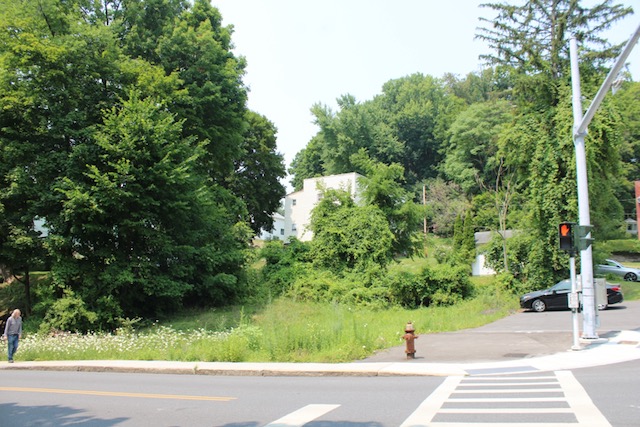
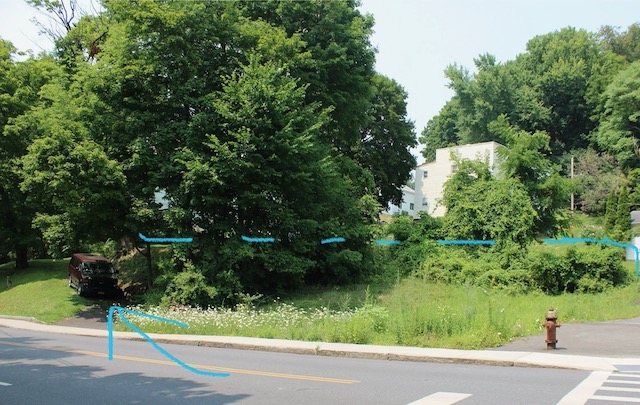
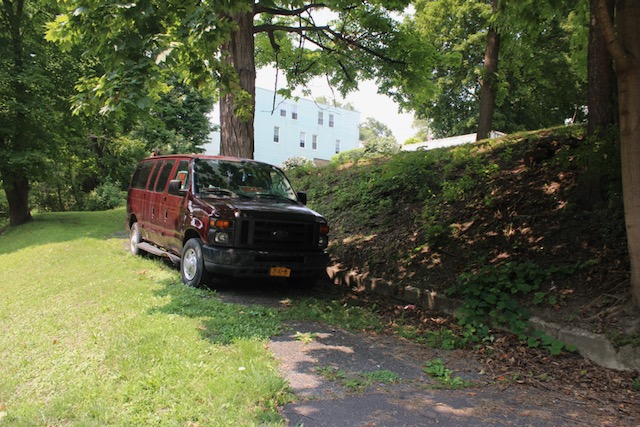
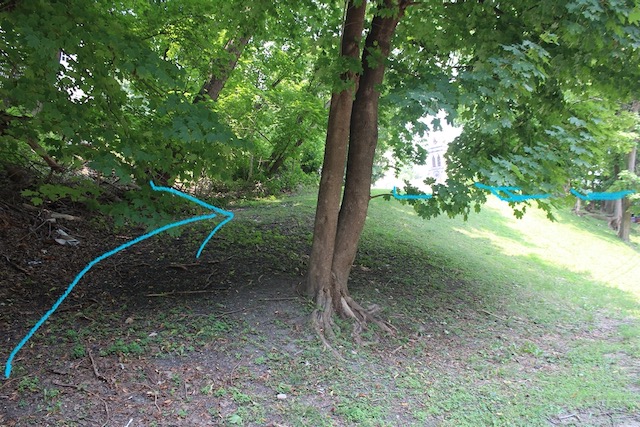
The last service was held on Palm Sunday, 1968, and the decision seemed prescient, given that during the following Winter the roof collapsed during a heavy snow storm and shortly afterward the church and manse were torn down. The lot for the two buildings remains empty, and stands on the corner of Mill and Erie Streets, and across Erie Street from the Woodside arts center, which was previously Woodside Presbyterian Church. The photographs below show the site, now obscured from the road by trees – the blue marks delineate the platform which remains and the two disused paths leading to it, one covered in gravel and the other metallized. The tower of the neighboring former Woodside Presbyterian Church can be seen beyond the trees. The platform can also be glimpsed behind current homes from the top of Erie Street.

The substantial buildings of the nail factory and Albany Steel Works, which lined the Wynantskill at the time, have also long-since disappeared. Today there is a walk around Burden Pond, down beside the Burden Falls and then on toward the Hudson River. If you look for them, there are still bricks and a few ruins of the old mills, in places. The location is famous for the giant Burden Water Wheel that used to stand there, purportedly the most powerful water wheel ever built. Several websites give those details, and also tell how an RPI student used his knowledge of this wheel, and his engineering skills, to build the first fairground pleasure wheel for the Chicago Columbian Exhibition in 1893. His name was George Washington Gale Ferris. For the first members of Levings Chapel however, it was simply one of the amazing pieces of new technology, which made them so productive and helped create Troy’s wealth.

As for the Rev. Noah Levings, this early convert to Methodism by the State Street faithful, while still an apprentice blacksmith, will need to have a brief history of his own at later date.

Line drawings and quotations are from “The History of Methodism in Troy” by Joseph Hillman, 1888, available as a PDF, free of charge, at a number of online archives, including the Library of Congress. Photographs are the author’s.

The Methodist Episcopal Churches of Troy, NY: Fifth Avenue/ North Second Street

Extended notes on the Methodist congregations associated with the State Street Methodist Episcopal Church (now Christ Church, United Methodist.)

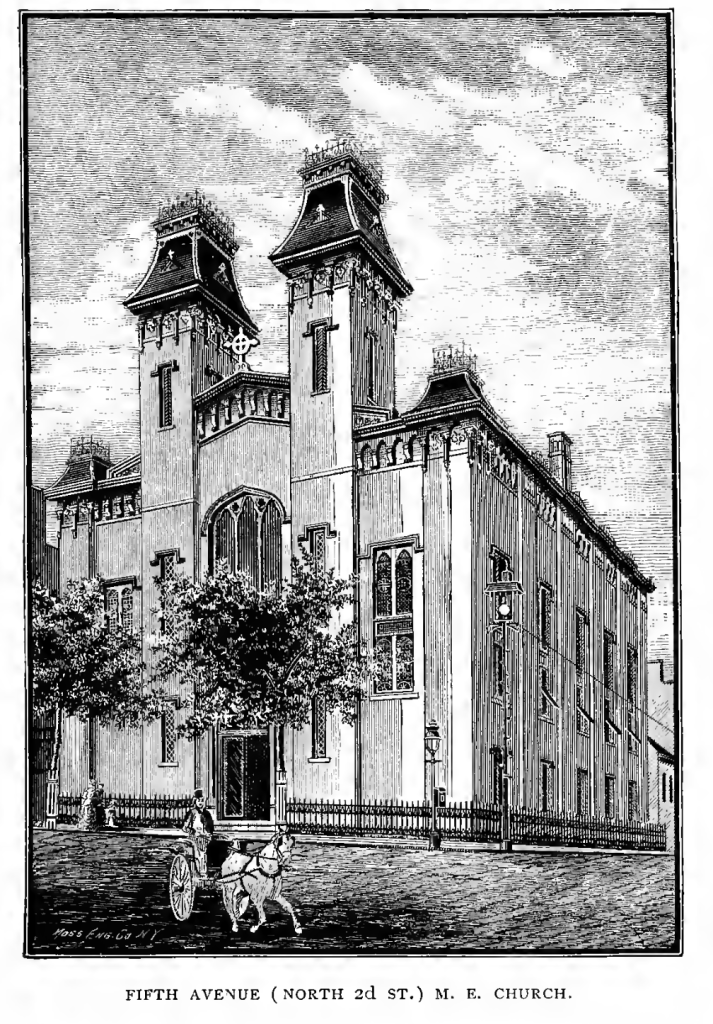
“The expediency of taking advantage of the growth of the city northward of Grand Division Street, and of having a church in which the seats were free, caused the State Street society to give consideration to the project of providing a place of worship in the north part of Troy. On May 23, 1831, the Quarterly Conference appointed a committee ‘to provide a place for preaching somewhere in the bounds of the fourth ward.’ On August 8, that year, the committee reported ‘that the only place to be had ‘ was ‘the dwelling-house’ of Stephen Monroe. A committee of five persons was then appointed ‘to provide a place or places for meetings in the first and fourth wards of the city (…) Considering that the lot on the northeast corner of North Second and Jacob streets would be an eligible site for a church.” (Hillman, pp 87-8)

On the evening August 13, 1831, the trustees of the State Street society “resolved that a subscription should be circulated throughout the City of Troy and elsewhere for the purpose of building a Methodist Episcopal Church in the fourth ward of the city ‘with free seats.” showing that the idea of having paid seating in the “mother church” on State Street had become an issue for some of the congregation.

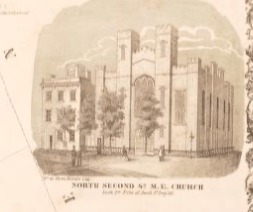
This building was a brick structure and included a basement. As soon as it was built the Sunday School which had been organized nearby, in the school-room of Miss Annie Manwarring, was moved there and prayer meetings began. “On Sunday afternoon, August 30, 1835, Bishop Elijah Hedding dedicated the church.“ (Hillman 87-88.) The congregation having grown in number, this church building was replaced with a grander structure, which was originally slightly less grand than the drawing found in Hillman’s book. The original aspect of the church can be seen in this 1869 map by William Barton which can be seen online at the New York Public Library website. The private house next door in that drawing, appears have become the parsonage.

The congregation chose to re-merge with the State Street congregation in the 1920’s, at the same time as the German Episcopal Methodist church. The merger of these three churches occurred in 1925, and is recalled by an unknown member of State Street Methodist Episcopal, upon the 125th anniversary of the church in 1939:“Time passed on with greater or less success to Methodism in Troy, until the year 1925 when the mother church grew lonesome for her children and it was decided to unite the congregations of State Street, Fifth Avenue and the German Church under one head whose name should be the Fifth Avenue-State Street Methodist Episcopal Church.”

(quoted by Rev. Dr. James Fenimore in his 1998 paper: “Christ Church, United Methodist – a Church on the Edge of an Apocalypse” from a letter to the church entitled “To the Pastor and People of State St. Methodist Episcopal Church.” This paper is available online.)

The building and its parsonage became the property of St. Peter’s Armenian Apostolic Church in 1927. That congregation left the building when they constructed their new church in Watervliet, in 1971. An African American congregation then worshiped in the church, until it became suddenly and dangerously unstable, and was razed by the City of Troy in the 1999. The parsonage was demolished a little later.

In 2024, the lot which was occupied by the church and parsonage, is used for parking. It is located between Federal and Jacob Streets on Fifth Avenue, in the area now known as Columbus Square.

Line drawings and quotations are from “The History of Methodism in Troy” by Joseph Hillman, 1888, available as a PDF, free of charge, at a number of online archives, including the Library of Congress. Photographs are the author’s.

The Methodist Episcopal Churches of Troy, NY: East Side Church/ Pawling Avenue.

Extended notes on the Methodist congregations associated with the State Street Methodist Episcopal Church (now Christ Church, United Methodist.)

Pawling Avenue/ East Side Methodist Episcopal Church

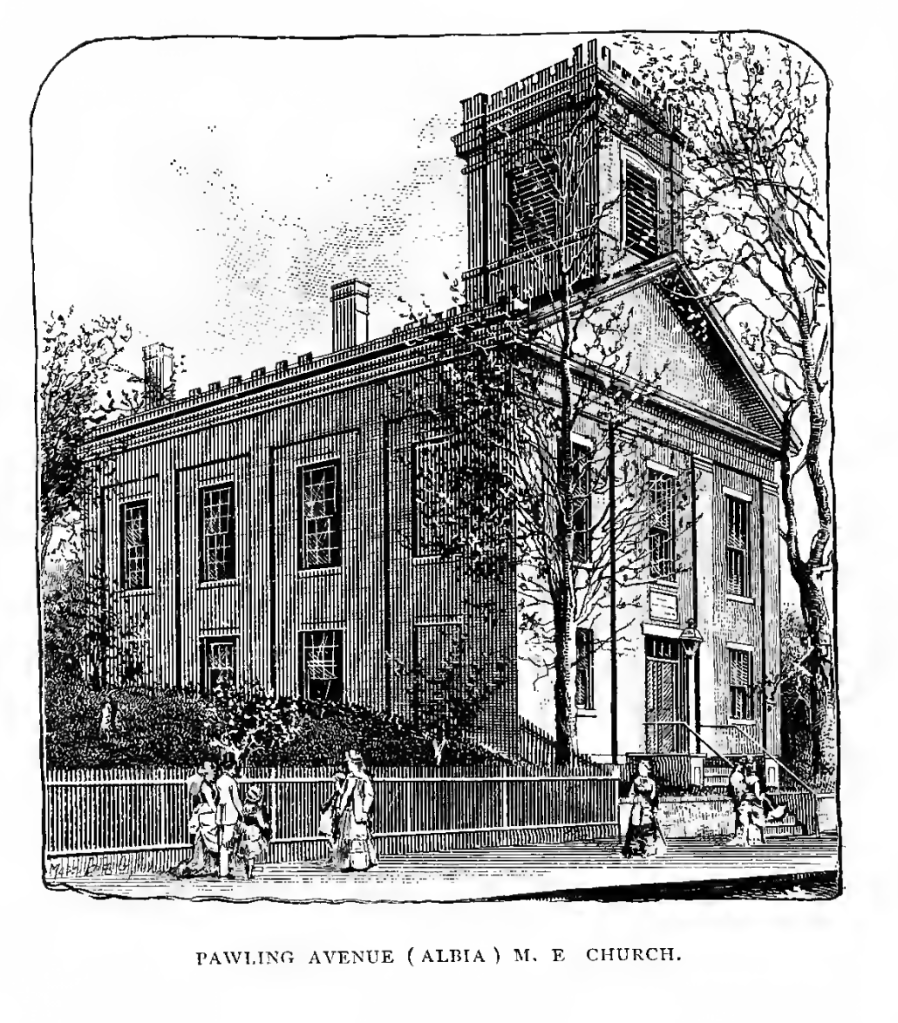
“The first Methodist meeting house at Albia, in the fifth ward of the city, was erected by the trustees of the State street society, for the purpose of providing its members with a convenient place for hearing preaching and for holding prayer -meetings, when they were precluded from attending religious services at the State Street Church.“ The trustees of State Street formed a committee to build a meeting house in Albia, on August 15, 1826. The first reported sermon was preached there in 1829 (Hillman. p 83.)

This Methodist “society” – congregation- was not only the the first satellite church of the State Street church, but of all of those churches, is the only one still in operation today, in a building within sight of the location of the original one. It was needed because the mill workers would have had a xxx mile work to downtown Troy, and then walking back up a steep valley side, not only taking a lot of time and effort, but on unpaved roadways and in all weather, it must have been a dangerous and difficult journey. It is remarkable that up to this point some actually had made it!

The original building was made of wood, and Hillman reported that the stone tablet above the door read that the church was erected in 1827, and rebuilt in 1858. Maps show it as being a little smaller than the still-standing original Presbyterian Church, now labeled as a Church of Christ, though not in use, just a hundred yards away at the junction of Pawling Avenue and Winter Street. The site of the East Side Methodist Church became home to the Oddfellows Society, and the structure still visible at the site does have the appearance of a chapel, but one made of brick, not wood. It now appears to be a home.

The site of the original East Side Methodist Episcopal Church on the east side of Pawling Avenue.

The view from the junction of Pauling Avenue and Winter Street, with the Wynantskill immediately behind the photographer. These banks were lined with mill buildings, and some remains are visible looking over the bridge as well as on adjacent properties.

The congregation adopted the official name of the “Pawling Avenue Methodist Episcopal Church” in 1868, and in 1888 Hillman reported a membership of 166 persons.

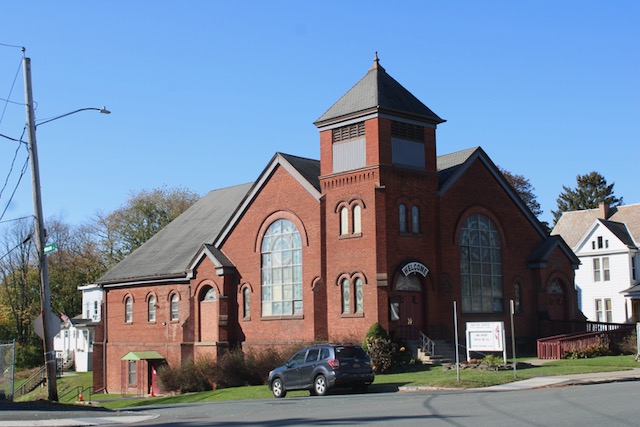
A few years after the publication of Hillman’s book, the current brick church, known locally as “The Welcome Church,” was constructed on the western side of the road, less than half a mile to the north. This congregation continues to welcome neighbors and friend to worship and community meals, and can be contacted on Facebook and the web. If your genealogical search leads you to this congregation, you should start by asking what records they have, as operational UMC churches usually hold their records.

Many of the imposing brick structures of the mills, including those first erected by Mahlon Taylor not long after his arrival in Troy in 1789, and their successors, were still standing beside the Wynantskill into the 21st Century.

Line drawings and quotations are from “The History of Methodism in Troy” by Joseph Hillman, 1888, available as a PDF, free of charge, at a number of online archives, including the Library of Congress. Photographs are the author’s.

The Methodist Episcopal Churches of Troy, NY: Third Street Church.

Extended notes on the Methodist congregations associated with the State Street Methodist Episcopal Church (now Christ Church, United Methodist.)

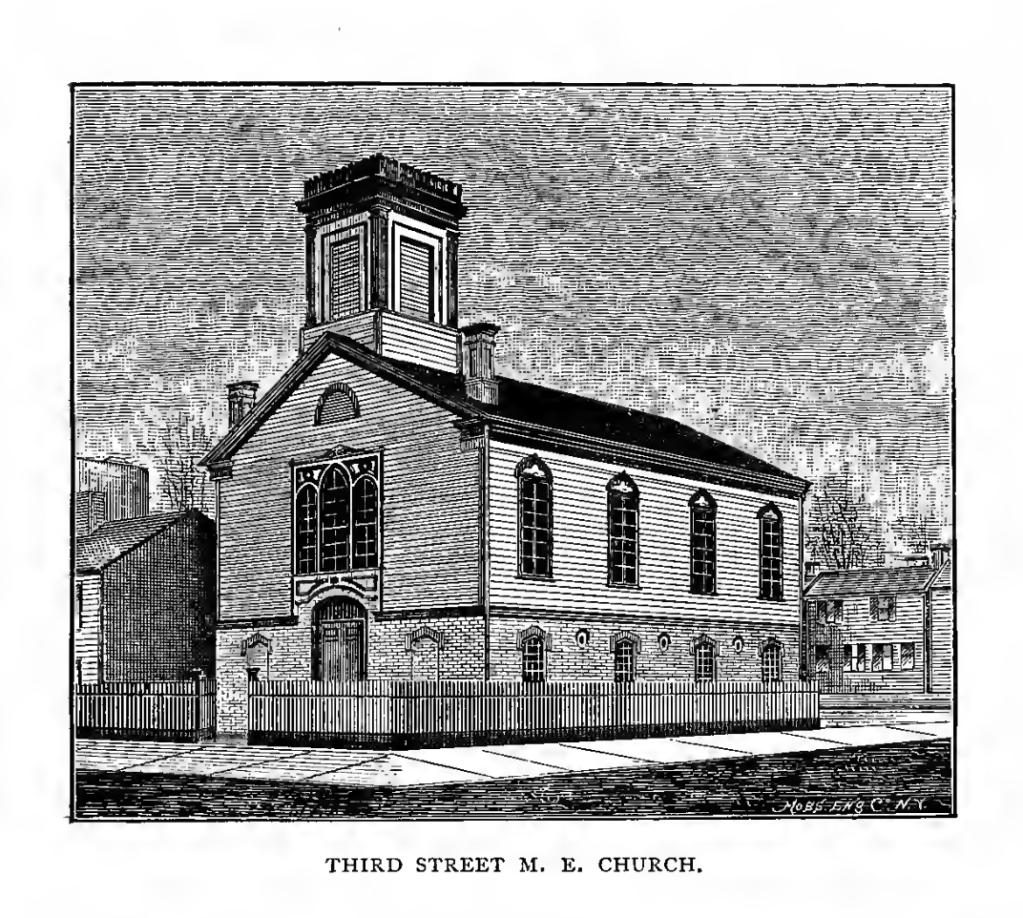
Third Street Methodist Episcopal Church, corner 3rd and Monroe Streets, South Troy.

In March 1844, trustees were elected for a separate congregation named “the Third Street Methodist Episcopal Society of the City of Troy” and a Sunday School was organized. The following year “a lot on the northeast corner of Third and Monroe Streets was purchased by the society to build a church. “  (Hillman, p.96) “The small society which had organized in 1843, began its erection in 1847(…) On Christmas day, that year, the building was dedicated.”  (Hillman p. 66)

“The origin of the Third Street Methodist Episcopal Church can be traced to a statement made by William Barrett, a class-leader of the State Street Church, at the leaders’ meeting held on May 2, 1842 (…) he suggested the suitableness of the house belonging to him in that part of the city for preaching.”  “ In1873, the church was enlarged by the construction of a lower story of brick, on which the wooden structure of the first edifice was placed.” (Hillman, 96-99)

Prayer meetings had been conducted in William Barrett’s house for a while, and when Daniel Hudson, an experienced Sunday School Superintendent, moved “from the northern part of the city,” a class of Methodists was formed. A “class” was the usual Methodist term for a neighborhood group of adults and families with children. The Trustees of the State Street congregation, seeing the success of the class, started to look for a building in earnest, meanwhile paying William Barrett for the use of his house for prayer meetings, preaching and a Sunday School. This saved South Troy participants from trudging the one mile each way to the State Street church, or not quite as far a walk for many – but up a steep hill – to Levings Chapel. 

Like other new congregations, the decision came at a time of dissension that pew rentals were being charged in the State Street building, usually reported by Hillman as temporary fees to pay for new buildings, but always mentioned with hints that the decision was not universally approved.  Certainly the cost to rent a pew could have dissuaded attendance by the workers of South Troy, many of whom worked in the steel mills and foundries of the area. In fact, Hillman tells us this would-be congregation decided not to accept State Street’s appeal for money for their building, but to create its own Board of Trustees and become a separate church. 

In October, 1844, the Sunday School reported having 15 teachers, in addition to two superintendents –  one for males and one for females – and a secretary-librarian, even though Hillman estimates membership of the society being around 35, with 75 students in the Sunday School. The first sermons were preached on the steps of the partially-built church, and the sanctuary was dedicated on Christmas Day, 1847.

After a time as a separate charge, the congregation reunited with State Street and operated under the name of Wesley Chapel. When attendance climbed again, peaking at 151, under the able leadership of its superintendent, Daniel Klock Jr., they once again took a minister and revived their Third Street name. The Sunday School had 288 members in 1888, and the school rooms were enlarged. Sadly, it was not to last. 

The congregation which had struggled, revived, and struggled and thrived for a few years, then struggled again, closing its doors at the end of the19th century, not so long after its best years.

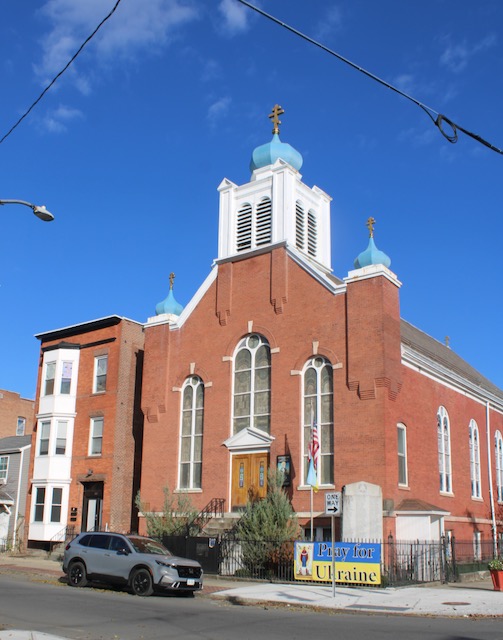
Saint Nicholas Ukrainian Orthodox Church, with a similar shaped, but brick, building now occupies the lot.

Line drawings and quotations are from “The History of Methodism in Troy” by Joseph Hillman, 1888, available as a PDF, free of charge, at a number of online archives, including the Library of Congress. Photographs are the author’s.