“The use of musical instruments in the church, it should be known, was not approved by its early members and no little opposition was shown to the gradual innovations that were made to support the congregational and choir singing with such instruments as the bass viol and organ. At one time, the singers in the church attempted to introduce the use of a bass viol and obtained a player to bring one to the church for a rehearsal. Seeing the objectionable instrument in the gallery, while on his way to class-meeting, Isaac Hillman took his pocket-knife and cut the strings of the viol, thereby defeating, the purpose of the ambitious choristers. Although he had used so summary a method to sustain the authority of the society, he nevertheless indemnified the viol-player for the loss of the strings of his instrument.” (Methodism in Troy by Joseph Hillman, son of Isaac, p. 60)
Accompanied music in churches today seems so very ordinary, it is hard to consider what outrage the introduction of musical instruments into worship could possibly have caused, though there are Christians denominations to this day which forbid their use. In fact, many of us are very familiar with the very opposite of that: friends and family members for whom the absence of a fabulous organist, extensive voice or hand bell choir, or a great band, is reason to avoid a church altogether.
Our early records reflect the progression happening in many Protestant churches of the day: from unaccompanied congregational singing and chanting – solos were also impermissible – to the arrival of an organ. Indeed, we even have the wording of the original letter detailing why a group of leaders tried to prevent it.
So what was the problem? After all, the Psalms, in the Christian Old Testament, mention singing and dancing accompanied by musical instruments. The issue centers on the fact that in the brief comments in the Book of Acts, and in the Letters, about the early gatherings of those who followed “the Way” of Jesus, mention no instruments by name. When the people driving the Protestant Reformation started to look closely at the Biblical texts, intending to return worship to what they felt had been its original form, they found no instruments mentioned and began to call accompanied singing a “heresy” and so they outlawed it.
The records of the State Street Methodist Church reveal the hesitancy of moving away from this received Protestant wisdom. The congregation had been hiring a succession of men to teach multi part singing in the “classes” as well as to general congregation, from at least the late 1820s. In the early 1830s, the choir requested they be allowed to rehearse, at least occasionally, and for a one month trial period, with a bass viol: a very tentative step, indeed. They understood there would be objections, as detailed above. Nonetheless, the choir prevailed, and the bass viol appears to have become somewhat acceptable in Sunday services within a decade. The idea of installing an organ, however, would be a far larger step, partly it seems, because siting an organ seemed such an irrevocable step, and maybe even an offensive one to the very structure of God’s house.*
Christian Heritage Edinburgh has this brief history of the organ in worship:
“In AD 670 Pope Vitalian introduced the first organ in church history at the cathedral in Rome, but organs were not widely played in churches until the eighteenth century. In fact often they were met with great suspicion and even anger. The organ gradually made its way into general usage in the Catholic Church by the thirteenth century but some of the Reformers, particularly John Calvin (1509-1564), considered it an instrument of the world and the devil.”
Even so, by the mid 1700’s organs were being installed in congregations in New England, especially in Episcopal and Congregational churches, and pressure gradually mounted in all denominations to include musical instruments, with a large and complicated organ as a prized status symbol.
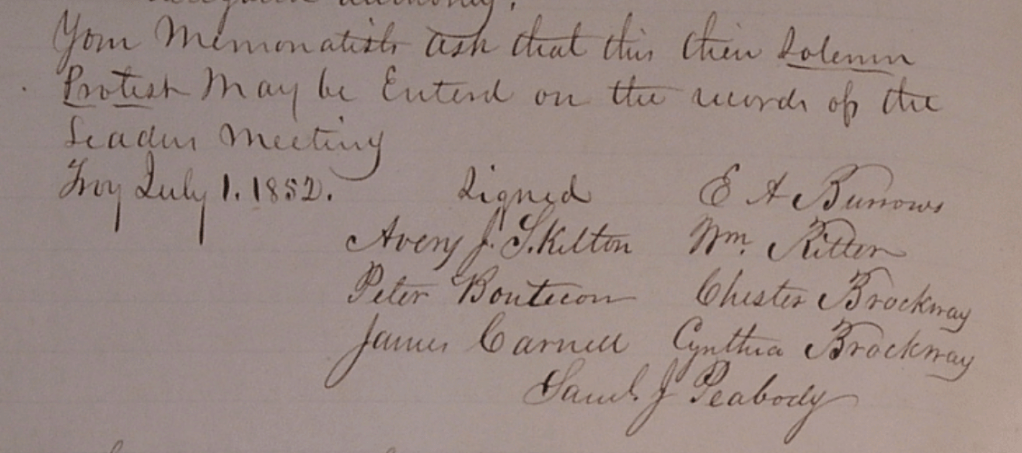
In the State Street Methodist society, those who fought hardest to prevent the acquisition of an organ called themselves the Memorialists. They were led by Dr. Avery J. Skilton, and when their cause appeared unsuccessful, they requested that the Leaders print their letter of objections, in full, in the minutes of their meeting held on August 22nd,1852. It begins:
” To the Leaders and Stewards Meeting regularly assembled Brethren.
A Church is an assemblage of pious persons associated together for the purpose of worshiping God, and of mutually aiding each other by advice, encouragement and exhortation to a Godly life and conversation, and to the exercise of holy disposition,” After several hundred words it concludes with a summary of the complaints of the Memorialists, who believed the leaders had made an “absurd” choice because firstly, the use of musical instruments is “unsanctioned by the Gospel”; an “imposition on their feelings” of people who joined the Church before this addition; an “injustice in a trespass upon the rights of property” of the members have paid their annual pew rental (threatening legal actions of trespass no less!); “an attempt to force the Church of God into accordance with man’s political preferences” (a comment on a presumed perceived imbalance between the objectors and those saying nothing, versus the leadership); “A withholding of the right of private judgment and conscience” – because there had not been a general ballot; and finally, they declared that the Leaders’ Meeting had “transcended its powers” and“violated the rights of members without the shadow of delegated authority” – a complaint that there had not been a vote for everyone, but neither were the leaders elected by the congregation as their representatives. The letter was signed by Dr Avery J. Skilton, Peter Bontecou, James Carnell, E. A. Burrows, William Ritter, Chester Brockway, Cynthia Brockway and S(Samuel? Sarah? Saul?) J. Peabody.
By early 1853, the organ was installed and the topic only reappeared in the minutes when requests were made in following months to first “dispense with the organ voluntarys”(sic) and later, the organ interludes, showing that while the organ was deemed helpful in hymn singing, not everyone was comfortable with it being used in a performative way – or maybe this was a nod to those who had objected all along. The disagreement had been intense and passionate, yet those who protested the installation of the first organ did not leave the congregation when they failed. If limiting the use of the organ for a while was a small accommodation to its detractors, who had not simply moved on when they lost the discussion, this author can find it nothing other than heartening.
Janet Douglass, Troy, NY. February 2026.
*The organ discussion takes place in the Leaders’ Minute Book which records meetings from1849. It begins with the February 1852 meeting: “On motion of Bro. Matthews, it was resolved that the chorister be permitted to introduce an instrument called the melodion into the choir of the church on trial for one month.” Permission was continued for another month in March, but there was a motion “to rescind use” in April, but the decision was delayed after much discussion. A second April meeting and another long discussion ended with the resolution “in view of the feeling of the church on the subject of instrumental music in divine worship the purchase of an organ for the above purpose is inadvisible.” At the meeting on July 2, 1852, “Dr. Skilton presented a paper…purporting to be a protest against the erection of an organ in this church, which he desired to read.” on the subject, and the following month his paper was recorded in the official minutes, as above.
The first organist of the church was Mr. Conant who had first been hired as the Singing Master or Chorister, both terms are used, in November 1849. He was discontinued some months later, rehired in December 1850 and in February of 1852 he made the request to introduce a melodion. After Mr Conant left his position, the society tried to hire a Mr. Clucas but this led to strife with the leadership of St Paul’s who also believed they had hired him. There is no evidence he ever took the position with the Methodists, but Mr William Cluett did, and the long and generous history of the Cluett family and this group of Methodists, began.
Quotation on the history of the organ is from www.christianheritageedinburgh.org.uk
For a contemporary take on the” heresy” of musical instruments in worship, read https://www.swrb.com/newslett/actualnls/InstrHer.htm

 janetintroy