An early story of the State Street Methodists, as recorded by Joseph Hillman
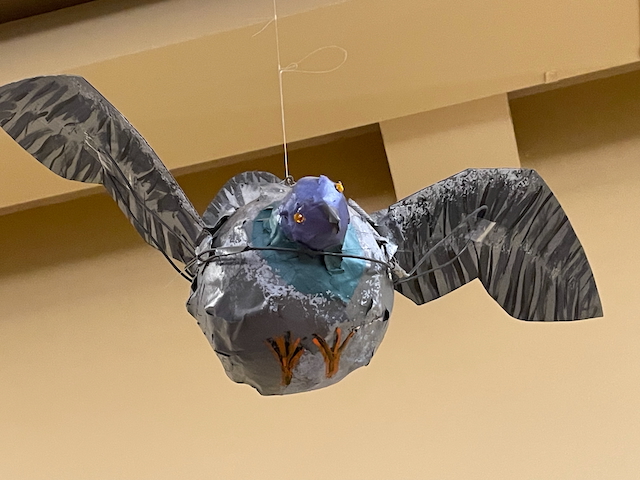
Isaac Hillman’s 1888 book,“Methodism in Troy,” is our main reference to the earliest days of the Methodist congregation on State Street in Troy, NY. We spent a whole year celebrating our 200th anniversary in 2007-8, including re-enacting some of those tales. We began with 3D wire and paper pigeons flapping their wings as they flew down wires from the balcony, over the heads of the congregation, landing at the communion rail at the start of worship one morning: an invention of resident engineer and installation creator, Alice Rose. They were decorated by members of the Sunday School and volunteers from the congregation, and 4 remain hanging in Fellowship Hall as a reminder of the dramatic event.
But why pigeons? In particular, why did we start with pigeons? It is because of a story told by Hillman. Here are his words:
”The congregation began to seek a suitable site for a meeting house. On the uninclosed ground then known as the Common, lying east of the line of Fourth Street, an eligible plot was found, which was designated on the map of the village as lots 743 and 744. They were originally part of the farm of Jacob D. Van der Heyden, which had been surveyed and laid out into building lots in 1807. As he had generously given to the Presbyterians and Baptists the ground on which they had built their meeting-houses, it was thought that if he were respectfully solicited he might be induced to convey lots to the society as a gift. When he was approached it was found• that he was not only unwilling to part with the property but personally opposed to the project of the society, asserting that the Methodists had no need of a meeting-house. Dr. John Loudon, a popular physician, who had begun his practice in the village in 1793, became greatly interested in the welfare of the society of which in 1810 he became a member, and he undertook to intercede with his brother-in-law to convey, for a small consideration, the lots to the trustees of the church. It is related that the business so much engaged his thoughts that one night he dreamed that he saw a large flock of pigeons fly over the village and settle down on the proposed site of the meeting-house. This dream he interpreted to presage the future prosperity of the church. After some further overtures, Jacob D. Vander Heyden consented to sell the ground for $500, demanding, however, the payment of an interest annually of $35 until the property was possessed by the purchasers. The conveyance was made on Christmas day, December 25, 1808.” (pp23-24 Methodism in Troy, Hillman, self-published 1888.)
The first two buildings were on that same piece of land, on the eastern edge of the Williams Street alley between Fourth and Fifth, facing State Street, where the parish house and garden are today. Early illustrations show that the first small white clapperboard building was on otherwise empty ground. The land had been Jacob D. Vanderheyden’s farm. This was the land which Vanderheyden had made available for the African American community, enslaved and free, to hold their annual week-long PInkerfest celebration. As the influence of the original Dutch farming families – with their numerous enslaved workers – waned, the land reverted to common land which Hillman describes as “not very inviting” as it was mostly dense weeds, briars and very little grass. Hillman further writes that a nearby stream would frequently overflow and leave “a strip of water on the east side of the church where children, in winter, found good sliding on the ice covering it.” (Hillman, p 27)
Housing at the time was still limited to First, Second and Third Streets with most commercial buildings on the banks of the Hudson, on River Street and increasingly along Congress Street: the land was, at the time, truly on the edge of the village.
The years of the 19th century would prove Loudon’s dream interpretation to be valid. The State Street site was the scene of many religious revivals, and birthed Sunday Schools and new Methodist churches in the area, as well as inspiring many to become pastors.
The trustees of the congregation solicited funds to build the “Troy University”, a towering ideal which sadly graduated only one full 4 year class, as original benefactors decided to promote other academic institutions. The building, with its four tall spires, dominated the Troy skyline for more than a century. It stood on the hill at the end of State Street, in full view of the congregation as they came to worship. When the university closed for lack of funding, it was purchased by the rapidly growing Roman Catholic faithful, and eventually sold to RPI. The last part of the original 1840’s structure was torn down 120 years later to build the current RPI library.
On the edge of Round Lake, a Methodist campground, set up by Hillman and his colleagues, in 1868, attracted 20,000 people annually to hear the preachers. It became a Chautauqua-style educational meeting, before becoming the settled village we see today, with houses built on the original church tent plots. Attendees gathered to hear well-known preachers and to sing hymns. The magnificent 1847 organ, which was placed in the tabernacle in 1888, is regarded as a treasure of the organ world, and the public can attend organ recitals every Summer. Methodist Farm on Crooked Lake, which is still operational as a Methodist summer camp, was bought and set up by local Methodists in the 1920’s, including the financial support of the State Street Methodists.
This all started with a dream about pigeons. As in the time of Jesus, early settlers of this nation put great store in dreams as a way for God to inspire them. A dream could sway even a staunch opponent like Vanderheyden to have his mind changed – at a price!
In the late 1860’s a plan was formed to build the current church, and the adjoining plot – now nowhere near an overwhelming stream – was purchased to make the site the size it is today.
As for Troy’s actual pigeon flock – some of whom survive despite the attentions of bald eagles and a variety of hawks – they can be seen at the end of the next block from the church at Barker (“Pigeon”) Park, along the Riverfront and in Monument Square, where some kind soul throws out food for them each morning.
The life of Dr. Loudon, the Round Lake campground, Methodist Farm on Crooked Lake, and Troy University will all have their own essays – as will the subject of antagonism toward early Methodists, as witnessed in the difficulty with which the congregation secured the land it still holds to this day.
Janet Douglass, August 2025.

 janetintroy