Stories from the lives of members of the State Street Methodist Episcopal Church
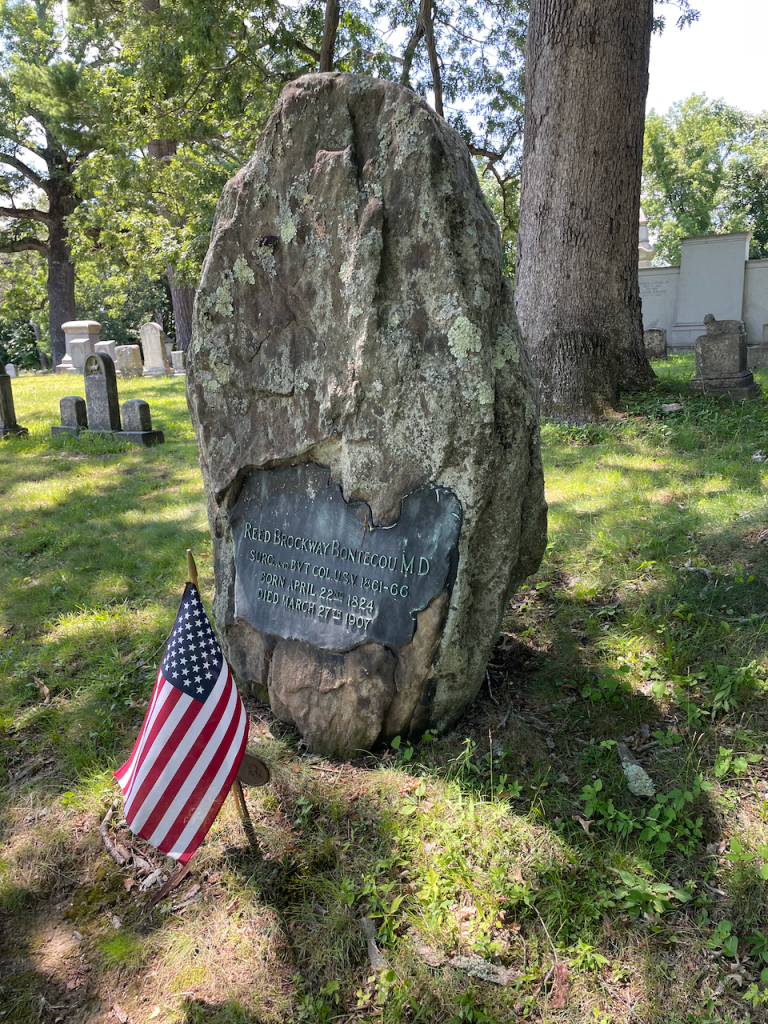
While the Cluett family, which played such an important part in the history of Christ Church, is now probably the best remembered name locally, on a national scale the most renowned person, by far, would be Dr. Reed Brockway Bontecou.
Dr. Bontecou’s name appears in medical journals dealing with surgery techniques and the beginnings of plastic surgery, in photographic journals detailing his photographs from the Civil War, and on Civil War and veteran sites, because of the pioneering nature of his surgical methods and how he recorded them in photos at such an early date of the craft. A few years ago, the Hart-Cluett Museum in Troy had a whole exhibit dedicated to Dr. Bontecou and displayed his medical bag.
In terms of the history of Christ Church, United Methodist in Troy, his lifetime spans all three of the buildings that have stood on State Street between the Williams Street alley and 5th Avenue, growing up in a devoted Methodist family.
He was descended from Pierre Bontecou, a French Huguenot, who was linked to Dutch Protestants before him. Pierre arrived in New York City as a refugee from the regime of King Louis XIV in the late 1600’s, and the family originally worshipped in a French speaking Huguenot (protestant) church. One branch of the family ended up in New Haven, CT. They were industrious and successful, but like many in the area suffered financially and physically at the hands of the British during the struggle for independence. This brought one branch of the Bontecous to the “village of Lansingburgh” in the late 1780s. Subsequently, Peter Bontecou, father of Dr. Reed Brockway Bontecou, was brought to Coeymans by his parents. But when still “a young lad” he removed to Troy to work as a clerk in a shoe store. He later became the proprietor.
Peter was a lifelong and ardent Methodist. Whether he heard about Methodism when he arrived in Troy, or had already made contact with the dedicated group already established in Albany County, we do not know. However, our records show he was a leader of State Street Methodist from its earliest days until his death in 1868. The family genealogist describes him as “cold and austere in manner, and strictly honest in all his dealings; a member of the Methodist Episcopal Church, and a great student of theological works.“
Reed was his first child. He had married Samantha Brockway in Troy in 1823. A year later he had a motherless infant son. Samantha’s death 2 weeks after giving birth was credited by some historians for Reed becoming a physician.
Even as a child, Reed was studious, with a naturally curious, scientific mind. When a boy, he started a collection of sea shells and he noted the similarities and differences as he catalogued them. According to the History of Rensselaer Co., New York by Nathaniel Bartlett Sylvester, published in 1880, he attended the “High School Academy” then Rensselaer Polytechnic Institute and then graduated M. D. from the Castleton Medical College, VT. At the age of 22 years, between attending RPI and medical school, he went on a year-long voyage up the Amazon to study. He was married, on July 18, 1849, to Susan Northrup and they went on to have 5 children.
In 1857, at the Troy Hospital, Bontecou “ligated the right subclavian artery for diffuse traumatic aneurysm of the axillary artery, the first successful case in America and one of the first three on record” https://en.wikipedia.org/wiki/Reed_Brockway_Bontecou
In 1861, he left his physician’s practice to become the medical officer of the Second Volunteer Infantry of New York. Within 3 months he was running the Fortress Monroe military hospital and then was asked to lead Harewood Hospital in DC, which he left at its closure in 1866. By that time he had been brevetted lieutenant-colonel and colonel of volunteers for his faithful and meritorious services during the war.
He returned to Troy and became the assistant surgeon at the Watervliet Arsenal, resident surgeon at Marshall’s Infirmary off Hill Street in South Troy, and had a private medical practice for four more decades. He is quoted in numerous coroner’s reports in Troy and area newspapers, was an official examiner for those seeking Civil War pensions, and held a number of prestigious positions in medical societies. He published reviews of his work and inventions, which included a special kit for soldiers to take with them into battles to self-treat a wound until help arrived, greatly increasing their chance of survival.
His name appears in the works of Arthur Weise who published several books on Troy in addition to Sylvester’s history of Rensselaer County. The Hart Cluett Museum had a display about his life and work, a few years ago, and displayed his medical bag.
According to the site dedicated to medical collections: “Bontecou’s peers respected ‘his unselfish character, his strict devotion to the truth, his extreme modesty and his unswerving fidelity to his students, colleagues and friends,’ noted one physician. Another doctor called him, ‘the Napoleon of Surgeons.’ “ That site hosts a long article, with illustrations, and catalogs his medical achievements. It is entitled: “Dr. Reed Bontecou’s Pocket Surgical Wallet, Bloodstained from the First Recorded Battlefield Amputation in the Civil War, on a Soldier of the 5th New York (Duryee Zouaves) And the Coins Driven into a Soldier’s Groin by a Bullet!”
The “Faces of the Civil War” blog has an entry entitled “The Napoleon of Surgeons” about Bontecou. http://facesofthecivilwar.blogspot.com/2013/05/the-napoleon-of-surgeons.html
In addition to the medical sites, he is remembered on historical photography sites for his pioneering use of the art as a documentary tool during the Civil War. This site has the most extensive descriptions of those achievements:
One of the largest online collections of his photographs can be found at:
https://www.robertandersongallery.com/gallery/reed-bontecou/
The site says: “Reed Bontecou was responsible for pioneering, and taking, the largest number of photographs of wounded soldiers during the Civil War and was the single largest contributor of photographs and specimens to the Army Medical Museum and medical publications of the time. His close up images of surgery, anesthesia, and patients posing with their pathological specimens were unique to his time.”
Just a few of the many sites which speak of Dr. Bontecou, for all his great qualities, do recount a lapse of judgment and somewhat of a fall from grace, in a situation that caused his wife Susan Northrup Bontecou to file for divorce. Details are few. One site (the Faces of the Civil War blog,) quotes a New York Times report that Susan’s accusation was “criminal intimacy”- the term used for an affair with a married person – and gives two names for the woman involved. All other references state simply that they divorced because of his affair with a young woman. For now we will leave it at this: in the strict society of his day, and doubtless among his colleagues and social group, this brief affair must have been quite a scandal, and stirred up much gossip once divorce proceedings began, but I have found few references to it.* What we do know is that, despite the embarrassment and notoriety, Dr. Bontecou did not leave the city in disgrace and his career does not seem to have been radically changed by the events. He continued to be a member – and head of – various esteemed organizations and to work with the military, at Marshall Infirmary and in private practice in Troy. The divorce was finalized in 1883. He never remarried.
Bontecou died in 1907. He is buried in Oakwood Cemetery, Troy.
(The photograph was taken by the author on 4th July, 2025. The headstone is very unusual, and I have not seen another in the century which is uncarved rock.)
Other interesting articles:
https://spotsylvaniacw.blogspot.com/2013/07/podcast-battlefield-photography-of-dr.html
https://www.hartcluett.org/rensselaer-county-blog/dreadful-accident?rq=bontecou
https://www.seekingmyroots.com/members/files/G000711.pdf
Bontecou genealogy, which starts with the amazing maritime adventures of a famous Dutch family member.
The FindaGrave website includes additional details of his Civil War Service I have not seen elsewhere and photos of the doctor, in uniform and on horseback.
https://www.findagrave.com/memorial/7050830/reed-brockway-bontecou
*Ron Coddington’s blog: Faces of the Civil War says: “Susan Northrup (1828-1911) and Bontecou married in 1849. She alleged criminal intimacy between her husband and Emma Josephine Murray, also known as Emma Brockway. According to the 1870 U.S. Census, she is the daughter of Reed Brockway. There may be a genealogical connection between this branch of the Brockway family and that of Bontecou’s mother, Samantha Brockway Bontecou (1803-1824). New York Times, November 28, 1883.” As I started to research the matter, errors in family trees made the strands of the tale hard to untangle for this essay: I may go back to researching who this Emma was, as the only Emma in the family was never known as “Emma Josephine Murray” – even a little research has thrown up other inconsistencies with even that brief account and no interest in the story in local newspapers so far – Janet

 janetintroy