Part of the series of extended essays on the early Methodist societies of Troy, New York.
The current sanctuary is the third building to house the Methodist congregation on State Street in Troy, NY, but it was a private home on State Street, which was regarded as the site of Troy’s first Methodist gatherings in the earliest days of the community, which would become the City of Troy. Records suggest Methodists first met on State Street in 1793. It is not yet possible to determine whose home that was and the location, but at that time there were few domestic buildings, and they centered on River, First and Second Streets. So, presumably where one of those crossed State there was a home where early Methodists found themselves welcome – which could never be assumed. Early Methodists were met with much opposition.
After its rocky start – Methodism did not have as many adherents as other protestant denominations at this point, and avowed Methodists were subjected, to ridicule, name-calling and outright violence for their beliefs – the congregation became sufficiently large and established, to need its own building. Lingering prejudice about the denomination is witnessed in the difficulty in obtaining the land to build. Jacob D. Vanderheyden, the landowner, had donated land for other denominations, or made the land extremely inexpensive for them to purchase, but he refused to sell land to the Methodists for a long time. It was the intervention of his brother-in-law, Dr. John Loudon, who shared his dream of pigeons “flocking” to the desired site, that is credited for Vanderheyden’s change of heart. Nonetheless, the Methodists paid top dollar for their piece of land.
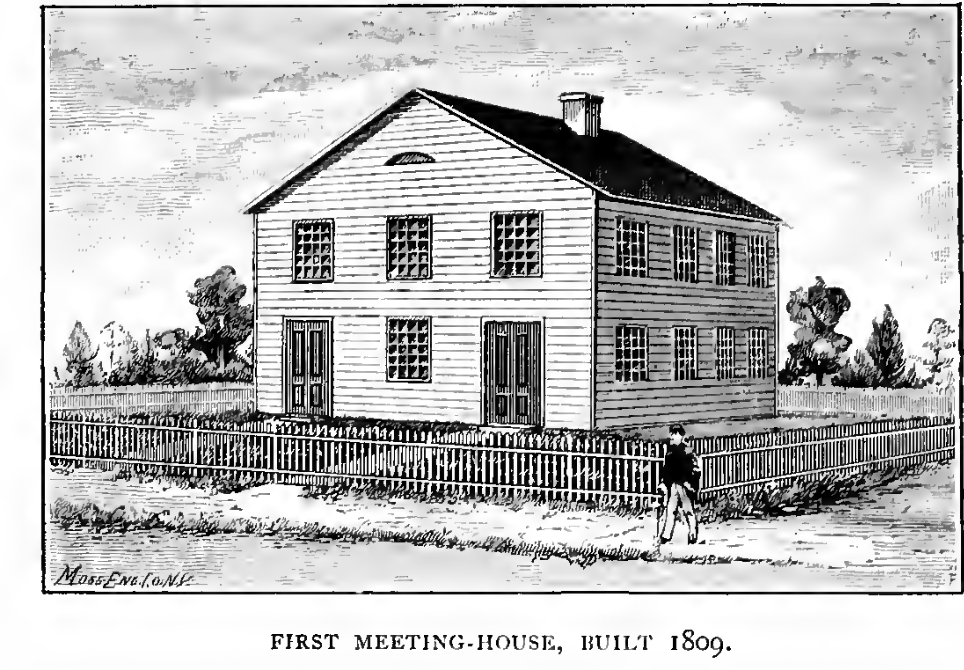
The congregation was incorporated as “The Methodist Episcopal Church of the Village of Troy” on November 29th, 1808, and a few weeks later, on Christmas Day, Vanderheyden conveyed the land to the trustees, having agreed to sell the land for $500, though with a $35 annual interest fee until paid off in full. The piece of land they acquired was the western half of the current site: two narrow lots, which has been designated the previous year as city lots 743 and 744, on the north east corner of State Street and Williams Street (the alley.) The building stood in what is now the small garden area in front of the parish house. It was two stories tall, plain, weatherboarded and painted white. The subscription started to pay for the construction of this modest building, despite having masons and carpenters in the congregation who gave their skills at no cost, still meant that the church was not ready to use for worship until 1811. Hillman reports that one of the largest sums donated came from Phebe, the daughter of Caleb Curtis: $5. He hints that there were very many, but very small donations, from those with less to give. The list of donations in the subscription book closed at $557.82.
The earliest drawing of that first clapperboard building is in A.J. Weise’s ‘Troy’s One Hundred Years” in which the building stands open on all sides. Weise describes the location as being built next to the common land. This was the land, donated by the Vanderheydens, for the annual Pingster or Pinkster Fest. Each Pentecost, both enslaved and free African Americans would gather for their annual celebration on this land, which included plenty of eating, drinking, music, singing and dancing…(See my essay on the African Zion congregation.)
The building was opened, still unfinished, with rough benches having been hurriedly made from planks by the congregation’s carpenters, just in time for the first service. Hillman reports the land around was not inviting and consisted of thick weeds and briars and patches of bare earth. The remains of a small stream passed by the eastern side of the building and when it iced over in winter, the narrow strip made for “good sliding” for the children.
Over time, the hurriedly made rough benches were replaced with slightly better plain pine benches, backed with a narrow board, but still at that time the pulpit was a a plainly-constructed desk on a small platform with several chairs. Tallow candles in tin sconces along the walls of the church lit it when evening meetings took place. By 1817, the church had a fence, which Hillman reported was to be “painted either all red or Spanish brown except the front part which was to be white”, as in the etching above from Hillman’s book. At the same time seats were added to the gallery and were likely the ones removed from the main auditorium. Women and girls sat on the east side, and men and boys took seats on the west side. The pulpit too had been replaced, Hillman reporting that there not being enough space, the children sat on the kneeling-step which surrounded the “altar.” (Hillman,p 46)
Frederick Garrettson – a man of great renown in the history of American Methodism – whose daughter traveled with him and acted as a secretary for his travels passed this on to his biographer:
” From Schenectady they returned to Troy, and put up at the house of the Hon. George Tibbits, whose hospitable mansion is delightfully situated on the side of a sloping hill ascending from the eastern part of the city, denominated Mount Ida. On the Sabbath, Mr. Garrettson preached in the Methodist Church, in this city, morning, afternoon, and evening, to an attentive congregation; and ‘truly’ says he, ‘it was a good day.’
He remarks that when he visited this place about thirty years before (in 1788) , there were only a few scattering of houses, and no Methodist society; but that he now rejoices to find a flourishing little city, in which there were four houses of worship, and not less than three hundred members of the Methodist Episcopal Church. what seemed to add to his religious enjoyment was the catholic and friendly spirit manifested by the several religious denominations toward each other. (Hillman, p 45-6.)
Even so, it was not until 1823 that the congregation secured sufficient money to pay off the debt on that first building. Only 16 years after its opening for worship, the congregation had outgrown their space: a new, larger sanctuary was required. On February 28th, 1827, the building was sold to Thomas Read and Sterling Armstrong for $500, only taking possession on November 1st. The first building had been moved to the corner plot, immediately east of its original location, the common land no longer being used for its intended purpose. So it looks like they shuffled the clapperboard building along, and worshiped there, while the brick chapel was being built. There, it was afterward used as a temporary court house, while the first court house on 2nd Street was being constructed, and then as a grocery store, until the erection of the current stone church in 1867. (Hillman p. 48 and p.52).
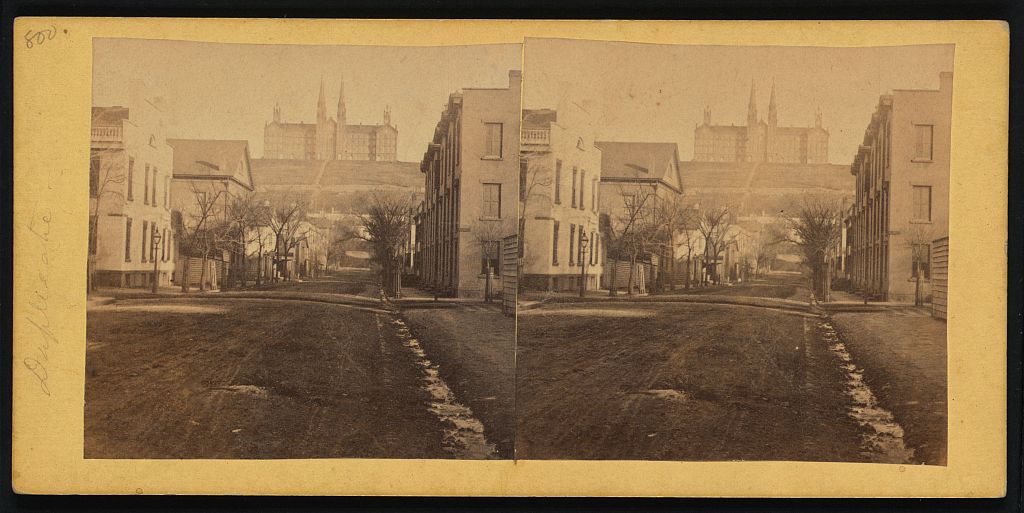
In the 1860 stereograph below, taken from the corner of State and 4th Streets, looking toward Troy University – about which, much more later – the brick sanctuary can be seen and beside it, a little harder to discern, is a much smaller, white wooden clapperboard building… standing there until the site construction of the current limestone sanctuary, which began 7 years after the photo was taken.
Dr. Loudon, his dream of pigeons, his work as one of Troy’s earliest doctors, and his importance to the congregation will all be covered in a later post.
The main historical source for the congregation is Joseph Hillman’s 1888 book “Methodism in Troy.” Other histories of Troy and Rensselaer County, many of which, like Hillman’s book, were published around the 100th year anniversary of the naming of Troy, include similar information. These include several books by A.J.Weise and also Rutherford Haynes and Sylvester Peck. All are available to read at no cost online. The Library of Congress site is a good place to start, but Google books and various university libraries also have digital versions. The stereograph above is from the Library of Congress archive, and is available for free use as part of the Charles F. Himes collection (Library of Congress Control Number 2005687324.)
 janetintroy