Searching the earliest records for a settlement that was only recently declared a village, and a decade before becoming an early northeastern city, turns out to be no simple matter.
Troy, New York had not long since chosen its name, when the people we are seeking arrived in search of a new life. Fellow congregation member, Alice Rose, and I have many questions we would like answered. However, even at these early stages of our research, we are learning a lot about the people who so determinedly created, and grew, a Methodist society in this new place. This is part of the story of State Street Methodist Episcopal Church. 230 years after the first followers of John Wesley showed up on State Street, we still worship there – at Christ Church, United Methodist.
How many hundreds of times did this story play out as the United States developed, in the decade or two after the Revolutionary War? How many thousands of stories could we tell about the earliest settlers of these villages, towns and cities, if we only had the journals and records of those women, men and children, itinerant preachers and circuit riders, who grew our denomination and without whom, we might not be Methodists today?
So what do we know? Well, we know these were adventurous people.
Most of the earliest Methodist members of the State Street society came from New England, and specifically from Connecticut. They arrived to find an unpaved, barely inhabited site, where farmers brought their corn to be weighed, and then shipped down the Hudson to New York City. Native Americans still hunted, fished and gathered the ample food supply growing along the flood plain of the Hudson River. Only three homesteads were located on the land that would become Troy: the three buildings designating the division of land between the 3 Vanderheyden patroons. The New Englanders who made the journey into what looked like nowhere, created a village, then city, from the farm lands of the Vandeheydens. That city became one of the third or fourth richest in the US in the following one hundred years, showing the first settlers to be not only adventurous, but resourceful and enterprising – and extremely hard-working.
As adventurous people, it is not so surprising that we found many so hard to locate because they simply continued their adventures – their sought-for better lifestyle – by moving on. Others were hard to find in the records because they were female, or African American, who, whether freed or enslaved, simply did not count enough to be counted and recorded. A few of the newcomers had already accrued some money. A lot more became wealthy in the city, inspired by the ingenuity of their fellow citizens. Many were the necessary tradespeople, providing the necessary needs of the population, shoes and coats and wheels and houses, earning a respectable and steady income from their craft. Others arrived, with only rural skills, seeking new trades, and often took their new skills even further west as new areas opened up.
The William McBurney family is one such case.
Joseph Hillman tells us that one of the earliest residents seeking a Methodist church was an Irishman, William McBurney (McBerney.) His descendants did some of the work to trace William, which I was able to confirm in my own research, but there was good reason I could not locate much about him in Troy.
William left County Down, Ireland, arriving in New York City in May, 1804, on the brigantine Sally (not the infamous slave ship of Rhode Island – that one had been wrecked a few years earlier in Barbados.) He came with his wife Alice, and 3 children: the “muster roll” quoted on geni.com states all children were under 5. William was 35, and Alice was 32. They were farmers, and most likely from the area around the small town of Dromore, some 21 miles from the port of Newry, which is cited as the port the ship left from. Newry and Donaghadee, 32 miles from Dromore, were popular ports for Irish ships bound for the United States in the 18th and 19th centuries.
The 2 leading preachers of Methodism had both visited that area in the preceding decades: Rev. John Wesley, the founder of Methodism followed his then chief substitute, Rev. George Whitefield, and preached in Lisburn, Co. Down in 1756. He returned every two years until his death in 1791. Methodism remains very strong in Lisburn to this day, and its main church is billed as the “mother church” of the younger Dromore Methodist congregation, just 10 miles away. It seems very possible that Willliam saw Wesley himself – at the very least, he surely must have known people who did.
Once in the US, the McBurneys wasted no time in moving to Troy. In our major historical source for our church – Methodism in Troy by Joseph Hillman, published in 1888, we read that “in 1806, William McBurney joined the class” of Caleb Curtis, one of our earliest members. When John Wright enquired about a Methodist society in the village a “colored woman informed Mrs. Wright that she knew an Irishman, named William McBurney, who was a Methodist. While in search of his house, John Wright heard a number of persons singing together a familiar Methodist hymn, and without attempting to repress his joyful feelings, he abruptly opened the door of the dwelling in which the voices were united in praise, and identifying the small company of men and women as Methodists, he gladly exclaimed, ‘Now I have found you!’ ”
In the list of official members of the Church in 1821-2, William McBurney is mentioned as one of the 12 “Leaders.” However, by the time we come to the first Troy City Directory, in 1829, which listed businesses and residences, only one McBurney- James- a “laborer,” is mentioned.
The family speculates, with good reason, that the family, left Troy, in the early 1820’s and followed the Erie Canal west, as did so many others. William is next found in the censuses as being in Ira, Cayuga County, home of a well-known local potter of the same name. The family located a reference, in one of William Ketchum’s books on New York State Potters, to a William McBurney, making and selling stoneware in Troy in 1820. They wonder if the well-known Cayuga potter, therefore, is “their“ William. Certainly, the newly-arrived William purchased land in Ira in 1825, and other members of the family, having disappeared from Troy records, seem to be in Ira and nearby Jordan, which is just to the south, on the Erie Canal. Indeed, a James McBurney is recorded as being in Jordan, right after the name disappears from the Troy City Directories.
This all reminds me that Troy’s fame as “The Collar City,” so much tied to the Cluett heritage, happened, in part, because Mrs. Cluett became sick on the Cluetts’ own journey to Western New York, and they simply stayed, after her recuperation in the city. Interestingly, the Cluetts were also leading Methodists and a big part of the State Street congregation for many decades. It is a story for another day, but like many other families, once they became wealthier, most of the family left Methodism – to become Episcopalian! At least, before leaving, they put the spire onto the tower – and probably left us a rare and magnificent Steinway piano…all for another day…
Today, many people who find themselves in the Methodist congregation on State Street, are also passing through the city. Visitors, looking for a Methodist congregation downtown, frequently stop in. Hundreds of students from Rensselaer Polytechnic Institute and Russell Sage College have worshiped with us over the last 230 years, before graduating and moving on. The position of the church downtown, with the closest residences now being apartments, has also created a more transient community, held together by loyal and determined long-term members, and the legacy of the first Methodists – like William McBurney – who settled in what would become the City of Troy and practiced their Methodist faith on State Street..
Janet Douglass
A sad postscript, to this story is that of a very early Methodist preacher in the area William came from – a John M’Burney who may be related, but we cannot know. John M’Burney was beaten and killed for being a Methodist. The brutal attack is detailed in ‘The Centenary of Methodism”(p.160ff) published in Dublin in 1839 , and details how, even as his assailants beat him, he forgave them. The book can be read free of charge on Google books. The website of the Irish Methodist Church lists John as a preacher from 1772 to around 1779.
Joseph Hillman’s book, Methodism in Troy, can be read free of charge at number of online archives. The book has been our starting point. However, one of the resources Hillman used, and which we would love to locate, is a publication by the “young daughter” of Caleb Curtis, mentioned above. Phebe Curtis’ “Rise of Methodism” has been much quoted through the years, but we have not found a copy. If you happen to know of such we would be grateful to know where we can access it.
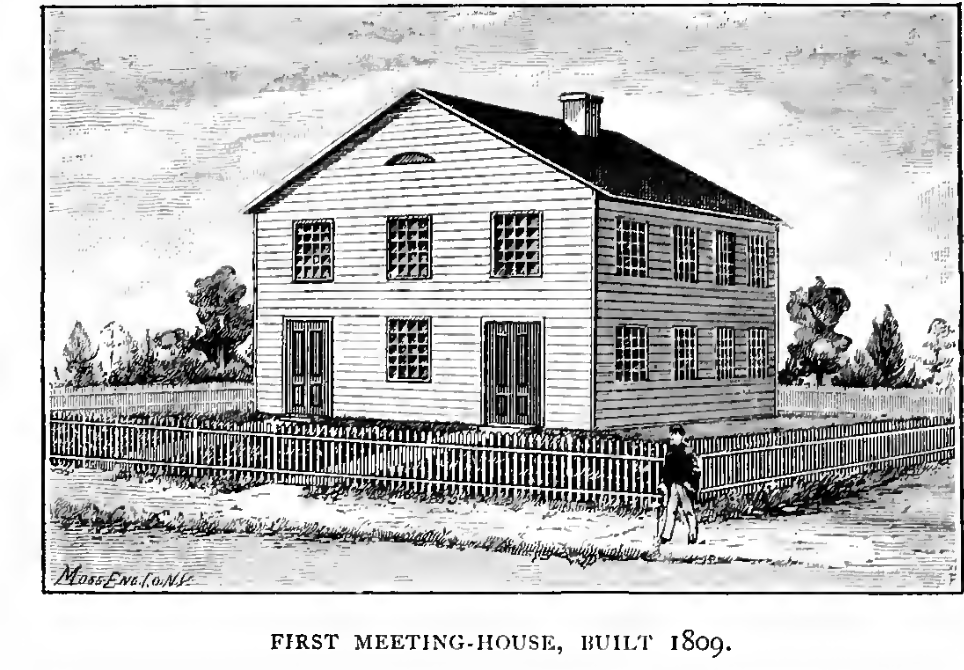
The above illustration is an engraving taken from Hillman’s book showing the first of the 3 Methodist sanctuaries that have stood on the piece of land on State Street, between William Street (alley) and Fifth Avenue, in Troy, NY.

 janetintroy