Extended notes on the Methodist congregations associated with the State Street Methodist Episcopal Church ( now Christ Church, United Methodist.)
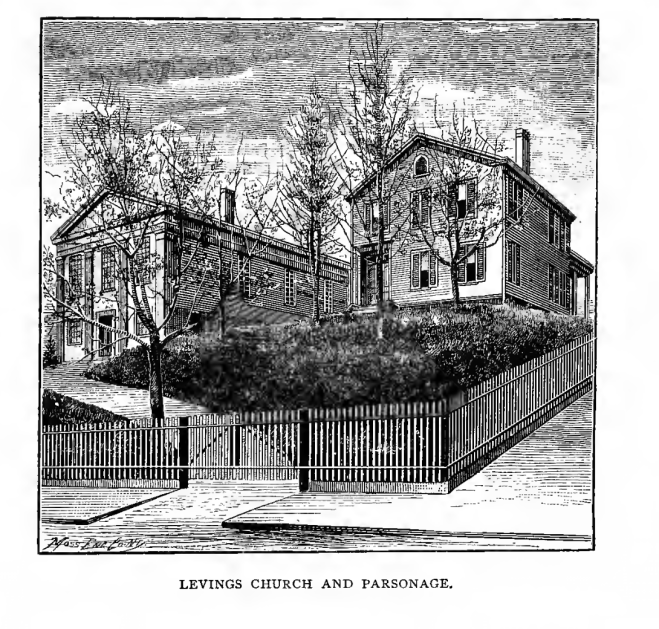
Fourth Methodist Church/ Levings Chapel, 63 Mill Street, South Troy, NY
In the mid 1830s, Methodists who were working in the nail factory on Mill Street, began to ask for a church to be erected closer to their place of work and homes. According to Hillman, they were holding worship services at the nail factory. On September 24, 1838, they met at the factory and designated themselves as the “Trustees of the Levings Chapel in the city of Troy,” also known as Fourth Methodist Church of Troy.
In 1850, they erected a sanctuary opposite the factory. Two years later, the Rev. Tobias Spicer, another early Methodist from the State Street church, and who was appointed as pastor of the Levings Chapel society, spoke unflatteringly of his work there: “My labors this year were mostly in South Troy, where we had a feeble society, which had lately built a church. “ None the less, by the early 1860’s the church had a membership of 140, and in 1888, at the publication of Hillman’s book, the number had swelled to 212 members, by which time the church had been renamed “Leving’s Church” though the old name of Chapel was often used.
The congregation continued until the 1960’s, when the decision was made to close it, rather than execute the much needed expensive repairs. The remaining members merged with the Green Island Methodist Church, now called Good Shepherd United Methodist Church, and anyone looking for genealogical materials from Levings Chapel could start there.
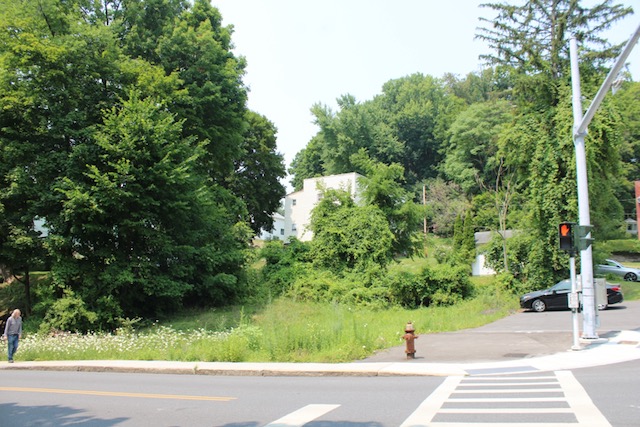
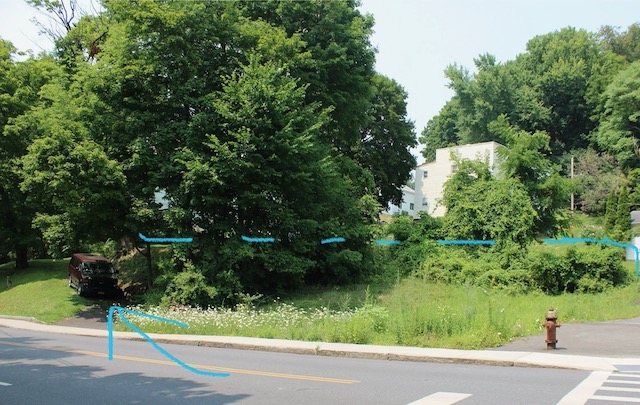
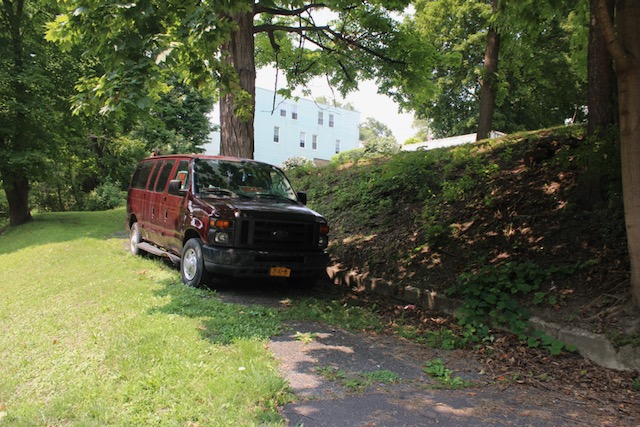
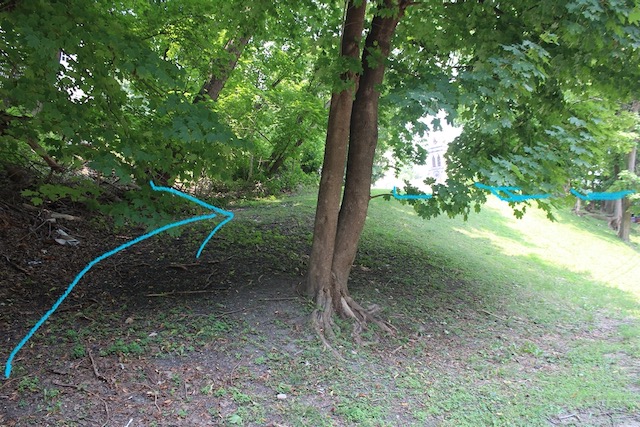
The last service was held on Palm Sunday, 1968, and the decision seemed prescient, given that during the following Winter the roof collapsed during a heavy snow storm and shortly afterward the church and manse were torn down. The lot for the two buildings remains empty, and stands on the corner of Mill and Erie Streets, and across Erie Street from the Woodside arts center, which was previously Woodside Presbyterian Church. The photographs below show the site, now obscured from the road by trees – the blue marks delineate the platform which remains and the two disused paths leading to it, one covered in gravel and the other metallized. The tower of the neighboring former Woodside Presbyterian Church can be seen beyond the trees. The platform can also be glimpsed behind current homes from the top of Erie Street.
The substantial buildings of the nail factory and Albany Steel Works, which lined the Wynantskill at the time, have also long-since disappeared. Today there is a walk around Burden Pond, down beside the Burden Falls and then on toward the Hudson River. If you look for them, there are still bricks and a few ruins of the old mills, in places. The location is famous for the giant Burden Water Wheel that used to stand there, purportedly the most powerful water wheel ever built. Several websites give those details, and also tell how an RPI student used his knowledge of this wheel, and his engineering skills, to build the first fairground pleasure wheel for the Chicago Columbian Exhibition in 1893. His name was George Washington Gale Ferris. For the first members of Levings Chapel however, it was simply one of the amazing pieces of new technology, which made them so productive and helped create Troy’s wealth.
As for the Rev. Noah Levings, this early convert to Methodism by the State Street faithful, while still an apprentice blacksmith, will need to have a brief history of his own at later date.
Line drawings and quotations are from “The History of Methodism in Troy” by Joseph Hillman, 1888, available as a PDF, free of charge, at a number of online archives, including the Library of Congress. Photographs are the author’s.

 janetintroy