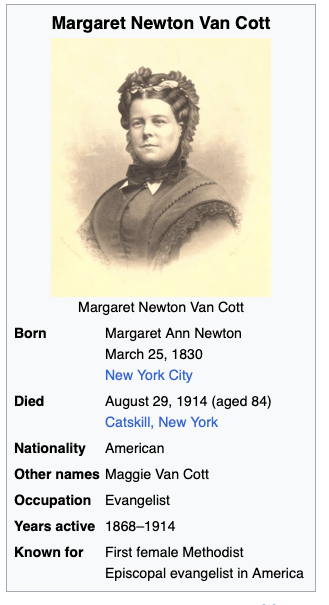
Maggie Van Cott (Margaret Newton Van Cott): early woman preacher & evangelist.

Maggie van Cott (1830-1914), seen here in a screen shot of her biography on Wikipedia.com, was the first woman in Troy Conference to be given a license to preach, and became famous throughout the North East as a leader of revivals, and even made tours out West. She received her license to preach in 1869, which was obviously controversial, and yet also very popular. In the book “The Harvest and the Reaper” written from her recollections,  there are contemporary reviews of her preaching, and whilst some criticize her lack of training as an orator and theologian, (and talk about her “womanly logic” – meaning lack of it,)  they all have to admit to her success at her goal of “bringing souls to Christ.”

 In March and April,1876, Maggie van Cott visited the State Street, Troy, NY congregation, staying with the Hillman family. Both Maggie and the Troy Praying Band, under Hillman,  had visited the Springfield, MA Methodists in the past to run revivals. 

The Troy Daily Times reports the revival events, reporting that the church was full for some, and that the one – weekday – afternoon, when they reported a smaller crowd, it still numbered several hundred. The pastor’s wife, Mrs. Kimball, and Mrs Joseph Hillman held some women only events, in addition to those open to the general public.

Joseph Hillman records in his book, Methodism in Troy, both his home and that of the pastor, Rev. H.D.Kimball, were robbed during the revival at the church: “the writer took the most complacent view of the loss as was possible, and proposed that the hymn “Hallelujah, ‘tis done” should be sung.” (Hillman, p.73.) He then continues to speak of the revival being a “glorious success” and how it also gave the Presbyterian church some new members.* Several of the revivals, at State Street Methodist Episcopal do appear to have been led with some support from the local Baptists congregations.

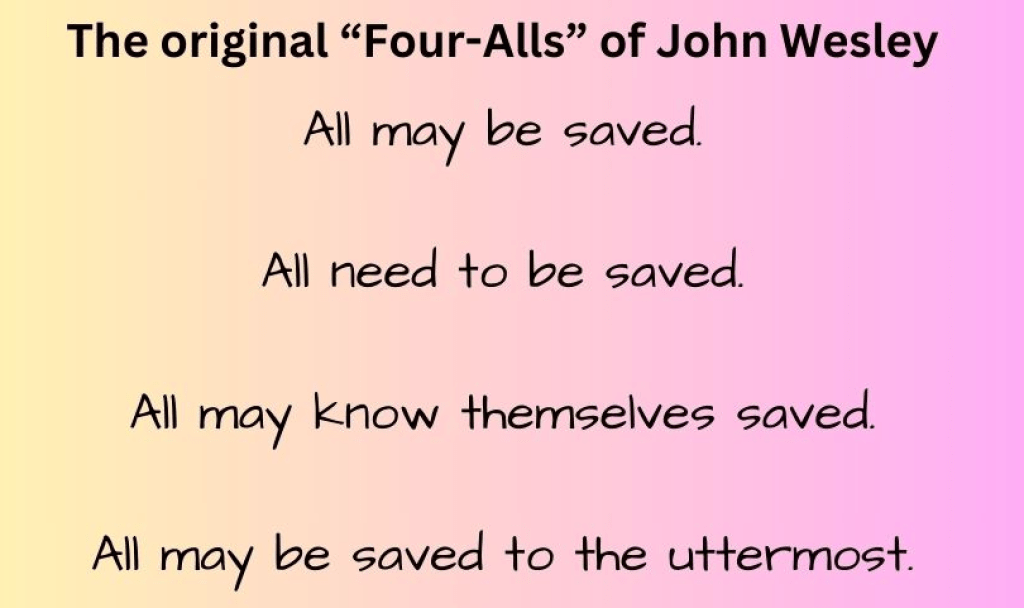
Revivals were not always seen positively in the Presbyterian denomination, as can be read at the link below, so it is interesting that the friendly relationships between denominations, praised more than half a century earlier by Frederick Garresttson when visiting Troy, seems to have continued to some extent.  The objections by the Presbyterian denomination included the inordinate “enthusiasm” which so often was a criticism of Methodist worship, but also the preaching. The nature of revival preaching made it less likely to be on the theology of Calvin. Revivalists were often Methodists, and their founder, John Wesley, had written many treatises in direct opposition to Calvinism, contrasting it with his own theology of the Four Alls, a traditional summary of Methodism teaching which underpins British Methodism to this day: 
She was born in New York City, but it is widely reported that, on the death of her husband,  moved to Greene County, which she deemed a better base for her revival work, and died at Catskill. A Maggie Van Cott does appear on the list of city residents in the 1830s, which hints that maybe she moved first to Troy and, as her travels and fame grew, moved  to Greene County. 

 By her 50th birthday she had supposedly traveled 143,417 miles, held 9,933 revival meetings, and given 4,294 sermons, but the total was far greater as continued her work until her eighties.

The New York Annual Conference of the Methodist Church created a bulletin insert for Women’s History Month in 2016, and it can be accessed at their site.

Online copy of her book: The Harvest and the Reaper can be read online, free of charge, at Google.com/books

Online copy of The Life and Labors of Mrs. Maggie Van Cott by John Onesimus Foster can be read free of charge, online, at Google.com/books

For more information on the Four Alls, one resource is the “What is Distinctive about methodism” page of the British Methodist Church.please visit the Methodist Church site at methodist.org.uk

The image at the top of the page comes from Wikipedia.com and is the title of their boigraphical sketch of the Mrs. Van Cott. The image of the “Four Alls” was created by the author.
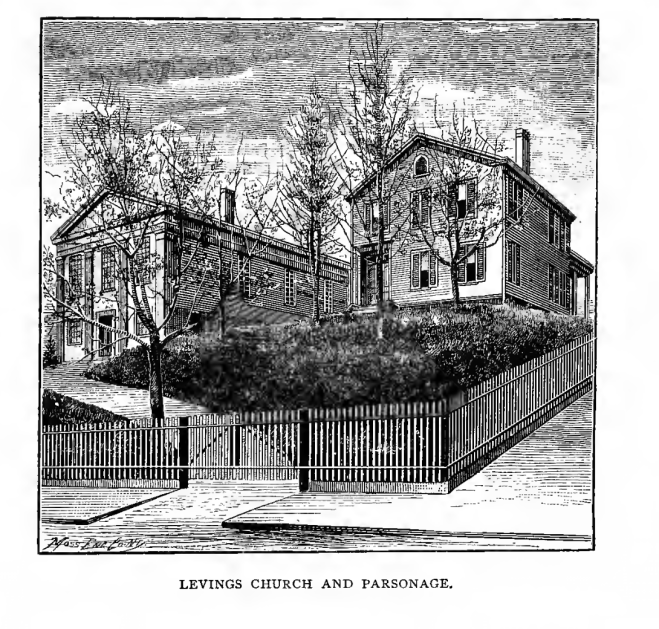
The Methodist Episcopal Church of Troy, NY: Levings Chapel/ Fourth Methodist Church/ Levings Church.

Extended notes on the Methodist congregations associated with the State Street Methodist Episcopal Church ( now Christ Church, United Methodist.)

Fourth Methodist Church/ Levings Chapel, 63 Mill Street, South Troy, NY

In the mid 1830s, Methodists who were working in the nail factory on Mill Street, began to ask for a church to be erected closer to their place of work and homes. According to Hillman, they were holding worship services at the nail factory. On September 24, 1838, they met at the factory and designated themselves as the “Trustees of the Levings Chapel in the city of Troy,” also known as Fourth Methodist Church of Troy.

In 1850, they erected a sanctuary opposite the factory. Two years later, the Rev. Tobias Spicer, another early Methodist from the State Street church,  and who was appointed as pastor of the Levings Chapel society, spoke unflatteringly of his work there: “My labors this year were mostly in South Troy, where we had a feeble society, which had lately built a church. “ None the less, by the early 1860’s the church had a membership of 140, and in 1888, at the publication of Hillman’s book, the number had swelled to 212 members, by which time the church had been renamed “Leving’s Church” though the old name of Chapel was often used. 

The congregation continued until the 1960’s, when the decision was made to close it, rather than execute the much needed expensive repairs. The remaining members merged with the Green Island Methodist Church, now called Good Shepherd United Methodist Church, and anyone looking for genealogical materials from Levings Chapel could start there.

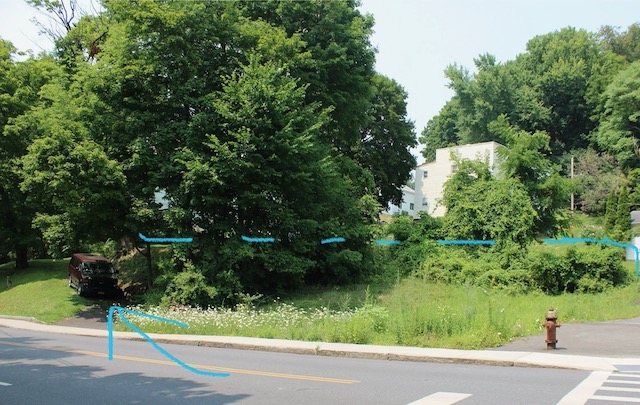
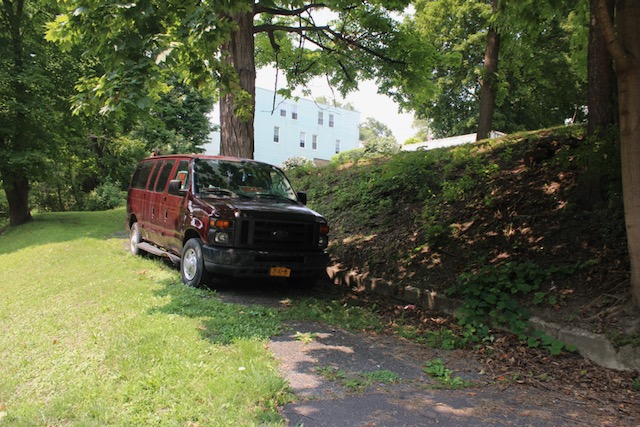
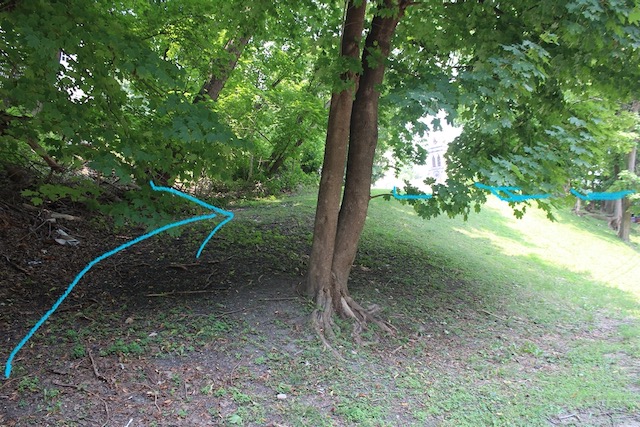
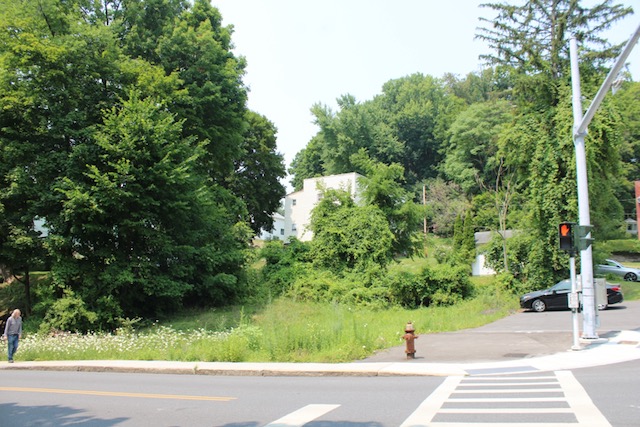
The last service was held on Palm Sunday, 1968, and the decision seemed prescient, given that during the following Winter the roof collapsed during a heavy snow storm and shortly afterward the church and manse were torn down. The lot for the two buildings remains empty, and stands on the corner of Mill and Erie Streets, and across Erie Street from the Woodside arts center, which was previously Woodside Presbyterian Church. The photographs below show the site, now obscured from the road by trees – the blue marks delineate the platform which remains and the two disused paths leading to it, one covered in gravel and the other metallized. The tower of the neighboring former Woodside Presbyterian Church can be seen beyond the trees. The platform can also be glimpsed behind current homes from the top of Erie Street.

The substantial buildings of the nail factory and Albany Steel Works, which lined the Wynantskill at the time, have also long-since disappeared. Today there is a walk around Burden Pond, down beside the Burden Falls and then on toward the Hudson River. If you look for them, there are still bricks and a few ruins of the old mills, in places. The location is famous for the giant Burden Water Wheel that used to stand there, purportedly the most powerful water wheel ever built. Several websites give those details, and also tell how an RPI student used his knowledge of this wheel, and his engineering skills, to build the first fairground pleasure wheel for the Chicago Columbian Exhibition in 1893. His name was George Washington Gale Ferris. For the first members of Levings Chapel however, it was simply one of the amazing pieces of new technology, which made them so productive and helped create Troy’s wealth.

As for the Rev. Noah Levings, this early convert to Methodism by the State Street faithful, while still an apprentice blacksmith, will need to have a brief history of his own at later date.

Line drawings and quotations are from “The History of Methodism in Troy” by Joseph Hillman, 1888, available as a PDF, free of charge, at a number of online archives, including the Library of Congress. Photographs are the author’s.

The Methodist Episcopal Churches of Troy, NY: Fifth Avenue/ North Second Street

Extended notes on the Methodist congregations associated with the State Street Methodist Episcopal Church (now Christ Church, United Methodist.)

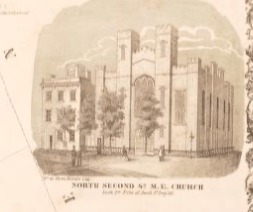
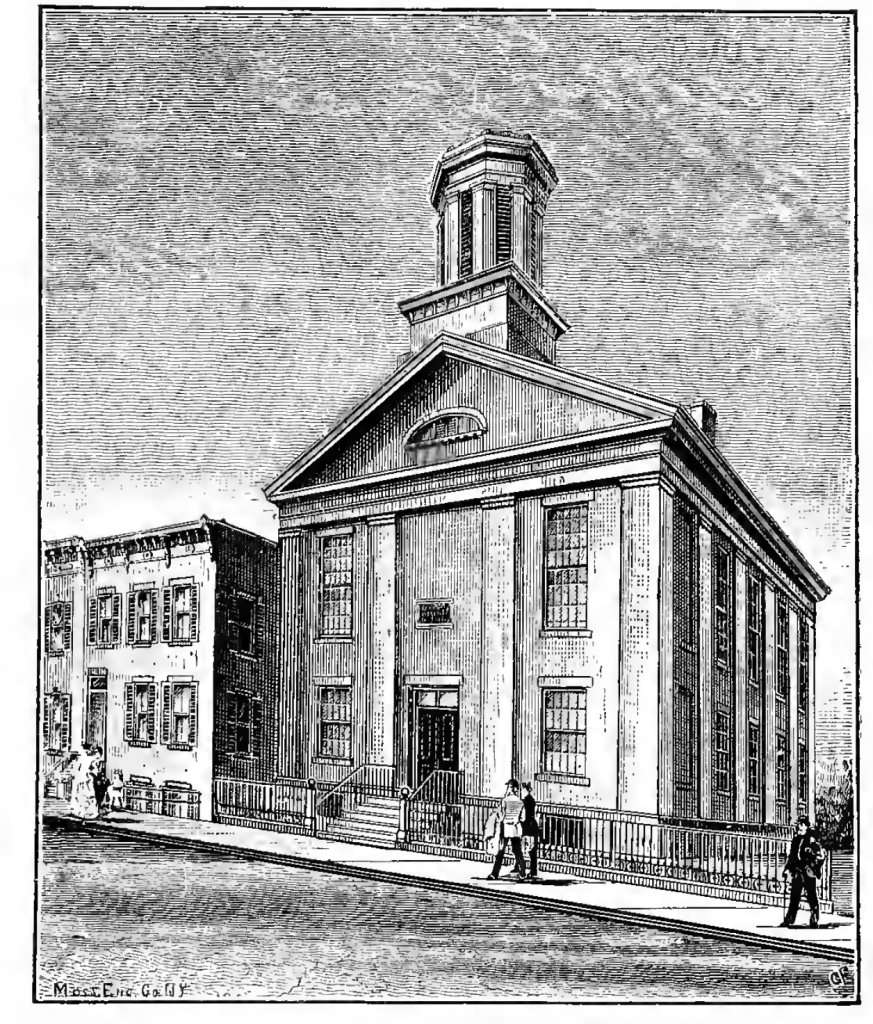
“The expediency of taking advantage of the growth of the city northward of Grand Division Street, and of having a church in which the seats were free, caused the State Street society to give consideration to the project of providing a place of worship in the north part of Troy. On May 23, 1831, the Quarterly Conference appointed a committee ‘to provide a place for preaching somewhere in the bounds of the fourth ward.’ On August 8, that year, the committee reported ‘that the only place to be had ‘ was ‘the dwelling-house’ of Stephen Monroe. A committee of five persons was then appointed ‘to provide a place or places for meetings in the first and fourth wards of the city (…) Considering that the lot on the northeast corner of North Second and Jacob streets would be an eligible site for a church.” (Hillman, pp 87-8)

On the evening August 13, 1831, the trustees of the State Street society “resolved that a subscription should be circulated throughout the City of Troy and elsewhere for the purpose of building a Methodist Episcopal Church in the fourth ward of the city ‘with free seats.” showing that the idea of having paid seating in the “mother church” on State Street had become an issue for some of the congregation.

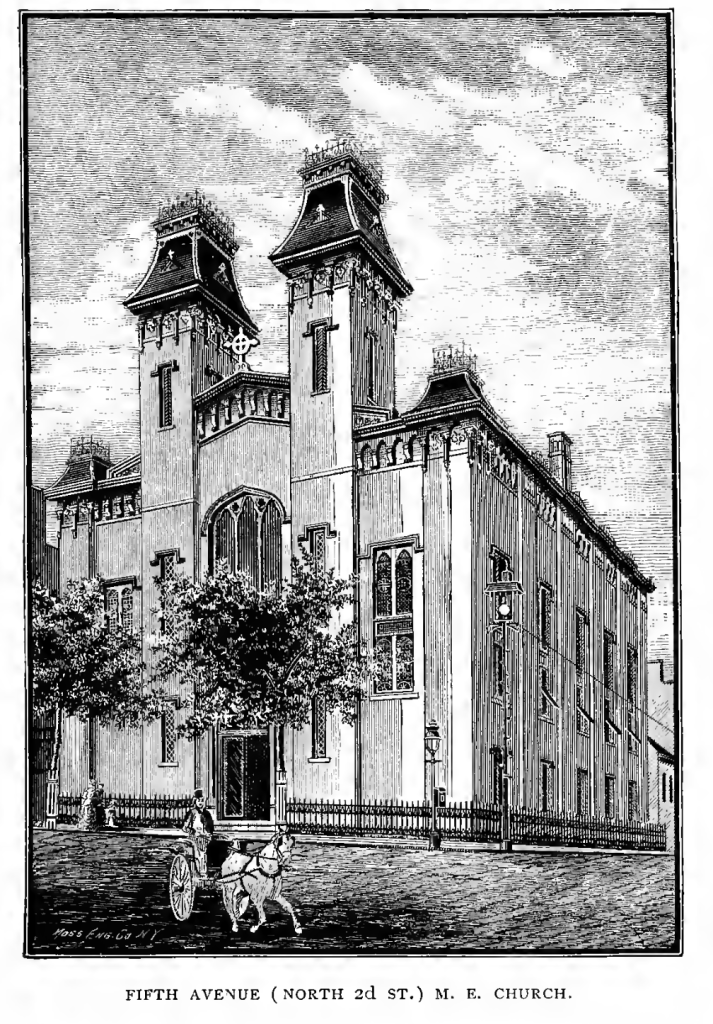
This building was a brick structure and included a basement. As soon as it was built the Sunday School which had been organized nearby, in the school-room of Miss Annie Manwarring, was moved there and prayer meetings began. “On Sunday afternoon, August 30, 1835, Bishop Elijah Hedding dedicated the church.“ (Hillman 87-88.) The congregation having grown in number, this church building was replaced with a grander structure, which was originally slightly less grand than the drawing found in Hillman’s book. The original aspect of the church can be seen in this 1869 map by William Barton which can be seen online at the New York Public Library website. The private house next door in that drawing, appears have become the parsonage.

The congregation chose to re-merge with the State Street congregation in the 1920’s, at the same time as the German Episcopal Methodist church. The merger of these three churches occurred in 1925, and is recalled by an unknown member of State Street Methodist Episcopal, upon the 125th anniversary of the church in 1939:“Time passed on with greater or less success to Methodism in Troy, until the year 1925 when the mother church grew lonesome for her children and it was decided to unite the congregations of State Street, Fifth Avenue and the German Church under one head whose name should be the Fifth Avenue-State Street Methodist Episcopal Church.”

(quoted by Rev. Dr. James Fenimore in his 1998 paper: “Christ Church, United Methodist – a Church on the Edge of an Apocalypse” from a letter to the church entitled “To the Pastor and People of State St. Methodist Episcopal Church.” This paper is available online.)

The building and its parsonage became the property of St. Peter’s Armenian Apostolic Church in 1927. That congregation left the building when they constructed their new church in Watervliet, in 1971. An African American congregation then worshiped in the church, until it became suddenly and dangerously unstable, and was razed by the City of Troy in the 1999. The parsonage was demolished a little later.

In 2024, the lot which was occupied by the church and parsonage, is used for parking. It is located between Federal and Jacob Streets on Fifth Avenue, in the area now known as Columbus Square.

Line drawings and quotations are from “The History of Methodism in Troy” by Joseph Hillman, 1888, available as a PDF, free of charge, at a number of online archives, including the Library of Congress. Photographs are the author’s.

The Methodist Episcopal Churches of Troy, NY: East Side Church/ Pawling Avenue.

Extended notes on the Methodist congregations associated with the State Street Methodist Episcopal Church (now Christ Church, United Methodist.)

Pawling Avenue/ East Side Methodist Episcopal Church

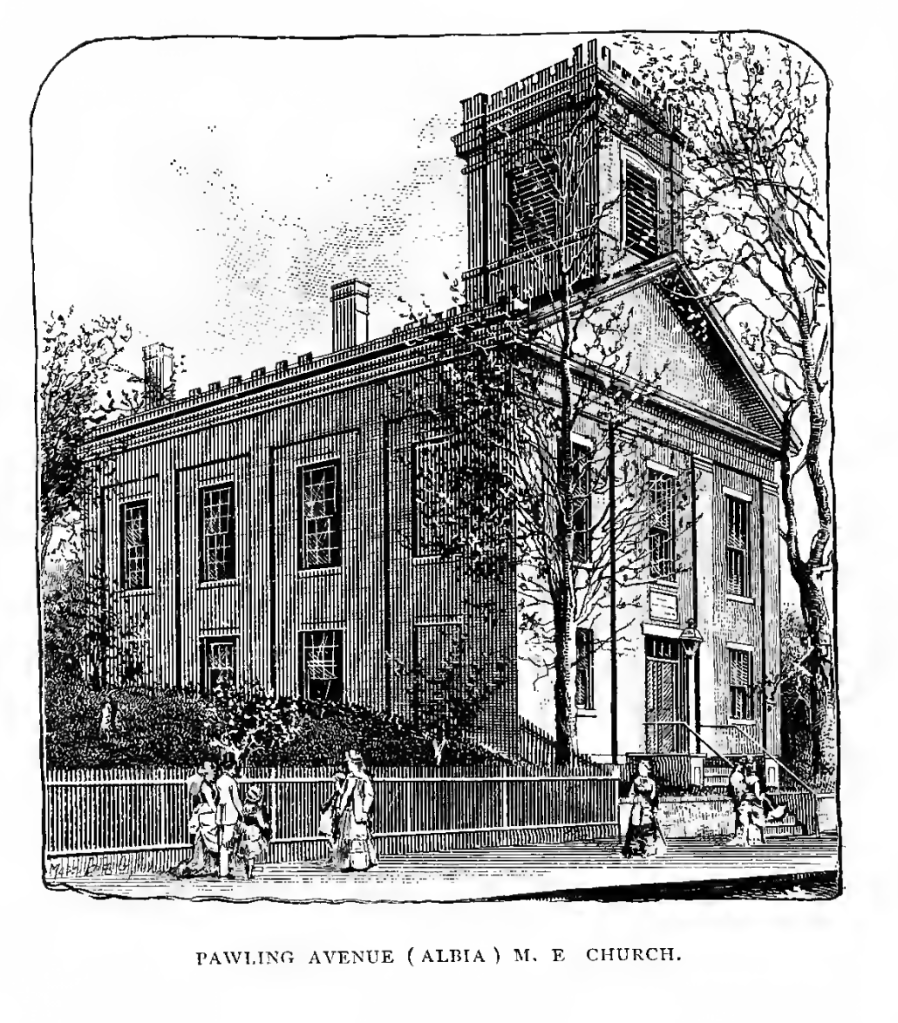
“The first Methodist meeting house at Albia, in the fifth ward of the city, was erected by the trustees of the State street society, for the purpose of providing its members with a convenient place for hearing preaching and for holding prayer -meetings, when they were precluded from attending religious services at the State Street Church.“ The trustees of State Street formed a committee to build a meeting house in Albia, on August 15, 1826. The first reported sermon was preached there in 1829 (Hillman. p 83.)

This Methodist “society” – congregation- was not only the the first satellite church of the State Street church, but of all of those churches, is the only one still in operation today, in a building within sight of the location of the original one. It was needed because the mill workers would have had a xxx mile work to downtown Troy, and then walking back up a steep valley side, not only taking a lot of time and effort, but on unpaved roadways and in all weather, it must have been a dangerous and difficult journey. It is remarkable that up to this point some actually had made it!

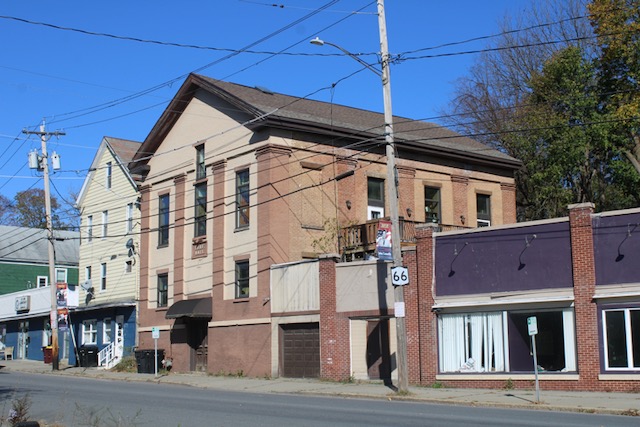
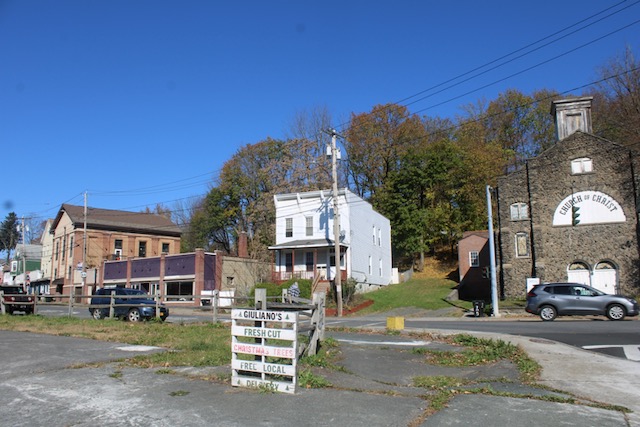
The original building was made of wood, and Hillman reported that the stone tablet above the door read that the church was erected in 1827, and rebuilt in 1858. Maps show it as being a little smaller than the still-standing original Presbyterian Church, now labeled as a Church of Christ, though not in use, just a hundred yards away at the junction of Pawling Avenue and Winter Street. The site of the East Side Methodist Church became home to the Oddfellows Society, and the structure still visible at the site does have the appearance of a chapel, but one made of brick, not wood. It now appears to be a home.

The site of the original East Side Methodist Episcopal Church on the east side of Pawling Avenue.

The view from the junction of Pauling Avenue and Winter Street, with the Wynantskill immediately behind the photographer. These banks were lined with mill buildings, and some remains are visible looking over the bridge as well as on adjacent properties.

The congregation adopted the official name of the “Pawling Avenue Methodist Episcopal Church” in 1868, and in 1888 Hillman reported a membership of 166 persons.

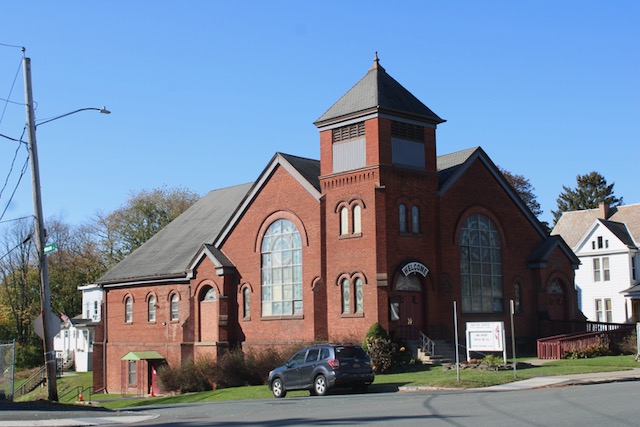
A few years after the publication of Hillman’s book, the current brick church, known locally as “The Welcome Church,” was constructed on the western side of the road, less than half a mile to the north. This congregation continues to welcome neighbors and friend to worship and community meals, and can be contacted on Facebook and the web. If your genealogical search leads you to this congregation, you should start by asking what records they have, as operational UMC churches usually hold their records.

Many of the imposing brick structures of the mills, including those first erected by Mahlon Taylor not long after his arrival in Troy in 1789, and their successors, were still standing beside the Wynantskill into the 21st Century.

Line drawings and quotations are from “The History of Methodism in Troy” by Joseph Hillman, 1888, available as a PDF, free of charge, at a number of online archives, including the Library of Congress. Photographs are the author’s.

The Methodist Episcopal Churches of Troy, NY: Third Street Church.

Extended notes on the Methodist congregations associated with the State Street Methodist Episcopal Church (now Christ Church, United Methodist.)

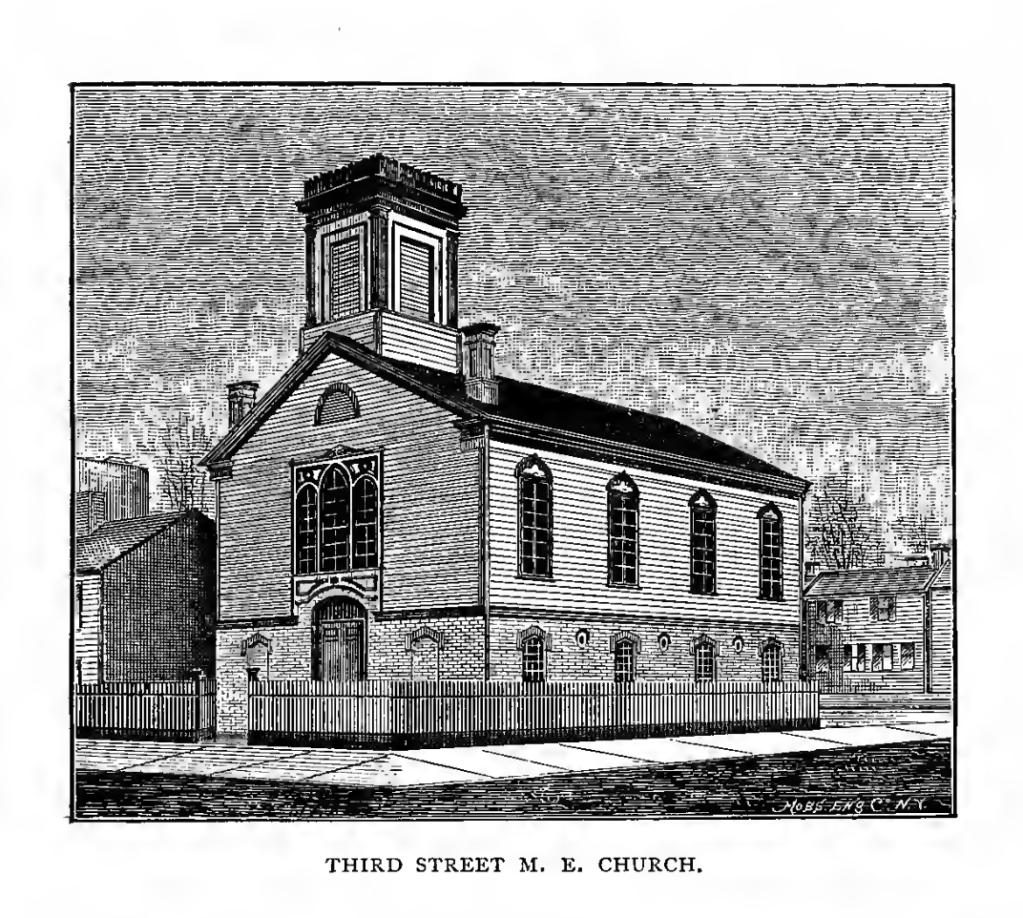
Third Street Methodist Episcopal Church, corner 3rd and Monroe Streets, South Troy.

In March 1844, trustees were elected for a separate congregation named “the Third Street Methodist Episcopal Society of the City of Troy” and a Sunday School was organized. The following year “a lot on the northeast corner of Third and Monroe Streets was purchased by the society to build a church. “  (Hillman, p.96) “The small society which had organized in 1843, began its erection in 1847(…) On Christmas day, that year, the building was dedicated.”  (Hillman p. 66)

“The origin of the Third Street Methodist Episcopal Church can be traced to a statement made by William Barrett, a class-leader of the State Street Church, at the leaders’ meeting held on May 2, 1842 (…) he suggested the suitableness of the house belonging to him in that part of the city for preaching.”  “ In1873, the church was enlarged by the construction of a lower story of brick, on which the wooden structure of the first edifice was placed.” (Hillman, 96-99)

Prayer meetings had been conducted in William Barrett’s house for a while, and when Daniel Hudson, an experienced Sunday School Superintendent, moved “from the northern part of the city,” a class of Methodists was formed. A “class” was the usual Methodist term for a neighborhood group of adults and families with children. The Trustees of the State Street congregation, seeing the success of the class, started to look for a building in earnest, meanwhile paying William Barrett for the use of his house for prayer meetings, preaching and a Sunday School. This saved South Troy participants from trudging the one mile each way to the State Street church, or not quite as far a walk for many – but up a steep hill – to Levings Chapel. 

Like other new congregations, the decision came at a time of dissension that pew rentals were being charged in the State Street building, usually reported by Hillman as temporary fees to pay for new buildings, but always mentioned with hints that the decision was not universally approved.  Certainly the cost to rent a pew could have dissuaded attendance by the workers of South Troy, many of whom worked in the steel mills and foundries of the area. In fact, Hillman tells us this would-be congregation decided not to accept State Street’s appeal for money for their building, but to create its own Board of Trustees and become a separate church. 

In October, 1844, the Sunday School reported having 15 teachers, in addition to two superintendents –  one for males and one for females – and a secretary-librarian, even though Hillman estimates membership of the society being around 35, with 75 students in the Sunday School. The first sermons were preached on the steps of the partially-built church, and the sanctuary was dedicated on Christmas Day, 1847.

After a time as a separate charge, the congregation reunited with State Street and operated under the name of Wesley Chapel. When attendance climbed again, peaking at 151, under the able leadership of its superintendent, Daniel Klock Jr., they once again took a minister and revived their Third Street name. The Sunday School had 288 members in 1888, and the school rooms were enlarged. Sadly, it was not to last. 

The congregation which had struggled, revived, and struggled and thrived for a few years, then struggled again, closing its doors at the end of the19th century, not so long after its best years.

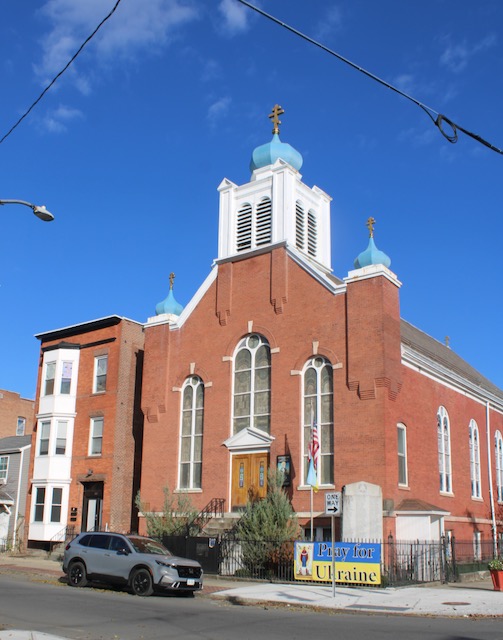
Saint Nicholas Ukrainian Orthodox Church, with a similar shaped, but brick, building now occupies the lot.

Line drawings and quotations are from “The History of Methodism in Troy” by Joseph Hillman, 1888, available as a PDF, free of charge, at a number of online archives, including the Library of Congress. Photographs are the author’s.

The Methodist Episcopal Churches of Troy, New York: N.Troy/ Vail Ave/ Grace

Extended notes on State Street Methodist Episcopal Church (now Christ Church United Methodist) and the buildings and congregations that came from it.

 1852 – North Troy Methodist Episcopal Church: Grace (Vail Avenue) Church, Troy.

“… a number of Methodists began holding meetings of prayer and exhortation in the school-house in the tenth ward of the city, and they organized themselves on May 15, 1852, as a society known as ‘the Methodist Episcopal Church in North Troy’. The schoolhouse was on Glen Avenue (...) The first meeting-house of the society was erected in 1858 on the west side of Vail Avenue, between Douw Street and Turner’s Lane, and was dedicated on December 10th of that year.” (Hillman, p.112)

The third sanctuary of the “mother” church on State Street (now Christ Church, United Methodist) still stands, the same site being used for all 3 buildings. In South Troy, the church currently standing where members from State Street Methodists seeded a congregation, bears similarity in layout to the original church, but brick replaced wood long ago. In the case of Vail Street we can still see the original brick building of 1858 – once you know what to look for…

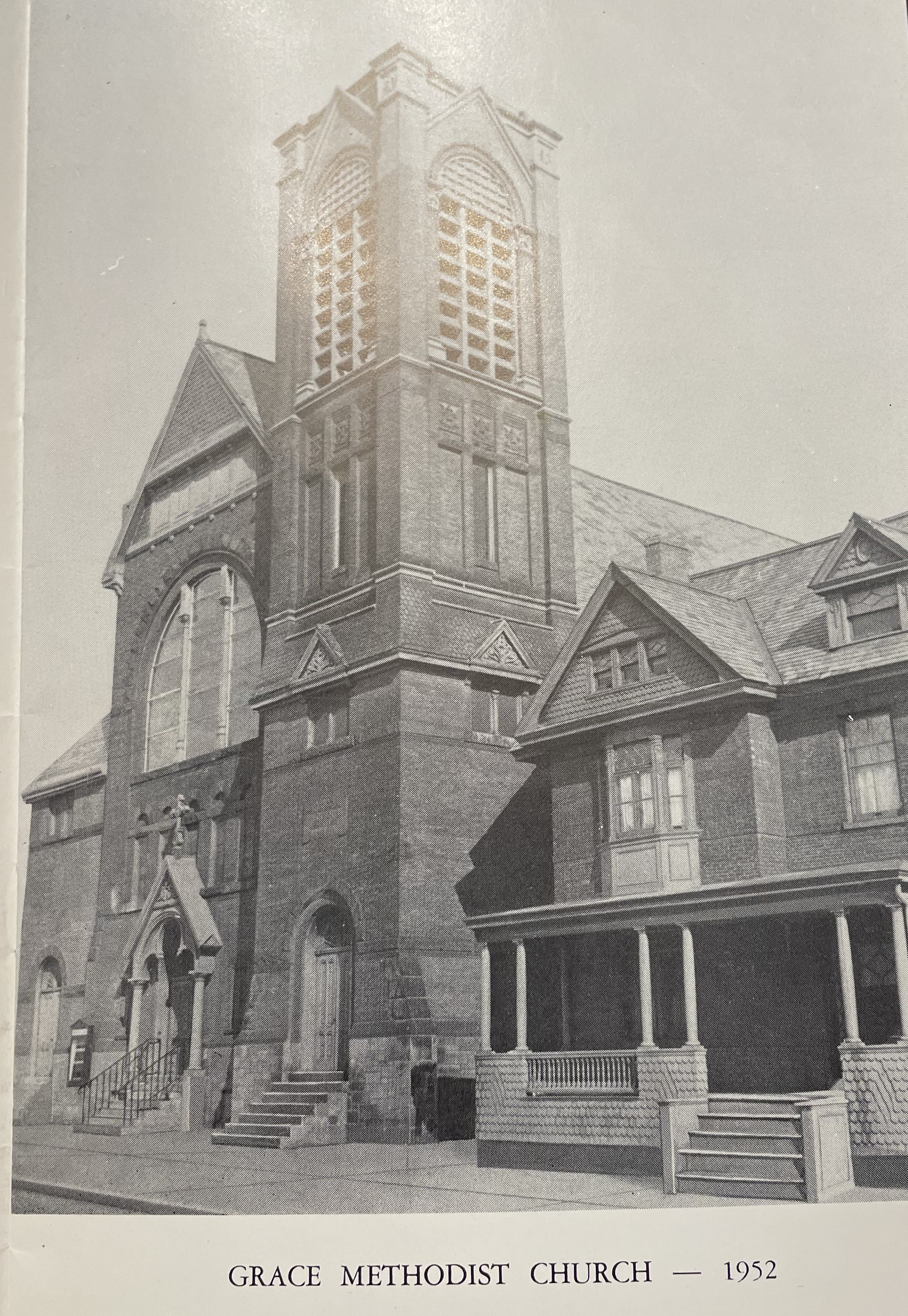
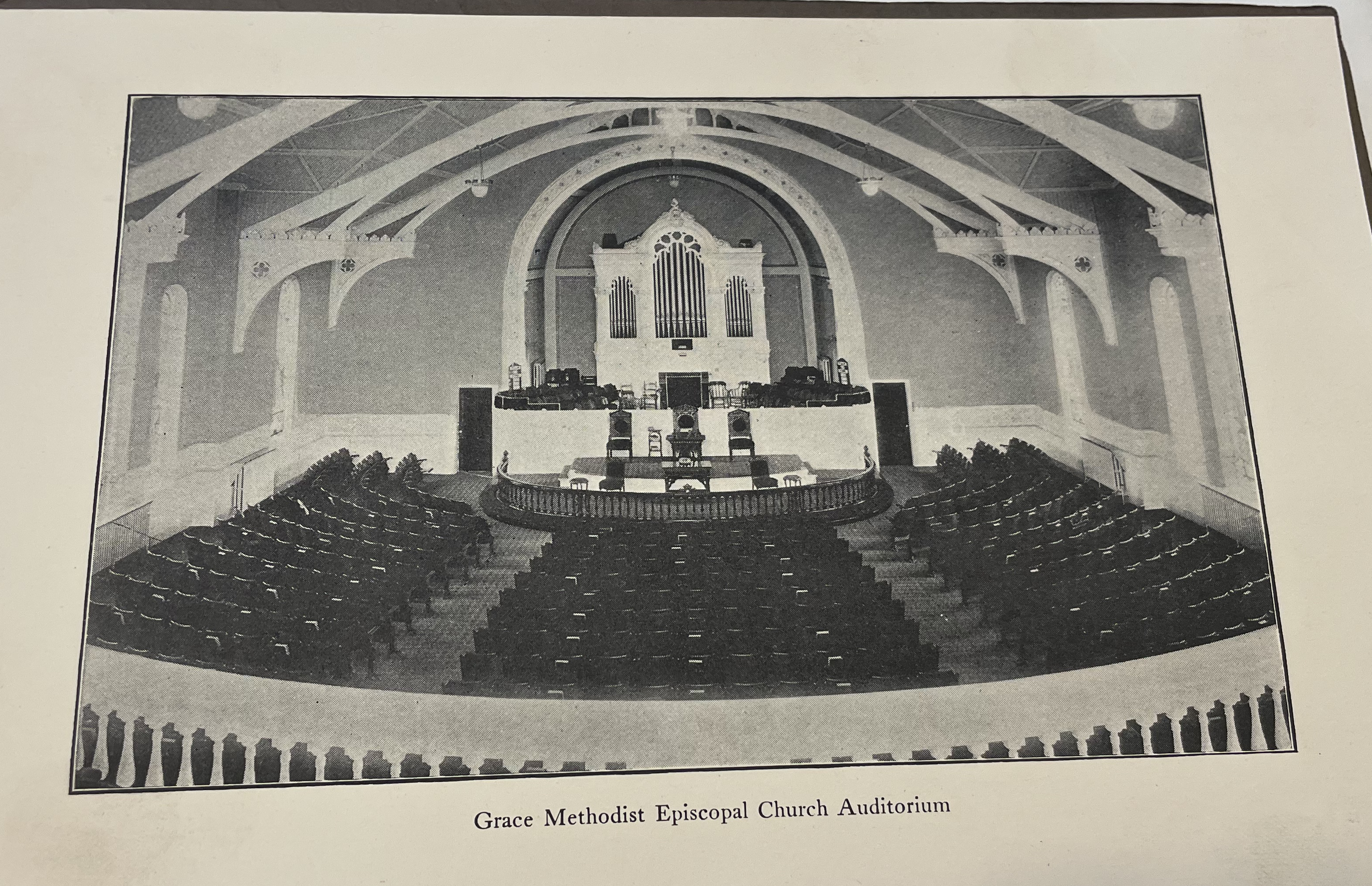
Grace Methodist Church, was the final name of several names for this congregation, and the final name came with its construction of a large brick church and parsonage complex half a block south of the 1858 building. This imposing structure was being built, but not yet opened, at the time of publication of Hillman’s book. The corner-stone was laid on August 16th, 1888, and the church was dedicated on Sunday, June 2nd, 1889. It stood on the corner of Douw and Vail Streets (now 6th Avenue) half a block north of the (now closed) St Patrick’s Roman Catholic Church.

The origins of the congregation go back to a Sunday School class in 1843 in unknown premises but in the 1840’s moved into the district school house on Turner’s Lane ( now Glen Avenue.) In 1852, Hillman records that some of the Methodists who had been worshiping moved form a congregation at the site, and elected trustees, including Titus Eddy and Oliver Boutwell.

By 1888 this congregation had 506 members, and was about to move to its new building, build a second and larger parsonage and later had plans to expand upon the site behind it to create community rooms.

In the 20th century, the church became known for a walking club started by one of its more popular pastors, and it received publicity for their various climbs of the Adirondack Peaks. If you have family history in the congregation, this club especially made the newspapers on a number of occasions.

Sadly, the building was gutted by fire shortly after it had celebrated its 75th anniversary. Some of the members came back to State Street, others choosing to attend the Methodist Church in Lansingburgh, then known as St. Mark’s. The lot where it stood remains empty, to this day.

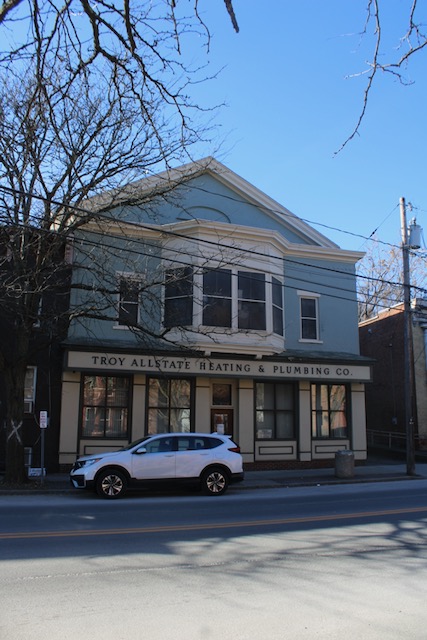
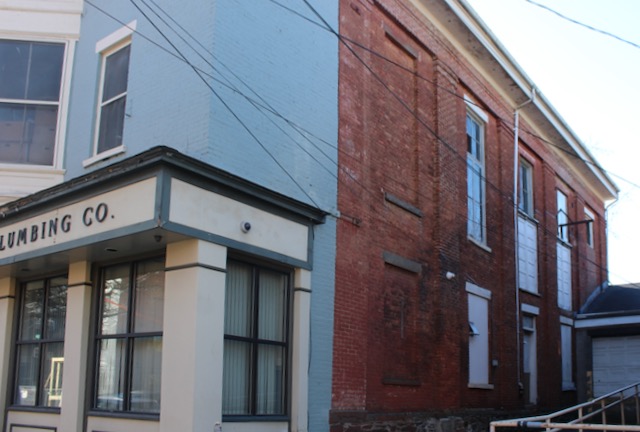
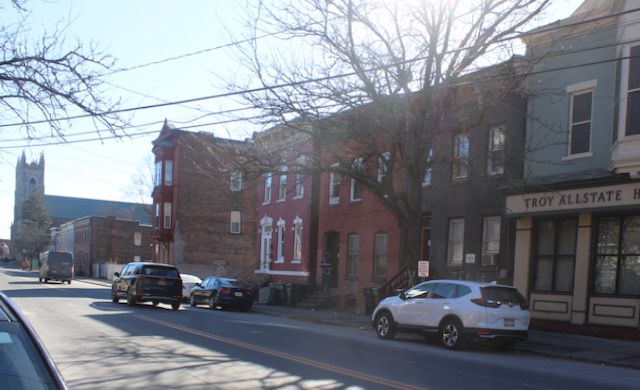
However, the 1858 building, photographed below in 2024, can still be seen at 3165 Sixth Avenue, and its original purpose glimpsed above the facade and down the side of the building. These photographs shows the 1852 building, in use by the current family business for over 60 years, and secondly, its proximity (extreme right) to the 1888 building which was – not as previously stated – on a large empty lot behind a man in a bright orange top, but across the road from him, on the east side of the road, behind a large garden fence, just north of the junction of 6th Avenue and Douw Street.. The towers of the former St. Patrick’s RC Church are beyond the location of Grace Church and on the opposite side of the street: south and west of the Grace lot. I am gratefl for people helping me correct the post

This congregation also used the following names: Batestown Mission; Methodist Episcopal Church of N. Troy; North Troy ME Church, Vail Avenue ME Church before becoming Grace Methodist Episcopal Church of Troy, N.Y. in 1888 (Hillman, p 112).

Turner’s Lane is now known as Glen Avenue, and Vail Street is Sixth Avenue, Troy.